Hang around some gun guys, and pretty soon you will hear the name of John Moses Browning uttered—often with a tone of reverence. Browning was the most prolific gun inventor of all time with a career spanning nearly 50 years from the latter 19th century to his death in 1926. His body of work ranges from single shots to machine guns; from the plebian to the aristocratic, in terms of firearms. Like many men with minds forward of society, Browning often had to struggle to sell arms makers on new and innovative designs.
Browning gave us the first successful repeating shotgun in the lever-action 1887 model. Though it had its adherents, the 1887 shotgun was clumsy to operate, heavy and not entirely reliable. Pump, or slide-action, firearms were enjoying popularity in the last decade of the 19th century so Browning turned his fertile mind toward a shotgun design utilizing this operating system. It is said that Browning had some difficulty selling this concept to Winchester at first, but eventually the Model 1893 pump shotgun was brought to market. It was fairly successful but had some flaws, chief being that it opened occasionally during firing. Too, it lacked the strength and size to accommodate the 2 5/8" and 2 3/4" shotgun shells that were popular at the time for hunting.
So Browning set about addressing these issues. He lengthened the frame, beefing it up and including a bridge across the top and moving the ejection to the side via a port on the right side of the frame. The lock work was changed so that in order to open the bolt the slide needed to be moved slightly forward to unlock the bolt. During firing, the recoil of the gun could usually be depended upon to make this a virtually automatic feature. This particular feature ensured the safety of the shooter from debris from firing coming back into his face, as well as preventing the gun from jamming in the event of a misfire and is incorporated in some manner in all pump shotguns made today. Browning also added a moveable cartridge guide that prevented a shell from the magazine from falling out of the gun if it was operated with the ejection port pointed downward. Finally, he made the length of pull longer to help keep shooters from banging their noses with their thumbs.
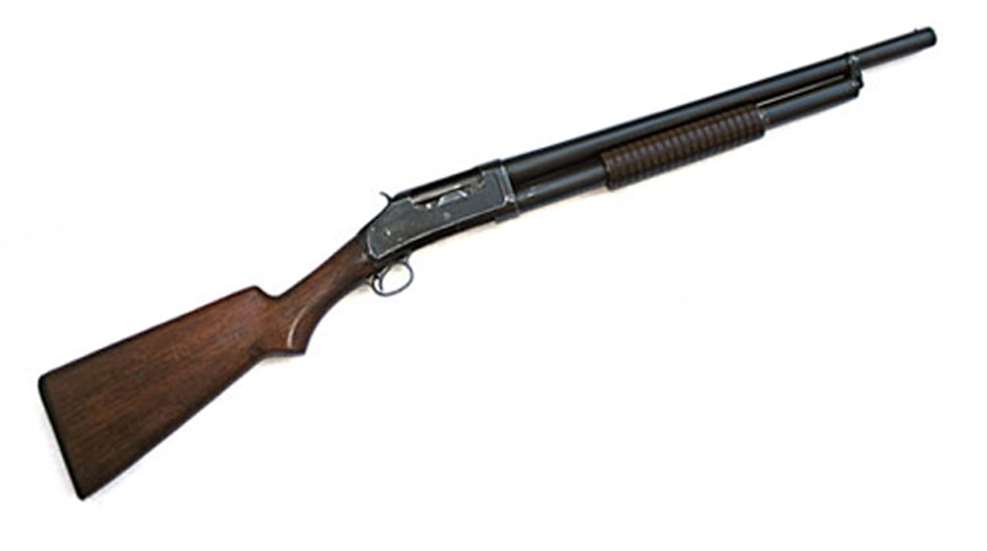
This improved shotgun was dubbed the Model 1897 for its year of introduction and was an immediate and long-time success for Winchester. In continuous manufacture for 60 years, the Model 97—as it is more commonly known—has served hunters, law enforcement and the military, enjoying an enviable reputation for reliability and effectiveness.
The Model 97 featured a distinctive external hammer and a shell carrier that dropped from a rearward hinge point from the bottom of the receiver during operation of the slide. In its first year of manufacture the ’97 had a solid frame, but the next year a takedown version appeared and stayed throughout its production run. This, too, was a seminal moment because it allowed replacing the barrel with little trouble, thus making the shotgun far more versatile. Most magazine-fed shotguns made today incorporate this feature as well. The tubular magazine under the barrel has a five-round capacity, and there is no disconnector in the fire-control system, allowing the shotgun to be slam-fired. Holding the trigger down and pumping the slide will fire the gun as the bolt locks into the breech. This feature has been discontinued in modern shotguns, but it ensured the ’97’s popularity as a military trench gun.
Chambered only in 12 and 16 gauge, the basic Model 97 carried a price of $25 at its introduction. A dolled up version with engraving on the receiver, better wood and checkering would set the well-heeled back a C-note 118 years ago. Barrel lengths ran from 20 to 30 inches, but custom lengths as long as 36 inches could be special ordered. Eight grades were offered: standard 12 or 16 gauge with a 28” or 30” barrel; a trap grade with the same chambering and barrel but better wood was offered from 1897 through 1931; a Pigeon grade that was the same as the trap but with an engraved receiver was offered until 1939; a Tournament grade was made with better wood and a matte finish along the top of the receiver and barrel until 1931; a Brush and Brush Takedown version featured a 26” barrel and a shorter magazine until 1931; and Riot and Trench versions were offered with a 20” barrel from 1917 through 1945. The Trench version differed from the Riot in that it had a heat shield, bayonet lug and sling swivels. An original Trench gun fetches some heavy coin today—as much as $3,500 for one in pristine condition.
An interesting sidebar to the Trench gun was the protest of the German government against its use during World War I. The Teutonic protest included this: “[i]t is especially forbidden to employ arms, projections, or materials calculated to cause unnecessary suffering,” as defined in the 1907 Hague Convention on Land Warfare. The U.S. in essence told the Germans to put their man pants on; this is war, and the shotgun did not violate any warfare convention. Both countries engaged in a war of words describing the hostile treatment of captured soldiers armed with a shotgun and what the U.S. would do to German captives. The shotgun remained in service.
The Model 97 survived and was manufactured parallel with the later hammerless Model 12, as well as other hammerless designs from other manufacturers because of its widespread popularity. Production of the Model 97 ceased in 1957 with more than a million copies produced. A revival of sorts brought about by its popularity as a cowboy action shotgun has brought about a replica made by Norinco. Any gun made as long as 118 years ago is going to show wear and tear, but the ’97 remains a solid and reliable shotgun even today.
Most Popular