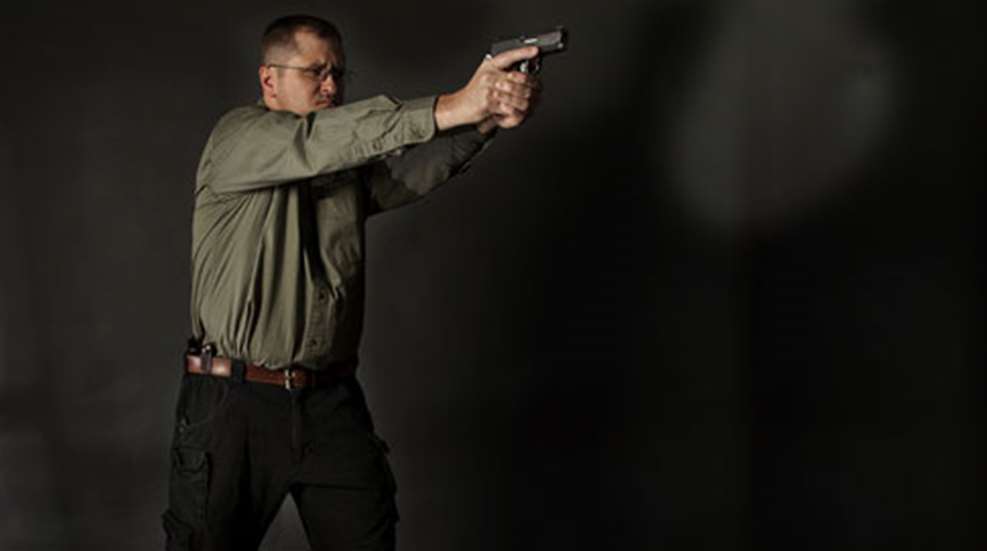
There are multiple factors involved in shooting a handgun well—grip, aiming, breath control, hold control, trigger control and follow through—as well as keeping both feet firmly on the ground. A good shooting stance provides a strong, stable platform, which is crucial for accuracy.
In today’s handgun world, there are two main upright shooting stances—the Isosceles and the Weaver—from which other stances have evolved. While the Weaver is probably better known, the Isosceles is more commonly taught to beginners.
Both the Isosceles and Weaver stances have proponents, and both have certain benefits depending on the shooting situation. The Isosceles stance is a naturally defensive stance that provides excellent coverage in most directions by simply rotating the upper body like the turret on a tank.
The Weaver is often used by police, military and self-defense advocates because it allows accuracy while presenting a smaller profile. This stance is also very popular with actors and directors on both the small and silver screens because it appears professional. Countless movies and TV shows have popularized versions of both stances to the point that many shooters don’t know how the Weaver differentiates from the Modified Weaver, or even that there is a stance called the Modified Isosceles.
The Isosceles
- • Stand facing the target with your feet shoulder width apart.
- • Bend your knees slightly.
- • Extend the handgun fully toward the target keeping your arms straight and locked.
- • With your shoulders squared, your arms form the perfect isosceles triangle from which the stance receives its name.
The Isosceles is the first two-handed stance taught in most firearms training classes, including NRA First Steps and Basic Pistol classes. It’s taught because the Isosceles is a strong, simple stance that is easy to remember under stress.
The Weaver
- • Stand with your feet shoulder width apart with your strong-side leg slightly back in what is often called a boxer’s stance.
- • Angle your support arm’s shoulder toward the target.
- • Bend your knees while keeping your body weight slightly forward.
- • Grasp the gun using opposite pressure with both hands.
- • Keep both elbows bent with the support elbow pointing downward.
The Weaver stance was developed by Jack Weaver while he competed in “Leatherslap” tournaments in Big Bear, Calif., during the late ‘50s. Simply put, Weaver was the first to use a two-handed grip with opposite tension from both hands. Weaver’s push/pull grip stance provided speed, stabilty and accuracy, and he started dominating the popular shooting events. Col. Jeff Cooper quickly realized the benefits of this stance and adapted it for self-defense shooting.
Modifications
The Modified Weaver is the Weaver stance with the shooting arm fully extended to take advantage of the body’s skeletal system for accuracy. With the shooting arm locked forward, sight movement is minimized because the weight of the gun is held by both bone and muscle. Everything else stays the same including the reverse isometric pressure of the hands on the gun.
In the Modified Isosceles, the shooter simply leans forward on the balls of his or her feet for better balance and to help absorb recoil. This makes the stance more instinctive and easier to remember. For example, imagine your response if someone suddenly charged toward you. More than likely you would lower your center of gravity by bending your knees and lean toward your aggressor. This stance is based on the natural response to being attacked.
However, the latest stance to enter the handgun world could be called the Tactical or possibly the Fighting stance. This stance combines parts of both the Weaver and Isosceles stances and is taught at many self-defense academies such as Gunsite. It could be called the Tactical because many tactical and special forces units have gone to this modified stance, or a similar version, for its speed and accuracy and because it keeps the body-armored chest facing forward rather than exposing the uncovered armpit to a potential threat.
- • Stand with your feet shoulder width apart. Your strong-side leg can be slightly behind the weak-side leg
- • Keep your shoulders squared with the target.
- • Grasp the handgun using opposite pressure with both hands.
- • Lock the shooting arm forward while keeping the support arm bent with the elbow close to the body and pointing down.
Choosing a Stance
The choice of a shooting stance usually comes from trial and error, and comfort. Some shooters choose one universally, while other shooters believe that each stance has a use depending on the situation.
Personally, I am of the second set when it comes to shooting stances. I believe that every stance has its place in the shooting world, so I train in each and every stance in preparation of having to fire in whichever position would best suit the situation.
The simple fact is that there is no best stance, only the best stance for a particular situation.
Most Popular