It was only a matter of time. There are some things that people just do not relish doing for themselves anymore. Even before Mike Rowe’s “Dirty Jobs” aired, one of my first clues was when a truck marked “pet waste management” turned up in my next-door neighbor’s driveway. His dog simply did not seem large enough to require the services of a professional. I recently saw an online ad for a mobile gun cleaning service (is Google trying to tell me I have dirty guns?), in which a guy in a van with complete gun cleaning operation pulls up in your driveway and cleans your guns for you. Considering the state of one friend’s gun collection, this service would make for an interesting Outdoor Channel pilot with elements of “Intervention,” “Hoarders” and “Dirty Jobs.”
While I must confess that I find gun cleaning one of the least appealing aspects of a day at the range, one can learn something from cleaning guns. It depends on the gun, of course, but if you are doing a basic field-strip or disassembly of a handgun or rifle, or even just swabbing out the barrel of a shotgun, while you are cleaning you’re doing something else—that is, inspecting it.
Here is something that we really should not have to tell people. If a crack on a critical part of a gun develops while you’re shooting a firearm, you should stop shooting it. If there is an obviously overly worn or broken part, you should stop shooting it then, too. Thanks to another friend’s sage advice, I inspect fired cases, too.
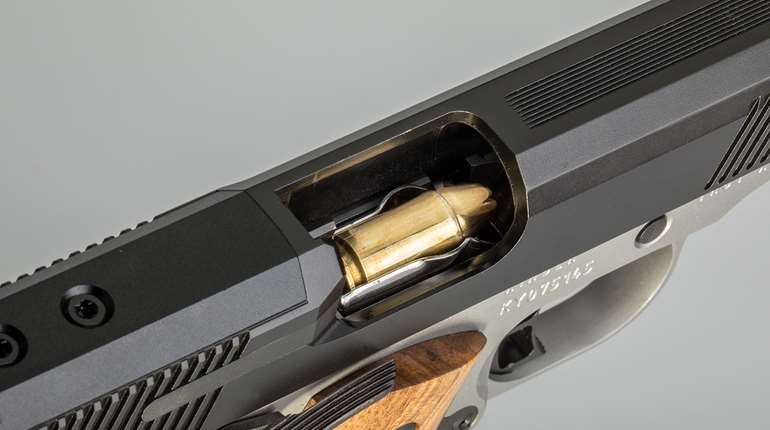
I recently received a “Product Safety Bulletin” and a note from a friend at Ruger. “You will soon see a ‘Product Safety Bulletin’ published for the Ruger American Pistol. The bulletin is pretty clear: On high round count guns, we are requesting our customers inspect their slides for abnormal wear or cracking and sign up for a free retrofit if they observe any. This shouldn’t be a difficult concept. The idea of cleaning a gun after a range session includes giving it an once-over to look for worn or broken parts.” The bulletin applies to 9 mm Luger Ruger American Pistols with serial number prefixes “860” and “862” and owners can find out more at Ruger.com/APRetrofit.
“Those of us who shoot our guns more than a box or two of ammo every now and then understand the importance of a periodic, careful inspection. In my personal opinion, not doing so would be akin to driving our cars for thousands of miles without ever checking the tire pressure.”
One of NRA’s Gun Safety Rules, found at gunsfetyrules.nra.org, is pretty clear. You should inspect your firearm before you shoot. “Be sure the gun is safe to operate. Just like other tools, guns need regular maintenance to remain operable. Regular cleaning and proper storage are a part of the gun's general upkeep. If there is any question concerning a gun's ability to function, a knowledgeable gunsmith should look at it.”
Once, a fellow staffer had scored quite a deal on a used polymer-frame pistol. The deal was offset by the fact that it had a crack developing in it slide, spreading downward from the ejection port. He brought it to my office and asked if it was safe to shoot. I told him unequivocally no, and, as it was out of warranty, I told him where he could buy a new slide.
Over the decades here, I have had many guns break or fail, typically little things like springs or pins, but I have seen cracks develop in receivers and slides and even had a pistol lock solid after sheering a locking lug. Needless to say, I immediately stopped firing the guns.
It is my assumption that those in the gun-detailing business would bring such matters to the owner’s attention. The local company, by the way, is High Caliber Weapons Detailing, and as fine a name as that is, it’s not quite as fertile a field for names as pet waste management. I believe “Turdminators” takes the cake, err, something.
Most Popular