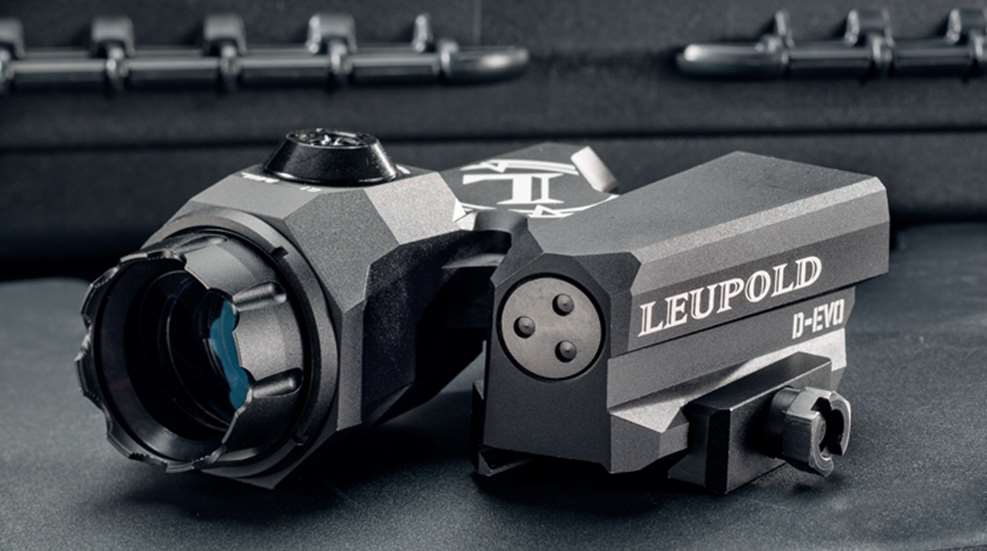
The first time a magnified optic was attached to a semi-automatic rifle, a dilemma was born. What the magnification offered in terms of increased range, it sacrificed in speed and short-range capability. Glass giveth, and glass taketh away. When the Global War on Terrorism began, magnified optics were fielded in great numbers by special operations forces and conventional troops to account for Afghanistan’s wide-open spaces. When those same troops deployed to Iraq, they found themselves clearing rooms one minute and taking overwatch shots at several hundred yards the next—no existing optic was ideal for the full spectrum of engagements that were taking place. Around the same time, the sport of 3-Gun was gaining rapidly in popularity. Like troops abroad, competitors were faced with a conundrum of shooting at point blank and long-range targets in the same fast-paced stages. The solution to both the competitive and wartime dilemmas was to mount multiple optics onto the same rifle. A magnified optic on the flat-top receiver of a rifle was often augmented by a red-dot sight placed either on top of the scope or off to the side at a 45-degree angle. This solution worked well, but, in both cases, it required the shooter to break cheekweld in order to use the unmagnified optic—time and precision were wasted in the process. Recently Leupold engineers set about to devise an unorthodox solution to this problem—the result of their efforts is the Dual-Enhanced View Optic, or D-EVO.
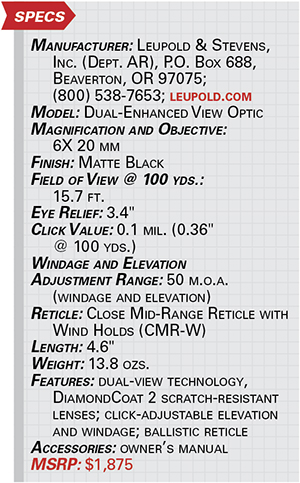
On paper, the D-EVO is a 6X 20 mm scope with a ballistic reticle—nothing remarkable. It only takes a glance at the unit, though, to know that it is completely different from anything else on the market. Like Porro-prism binoculars, the D-EVO offsets the front objective lens from the eyepiece. The offset objective lens allows the user to mount an additional optic in tandem with the D-EVO which puts both optics on the same plane with the shooter’s eye. The idea is that the shooter uses the magnified D-EVO for shots that require precision and, if a short-range shot presents itself, the shooter simply raises his eye slightly and uses the long-eye-relief red-dot sight. The Leupold Carbine Optic is an unmagnified red-dot sight designed to work as a stand-alone unit or in tandem with the D-EVO. Though the D-EVO can be used with a variety of red-dot sights, the LCO is the perfect height and size to match it.
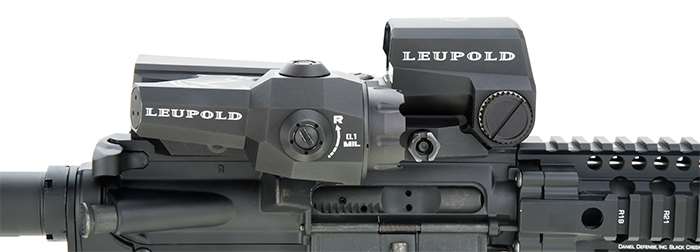
The D-EVO uses an integral mount to attach to a Picatinny rail so no additional hardware is necessary. Both windage and elevation adjustments are made with slotted screws valued at 0.1 mil. (0.36 m.o.a.) per audible click. The range of adjustment for both windage and elevation is 50 m.o.a. The body of the optic is constructed of 6061 T-6 aircraft aluminum, and the D-EVO is rated as waterproof to 66 feet.
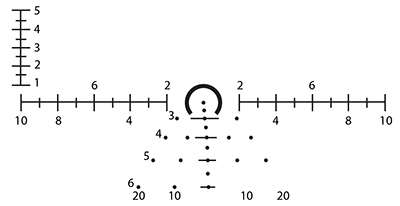
A key element in the usefulness of the D-EVO is its use of a ballistic reticle, namely the Close Mid-Range Reticle with Wind Holds (CMR-W). This m.o.a./mil. hybrid reticle is designed to match the trajectories of the 5.56x45 mm NATO/.223 Rem. and 7.62x51 mm NATO/.308 Win. cartridges. When zeroed at 200 meters, the CMR-W reticle provides holdover aiming points for shots out to 600 meters. In addition to the elevation holds, the CMR-W provides aiming points for wind drift out to 600 meters with 10- and 20-mile per hour full-value holds. The reticle also features horizontal and vertical scales of known value so that the shooter can measure the distance to the target or the size of objects downrange if the distance is known. At close inspection, the vertical holdovers on the D-EVO are canted slightly from left to right. This is designed to compensate for the off-axis position of the D-EVO’s objective lens and is necessary to provide accurate aiming points downrange.
No reticle is going to be perfectly calibrated for more than one load, much less more than one cartridge, so it is important to actually shoot the load in question at each distance to determine the correct points of impact. At 600 meters, the distance between a .223 firing a 55-gr. bullet and a .308 with a 168-gr. bullet is approximately 10" of drop and 30" of drift in a 20-m.p.h. wind. Reticles such as the CMR-W are a fantastic tool, but only if they are used in conjunction with real world data. A practical way to reduce the variance in ballistics among different cartridges is to zero the optic at 400 meters using the 400-meter aiming point—this may result in a slightly different point of impact at 200 meters, but it will match the reticle more closely across the spectrum of ranges.
 We mounted both the D-EVO and the LCO onto a custom 3-Gun rifle of known performance and accuracy. For starters, the setup works exactly as advertised. With both eyes open, both the CMR-W reticle on the D-EVO and the LCO’s 1-m.o.a. red dot were visible at the same time: changing focus between the reticle and the dot required zero head movement and took a fraction of a second. Transitioning between a target at distance and a close-in object that required the use of the LCO’s red dot was virtually automatic—by the time the muzzle was on the target, our eyes were on the dot. Eye position was somewhat critical in order to achieve a full image through the D-EVO so consistent cheekweld is important.
The D-EVO is a truly innovative solution to a real-world optical challenge. Leupold’s design staff thought “outside of the tube” with this product. This setup is ideal for fast-paced scenarios where a rifle or carbine must be employed at a variety of ranges with great speed. Given the popularity of this style of competition, the D-EVO fits a real niche in the market. While unusual in appearance, the D-EVO provides an effective capability to shooters when paired with a traditional red-dot optic.
Most Popular