A look at the history of Smith & Wesson clearly shows how the company has been—and continues to be—at the forefront of innovation and manufacturing prowess. From the time of the first totally enclosed cartridge—the .22 Short—introduced in 1857 to the modern X-frame in .460 and .500 S&W Magnum, the company has met the needs of handgunners, often before they even knew of that need. In 1957 Smith & Wesson introduced the Model 19 Combat Magnum at the behest of Border Patrolman Bill Jordan. Law-enforcement types flocked to the Model 19 like deer to a corn feeder, resulting in the nickname a “police officer’s dream gun.” It was the size and weight of most .38 Special revolvers, yet had the capacity to handle the powerful .357 Magnum that many officers preferred because of its superior stopping power and penetration. Even plain-clothed detectives liked the 2 1/2-inch-barreled version, and, naturally, the citizens competed in the marketplace for the premium revolver.
In 1965 S&W introduced the first revolver to be made from stainless steel—the Model 60. Basically a Model 36 Chief’s Special in the more modern material, it, too, found a reception far beyond the company’s initial expectations. It worked once; let’s try it in the Combat Magnum. So in 1970 the first .357 Magnum made from stainless steel was made. The first Model 66—as it would be known—came off the line on May 5 of that year, serial number K949100. Smith & Wesson would not announce the new revolver until July 8, 1971.
Like its blued predecessor, the Model 66 was the darling for men who strapped a revolver onto their waist every day to face the world. The everyday cop that worked an 8- to 12-hour shift appreciated the half-pound weight savings that the K-frame provided. The gunners among the force often preferred the heftier Model 27 because that half pound soaked up recoil better, but the everyday officer rarely had to shoot and most departments still used .38 Special cartridges anyway. The Model 66 offered everything the Model 19 did, plus it was rust resistant.
Three barrel lengths were initially offered: 2 1/2, 4 and 6 inches, and each had their fans. The 4-incher is hands down the most popular, offering a reasonable compromise in carry vs. shootability. The 2 1/2-incher was popular as either a concealed-carry or backup gun. The rural highway patrolman or sheriff deputy often opted for a 6-inch barrel because of the perception that armed encounters have a better chance of occurring at longer ranges or may involve barriers where a little more velocity would be desirable. There was a short run—2,500 units to be exact—of 3-inch barreled 66s made, and today they fetch a nice premium over standard barrel lengths. There have been eight engineering changes to the Model 66, often referred to as “the dashes.” The Model 66 without a dash came out in 1970; seven years later the Model 66-1 appeared with the gas ring attached to the cylinder rather than the yoke. The year 1982 gave us the Model 66-2 which eliminated pinned barrels and recessed cylinders. In 1986 the Model 66-3 with a new yoke retention system/radius stud package/hammer nose bushing and floating hand came to the marketplace. Eight years later in 1994 the Model 66-4 had a slightly different rear sight leaf, a relocated drilling and taping of the frame for the rear sight, along with optional Hogue grips and a change in the extractor. The Model 66-5 introduced in 1998 brought us a change in frame design: eliminating the cylinder-stop stud, the elimination of serrated tangs, a change to a MIM hammer with a floating firing pin, along with changes in the internal lockwork. The dreaded internal lock—a.k.a. Hillary Hole—was foisted upon us in 2002 yielding the Model 66-6, the Model 66-7 featured a two-piece barrel and more internal lock mechanisms. This year the Model 66-8 was brought to the market.
Smith & Wesson dropped the Model 66 from production in 2005. There were a couple of reasons. First, the trend in LE armament has almost entirely gone to the semi-auto pistol. Departments and officers who have the prerogative to purchase their own handguns rarely—if ever anymore—purchase revolvers, save a J-frame for undercover or as an off-duty weapon. Too, most .357 Magnum shooters have gone to the slightly heavier L-frame revolvers because they stand up to more abuse from the heavy loads.
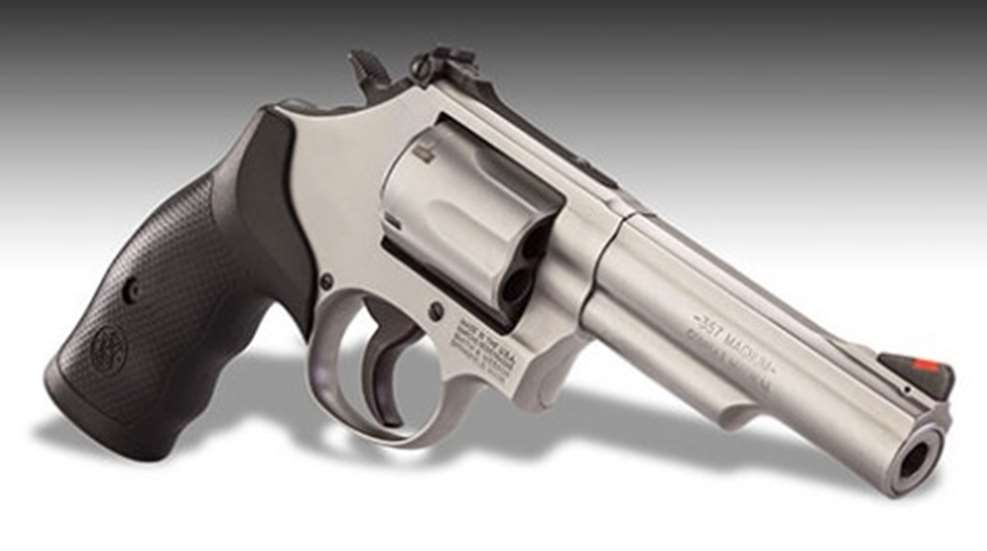
But the pining from the shooting public has jarred the brass at Smith & Wesson, and the company introduced the new Model 66-8 this year at the SHOT Show. I put a few rounds through it at Range Day and was impressed enough to have one sent to me for evaluation and testing. Three things jump out at you if you know the old 66s. First is the Hogue Monogrip that replaces the traditional S&W Goncalo alves target stocks. It takes some of the sting out of heavy loads and is eminently more practical, if rather plain in appearance. Second is the two-piece 4 1/4-inch barrel. Why two-piece and 4 1/4 inches? No one would fess up. Third is the new hammer and cylinder latch configuration. I suppose they are alright. Nowhere have I seen any evidence that these engineering changes have resulted in a failure to fire, causing the shooter to get shot by a bad guy. However, I must admit that I prefer to see that pivoting claw of a firing pin attached to my S&W revolver’s hammers.
I have taken this new 66 to the range a half dozen times, and it has been absolutely reliable and accurate. Even with my cast bullet handloads this new whippersnapper has shown itself perfectly capable of providing the kind of service one expects from a Smith & Wesson revolver. The MSRP of the Model 66 is $849, but street prices are seen in the mid-$600 range. With its proven performance, reliability and low-maintenance characteristics, the Model 66—either vintage or new—is a revolver belonging in every .357 Magnum aficionado’s collection.
Recently featured as an AmericanRifleman.org "Gun of the Week," you can see a video of the new Model 66 here.
Most Popular