The .223 Rem. is a fine varmint cartridge, and while some can take a deer or pronghorn with the cartridge when loaded with a relatively heavy bullet-say 60 grains or more-others prefer a larger caliber. Too, many state game departments require deer and antelope hunters to use a cartridge of at least .23 caliber, meaning the .223 Rem. is not legal. The Sharps Rifle Co. of Glenrock, Wyo., was looking for a way to strike a perfect balance of caliber, weight and velocity within the .223 Rem. case. One choice, the .300 AAC Blackout, uses heavy .30-caliber bullets with a reduced-sized case-great for sub-sonic and short-range engagements but decidedly too slow for even moderate-range hunting. So SRC decided to load .25-caliber hunting bullets into the .223 case. All other dimensions are the same as the .223 Rem., except that the case has been given slightly more body taper to facilitate easier feeding in an AR-platform rifle. This means that standard AR bolt carriers and magazines can be used. In a nod toward tradition, SRC calls its new cartridge the .25-45 Sharps.
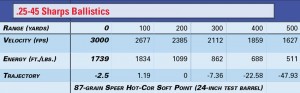
A standard .25-45 Sharps load has an 87-grain bonded-core bullet-a Speer Hot-Cor-loaded to 3,000 fps at the muzzle yielding 1,739 ft.-lbs. of energy from a 24-inch barrel. On a bitterly cold day, I clocked the load from a 20-inch barrel at an average of 2,987 fps. Given a more temperate day, I have no doubt this factory load would deliver its claimed velocity. With a 200-yard zero, it’s just a smidgen more than an inch high at 100 yards and 7.3 inches low at 300 yards. SRC plans on offering a 65-grain varmint load and an 87-grain FMJ in the near future.
At the SHOT Show Media Day this past January, SRC had a custom bolt-action in .25-45 Sharps equipped with a suppressor. I did not have an opportunity to shoot the rifle for groups, but the 300-yard gong took a beating from me and the others present.
Some have compared the cartridge to the .257 Roberts, but checking the ballistics reveals it’s more along the lines of the .250 Savage with lighter bullets. Because the cartridges must fit in an AR magazine, heavier bullets like the 100- to 117-grain projectiles would have to be seated deeply and would impinge on the powder capacity. A bolt-action, like the one I shot on Media Day, can be made with a longer throat, allowing heavier bullets to be loaded to a longer overall cartridge length, allowing the cartridge to achieve its maximum performance.
As of right now, only Black Forge of Orlando, Fla., is offering barrels and uppers in .25-45 Sharps. Tim Lesser, VP of sales and marketing for SRC told me that by the end of this summer the company expects to be making and marketing its own barrels. Ammo, however, is available now from SRC, as are loading dies from RCBS.
Tim sent me a prototype rifle with a lower marked SRC. I asked him if that meant that SRC will be making complete rifles. His reply was guarded, saying that SRC is looking into it, but that the company’s primary business of supplying top-of-the-line replacement AR components has been the focus.
The prototype AR struck a rather racy look with its Diamondhead VRS “T” 15-inch free-floating Versa Base handguard. It shielded a 20-inch stainless-steel bull barrel with a knurled thread protector at the muzzle. On top was a Leupold Mark AR MOD1 3-9x40 mm scope. Inside I found SRC’s Relia-Bolt, an AR bolt made from S-7 tool steel (air-hardened tool steel used to make jackhammer bits) that has 76 percent greater tensile strength than the Carpenter 158 steel used in most AR bolts. It is coated with an electroless-nickel NP3 coating that resists corrosion with increased lubricity over issue bolts. The Relia-Bolt also features tapered bolt lugs that purportedly increase reliability by making it easier for the bolt to feed into the lug recesses and cleaning out accumulated crud. SRC claims this bolt can be run dry, but I found that it still needed a little “juice” to ensure trouble-free functioning. My test rifle was equipped with a standard A2 stock.
Out at the range the .25-45 Sharps would put three shots into just less than an inch at 100 yards, but typically open up to 1 1/4 inches with the last two rounds starting a new group a quarter inch away from the initial group. I mentioned the bitter cold that I tested this rifle in-about 24 degrees with a variable 5 to 15 mph wind. Wind can raise cane with the relatively light 87-grain bullets, even at ranges as close as 100 yards. I tried some dinger targets at extended range. Once I got the windage correct it wasn’t difficult to hit a 10-inch plate out to 300 yards-plenty good enough for most deer hunting.
For those who wish to do their deer and antelope hunting with an AR but live in a state that restricts big-game cartridges to .23 caliber or greater, the .25-45 Sharps offers an excellent alternative. The only rifle component that needs changing from the original is the barrel. Recoil-while slightly greater than a .223 Rem.-is still very mild. The cartridge is accurate and performs well at all reasonable hunting ranges. My guess is that handloaders are going to get some custom bolt-actions made up to take advantage of the heavier .25-caliber bullets downrange performance and not have to deal with the OAL issues of AR magazines.
Most Popular