Shotshell ammunition is a bit more complex than centerfire rifle, pistol or revolver ammunition. With shotguns and shotshells, you need to know the gauge of the shotgun and the length of its chamber, but you must also consider shot and payload size and velocity. The total understanding of shotshell ballistics seems more like a soft than hard science, and ironically, when it comes to shotgun shooting, the practice seems to have more feel to it than the absolute of shooting rifles and handguns. To help you better understand shotshells, here’s a look at the basics of shotshell cartridges, shotshell pressures and velocities and shotshell shot sizes and payloads.
Shotshell Cartridges
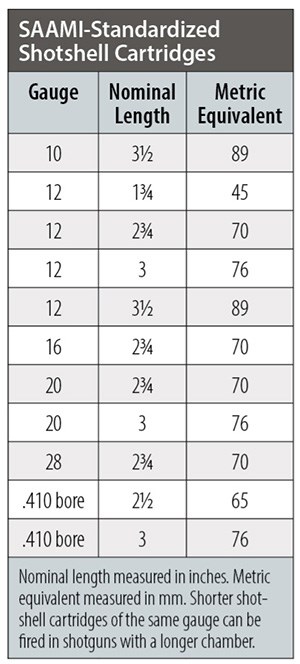
There are only 11 SAAMI-approved shotshell cartridges, and, except for two, they’re identified by the gauge and length of the shell. The gauge of a shotgun or shotshell represents the number of lead balls equal to the diameter of the bore of the gun that can be made from one pound of lead. For example, the nominal diameter of the bore of a 12-gauge shotgun is .729 inch, and a .729-inch round lead ball weighs 583 grains. A pound of lead will make 12 of those. Interestingly, early muzzleloading rifles were sometimes identified the same way—by balls per pound based on bore diameter. The shotshell-cartridge exception to this is the .410-bore, which gets its name from the .410-inch/caliber barrel the gun has.
In addition to the gauge of the shotshell, each shotshell cartridge has a length that ranges from 2 1/2 to 3 1/2 inches. (SAAMI just recently standardized a 1 3/4-inch, 12-gauge shotshell, and 24- and 32-gauge shotshell cartridges exist, but have not been standardized.)
 Shotshell Pressures and Velocities
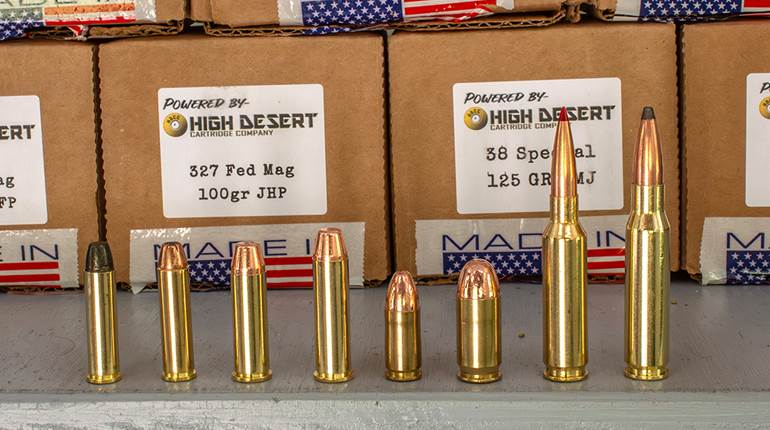
Compared with centerfire rifle, pistol and revolver cartridges, shotshell cartridges operate at dis- tinctly lower pressures. For example, the .327 Fed. Mag. revolver cartridge has a maximum average pressure (MAP) of 45,000 psi, and the .30-’06 Sprg. rifle cartridge has a MAP of 60,000 psi. Shotshell cartridges operate with a MAP of between 11,000 and 14,000 psi.
Shotshell velocities vary greatly, from as slow as 900 fps up to a high of 1,500 fps. When you start talking about shotshell velocities, the word “dram” comes into play, but what the heck is a dram? A dram is a unit of weight historically used in apothecaries and in avoirdupois systems in ancient Greece, but regarding shotshells, it relates to an equivalent between black powder and smokeless powder, as it relates to the volume of the powder charge. For example, to keep noise down and the distance shot will travel on public ranges, shotshells are sometimes limited to a 3-dram equivalent.
You might think that the length of the shotshell is indicative of power, velocity or payload, but that’s not necessarily true. With centerfire rifle, pistol and revolver cartridges, the weight of the bullet is typically indicative of velocity. There are exceptions, but, for example, a typical 150-grain .30-’06 Sprg. cartridge will have a nominal muzzle velocity of about 2,900 fps. With shotshells, the muzzle velocity of a 1-ounce, 12-gauge shell—regardless of the length—could vary from 1,000 to 1,500 fps. Velocity of a shotshell has more to do with application than length, and to some extent, with shot size and payload.
Shot Size and Payload
The size of individual pellets used in a shotshell can be confusing because the larger the number, the smaller the diameter. For example, a single No. 9 shot pellet has a diameter of .080 inch and a single No. 6 pellet has a diameter of .110 inch. Almost all lead shot contains some antimony, and with a 5-percent antimony lead alloy, a single No. 9 pellet will weigh about .75 grain, and a single No. 6 pellet will weigh about 1.9 grains. Because of their weight differences, the number of pellets inside a shotshell with a 1-ounce payload will be different. With No. 9 shot, a 1-ounce payload would contain about 576 pellets, and a 1-ounce payload of No. 6 shot would contain about 221 pellets.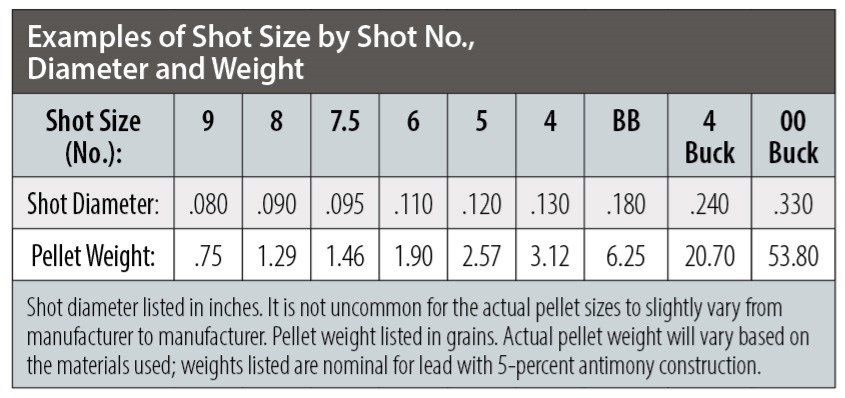
This can get confusing when you’re looking at more modern shot pellets made from tungsten super shot (TSS). A single No. 6 TSS pellet will weigh about 3.14 grains, and a 1-ounce payload would only contain about 139 pellets. Additionally, a 1-ounce payload of No. 7.5 TSS shot would contain about the same number of pellets as a 1-ounce payload of No. 6 lead shot. Shooters and hunters select shot size, payload size and velocity based on what they want to shoot at, and sometimes the ballistic difference in gauge can be almost nonexistent. There are more than 20 sizes of shotshell pellets.
It’s important to understand the shotgun predates the self-contained cartridge and some of the terms used to describe shotshell ammunition are carry-overs from that time. Under-standing how gauges, shell length, shot sizes and payloads all work together to determine shotshell ballistics will help you select the best shotshell ammo for your needs.