8/20/2012
Scottish immigrant Francis Bannerman started his legendary military goods firm in 1865 selling Civil War surplus, and for more than a century the company purveyed virtually every kind of martial item imaginable. Originally sited in a ship’s chandlery in New York City, in the 1890s Bannerman moved to a larger warehouse complex and, finally, in 1901 purchased Pollepel Island on the Hudson River and transferred his storage facility to a huge Gothic castle he had constructed there. Its ruins remain today as part of an historic trust.
Bannerman’s expansive catalogs, published for decades, listed everything from wheellock pistols and Zulu spears through field artillery pieces and steam launches festooned with machine guns and cannons. The firm boasted it was capable of “fitting out revolutions”… and it did so!
Bannerman died in 1918, and despite some devastating ammunition explosions, which destroyed part of the castle, the company that bore his name continued in operation until well past the second half of the 20th century. In fact, in the early 1960s I was still able to buy, among other things, unissued Civil War U.S. Artillery shell jackets from the firm for $39.
Though Bannerman began putting together his own rifles as early as 1913, especially between the world wars the company found itself in possession of large quantities of Mauser, M1903 Springfield, M1917 Enfield and Krag-Jorgensen parts. Not wanting to let anything go to waste, it began cobbling together affordable “Frankenstein” rifles made out of bits and pieces of those (and other) guns. Known generically as “Bannerman Specials,” the guns offer a fascinating look at opportunistic arms merchandising at its best.
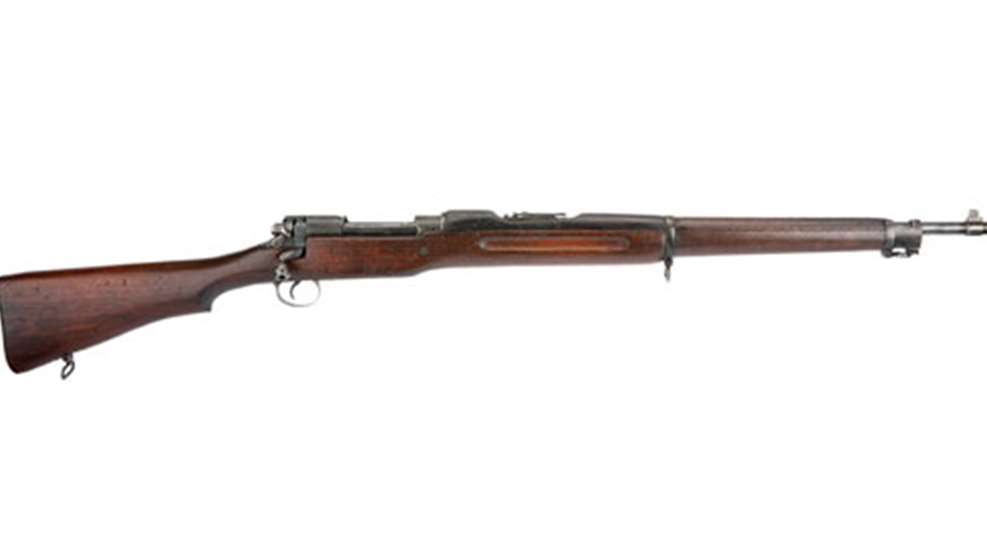
The rifle seen here is a good case in point. Comprised of a Remington action, a 1917 bolt and modified stock, 1903 barrel assembly, sundry Krag and “mystery” parts and a Buffington rear sight from a Model 1884 Springfield “Trapdoor” rifle, it follows the general lines of what Bannerman called its “Special ’37 Rifle.” Quality of the conversion is what could best be termed “workmanlike.”
Described in the catalog as possessing, “5 shot, flush magazine, with used SELECTED Springfield 24-inch barrel. Heat treated receiver properly head spaced. Assembled from Government parts, refinished and proof tested. Takes any caliber .30-06 cartridge. Turned down bolt handle, adjustable military rear sight. Enfield stock. No rifles are now being sold by the Government and this assembled rifle is the only caliber .30 rifle available … Krag bayonet with steel scabbard will fit.” While anything but prepossessing to today’s discriminating collector, the piece, selling for $18 in 1938 (bayonets were an added $1.50 each and slings, 50 cents), provided a good, low-cost rifle for the Depression-era shooter.
Possessed of an intriguing history, Bannerman Specials are still reasonably affordable—probably because they don’t neatly fit into any specific category of military arms collecting. This gun, in the condition described, would sell for between $475 and $550. As a fascinating example of one the products of America’s most famous surplus arms entrepreneur, it’s worth every penny.
Gun: Bannerman Special
Manufacturer: Remington Arms Co. (receiver)
Serial Number: 3943
Condition: NRA Very Good
Caliber: .30-’06 Sprg.
Manufactured: c. 1938
Value: $475-$550
Most Popular