From the July, 1944 issue of American Rifleman
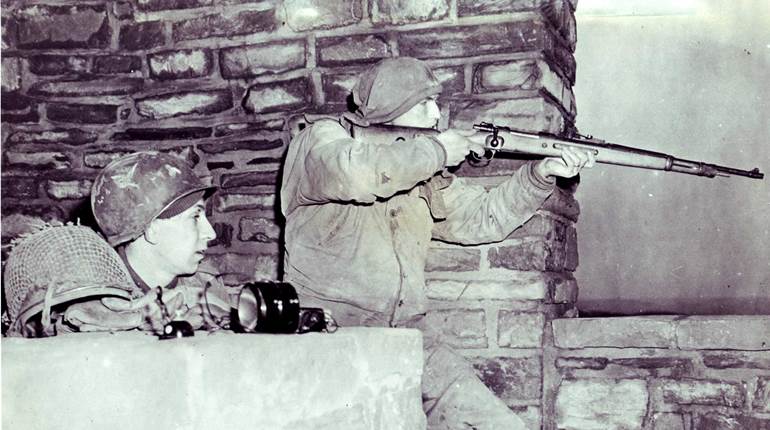
In this war, contrary to many predictions, there has been a reversion to close-quarter combat. In street and house-to-house fighting, in the jungles, in the mountains, on night patrols, wherever men come face to face in battle, the handgun can be a decisive offensive weapon.
But target-shooting skill alone is not enough to make the all-around combat shot with the handgun. After the target phase has been developed and the necessary familiarity with the weapon attained, the handgun user must develop a battlefield technique; which involves speed and the ability to use the gun from any position, with or without the aid of sights, under all light and terrain conditions. For the soldier who can handle his weapon quickly and accurately under all conditions, and under the physical and mental stress of combat, stands a much better chance of survival than does the untrained or partially trained shooter.
To develop this skill, a special type of training is needed: a type of training whereby the average man can be taught quickly to use his pistol to kill an enemy swiftly and instinctively, with or without the use of sights, at distances up to fifty feet.
Opinions differ as to the best methods of attaining this all-around combat proficiency with the handgun. The method discussed here has been used to instruct large groups of men in close-quarter combat firing, and men so trained have used it successfully against our enemies. After such training as this, they attain more confidence in themselves and in their weapon and in their ability to use their pistol in man-to-man combat under all battle conditions.
We begin our course in combat pistol training by pointing out these three facts about the use of the pistol in combat:
First: Ordinarily, in battle, due to bad light, lack of time, pressure of enemy fire, etc., the pistol shooter will not usually be able to use sights.
But any man can raise his hand, forefinger extended, and point accurately at an object. Add the gun to the hand, the barrel being merely an extension of the forefinger, and, with a reasonable amount of practice, the same thing can be done with a pistol. This is what we call shooting by “instinctive pointing.”
Second: When in combat or subject to enemy fire, the natural, instinctive position is a crouch. Since this is the position men will normally assume in combat, it is the position we teach in combat training. Although this crouch will be instinctively assumed in combat, shooters must be made to use it during training. The crouch should be natural, knees flexed, body bent aggressively forward from hips, feet, in natural position ready for forward movement.
Third: The muscles and nerves of a man in combat are tense. Therefore, his grip on a weapon is extremely tight.
Since his grip will be tight, convulsive, under battle firing conditions, the shooter must be made to use a tight grip in training. This is important because a tight grip has a decided effect on the pointing characteristics of his weapon.
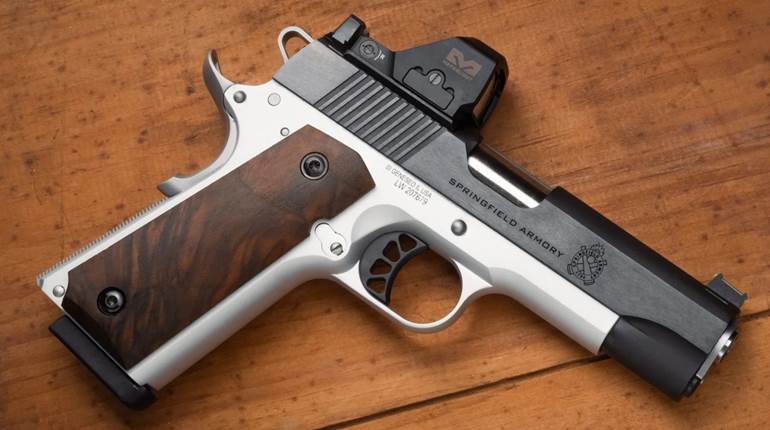
When the official Government Issue .45 Automatic is gripped tightly, as it will be in combat, its structural design tends to cause the muzzle to point at an angle below the horizontal when it is thrust forward at a target. (Grip the Colt .45 tightly, close the eyes and thrust it forward hard from the Raise Pistol to a straight-arm position and note how the muzzle tends to point low.) This tendency can be overcome by: (1) fitting the pistol with an adaptor that will alter its pointing characteristics, (2) training the soldier to cock his wrist slightly upward to compensate for the down-pointing tendency of the weapon, or (3) training the shooter in such a way that he avoids the forward-thrusting movements which accentuate a downward-pointing tendency inherent in many weapons, the .45 automatic in particular.
It is this writer’s opinion that the third solution is the best one. The method of combat pistol training described here is based on that assumption.
The soldier in combat will ordinarily have his weapon in his hand when he expects to use it; therefore, the recommended ready or carrying position is as follows: gun arm held straight, wrist and elbow both locked, the arm slanting forward and down at about a forty-five degree angle, with the gun arm swung in slightly toward the center of the body and the gun hand flexed slightly to the right to point the gun straight forward from the body center in the direction of movement.
The whole object of combat shooting, with this as with all other weapons, is to kill your enemy before he kills you. Any training that improves an American soldier’s ability to do that should be used!
Most Popular