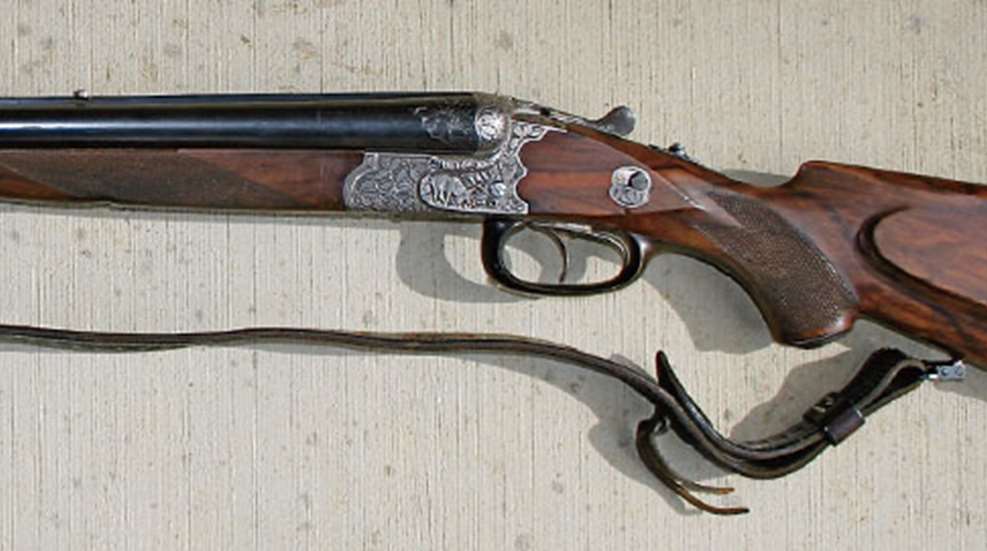
The title of this column, “I Have This Old Gun,” is an oft-heard phrase from firearm enthusiasts. Still, I was surprised to hear these words from my guide, Cody Plank, during a recent wild boar hunt on Southern California’s Tejon Ranch.
It seems Plank’s great-uncle brought a drilling back from Germany after World War II. His mother killed her first deer with it, and 10 years later Plank shot his first quail with it. The gun was “borrowed” by family members, and Plank lost track of it. Eventually, it made its way back into Plank’s possession, and he wanted to know what he had.
The gun was indeed a drilling, a nomenclature stemming from the German drei, or three, signifying a firearm with three barrels. Most often encountered are side-by-side smoothbores with a rifled barrel underneath, which explains how Plank’s gun was used for both fur and feathers. His German-made drilling features two 16-gauge smoothbores and a rifled barrel chambered in 7x57 mm Mauser.
The gun was made by Hermann Weihrauch who, in 1899, began producing quality rifles, shotguns and airguns in Zella-Mehlis, Germany. According to Hans-Hermann Weihrauch, Hermann’s great-grandson and the current president of Weihrauch-Sport GmbH, “[T]he company was closed during the Russian occupation in the late 1940s and nothing survived.” Weihrauch reopened in Bavaria during the 1950s and today produces only .22 pistols and high-grade airguns.
Plank’s classic pre-war drilling features Germanic engraving and a carved horn trigger guard. A tab on the bottom of the stock unlatches a compartment for four rifle cartridges. A sliding engraved button on the tang selects firing pins for shotgun or the rifle’s rear set trigger. The barrels are stamped “Bueler-Stahl,” a steel company that started in the 1920s, thus helping date this gun, which has no serial number. The stock sports an Old English recoil pad by Mershon Co., which was acquired by the late Frank Pachmayr in the ’60s and is not likely contemporary with the gun.
For all their old world craftsmanship, drillings are not as popular in America as in Europe. Nonetheless, Cody’s heirloom is worth between $4,500 and $6,500—all of which is academic. “It’ll never be for sale,” says Plank. “I’m going to give it to my daughter and hopefully when she’s old enough, she’ll kill her first game with it, too.”
Gun: Hermann Weihrauch Drilling
Caliber/Gauge: 7x57 mm Mauser; 16 gauge
Condition: 98 percent (NRA Modern Excellent)
Manufactured: 1925 to 1935 (estimate)
Value: $4,500-$6,500 (U.S. market)
Most Popular