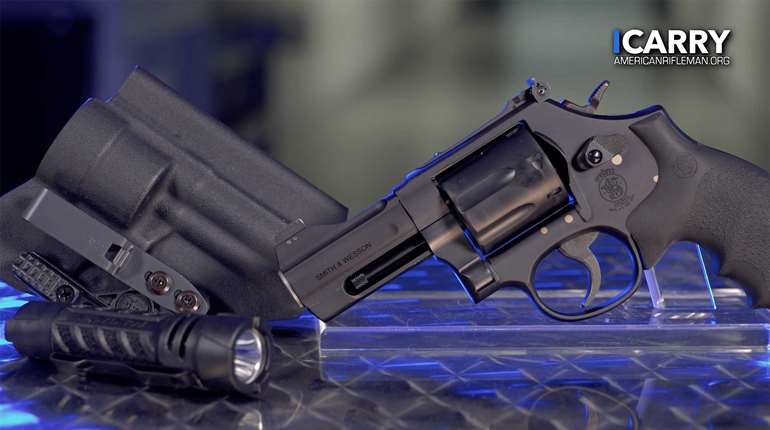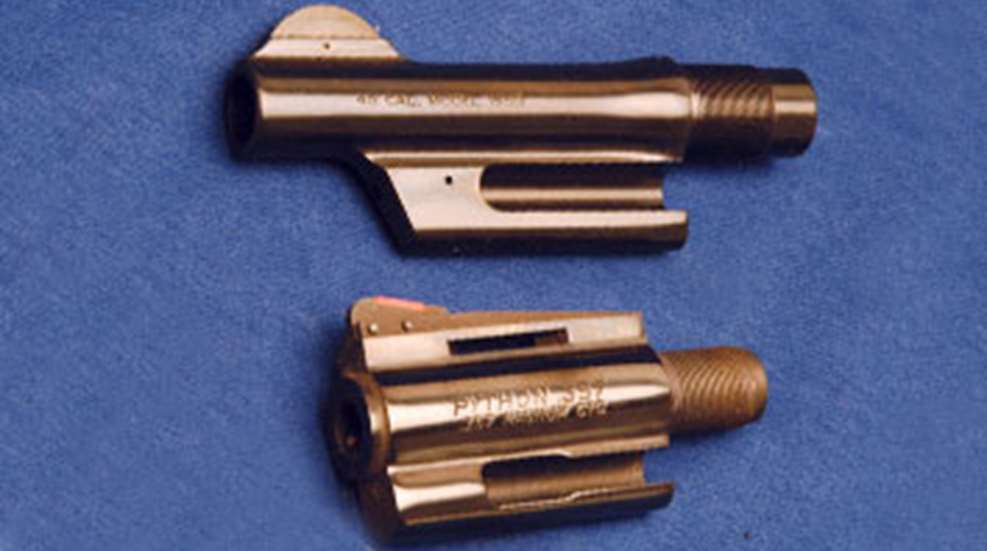
I'm not sure where this underlug business really got its start, but I was around when it really got rolling. A term that relates most commonly to DA/SA revolvers, underlug refers to an integral extension of metal that runs along the bottom side of the barrel. Although underlug-like fixtures are found on some of the Frontier-era S&W break tops, I think the first gun to have one (in the modern sense) was the Triple Lock of 1908. It was necessary for the complex locking system of that magnificent old gun, but it came to be highly regarded because it protected (or shrouded) the revolver's ejector rod. These shrouds are still a regular feature on most of S&W's N-frame revolver models. However, not until the 1950s did we see a shroud on the barrel of a K frame. It was on the Model 19, developed at the instigation of the late Bill Jordan. Bill was a real humorist at times; I can remember him chuckling over the use of an ejector rod shroud like it was a Holy Grail. He called it a “stroud,” solemnly assuring his listeners that every gun needed a good “stroud.”
Lots of things happened in the revolver world of the 50s. Among them was the introduction of a superb revolver in the Colt Python. This was a premier gun in every sense, including the introductory price of $125. There was much to commend the Python, including the gun's accuracy. It's most recognizable feature was an ejector rod shroud that was almost cylindrical in cross-section and extended to the muzzle end of the barrel. Now, there was no need for all that metal for shrouding the ejector rod, but it looked cool as hell. After people used their Pythons, the feature came to be prized for the positive effect on the gun's heft and balance. The weight was now much more forward, which contributed to stability in aimed shots and recoil recovery at any time. It was at this point that I recall the first use of the term “underlug.” It got to the point where a full length underlug was so desirable that shooters were buying Colt Python barrels and having good gunsmiths install them on S&W K frame revolvers, resulting in a “Smython” or “Smolt.” In doing so, they accomplished the same thing that the old King Gunsight Co. did with the tube-mounted adjustable weight system that dated to the late 1930s. Underlugs were in and it was no surprise that they showed up on S&W's L frames in the late 1970s. The L frames were the first, but not the last, 'Smiths to have the full-length slab of steel under the barrel. You can even see a similar device on Ruger GP100s.
It is now part of American (even European) revolver design. But—in my humble opinion—you can get too much of a good thing. Like sunshine or single malt scotch, too much can produce problems. Frankly, an 8-inch Python or equivalent S&W 686 is an unwieldy gun for most handgun uses. Even the 6-inch versions are just a tad muzzle heavy. I think the full underlug serves a good purpose on guns up to four inches in barrel length. After that, its utilitarian value drops off rapidly.
The underlug is a feature that started out of necessity on the Triple Lock and persists for other reasons on just about every modern DA/SA revolver worth having.
Most Popular