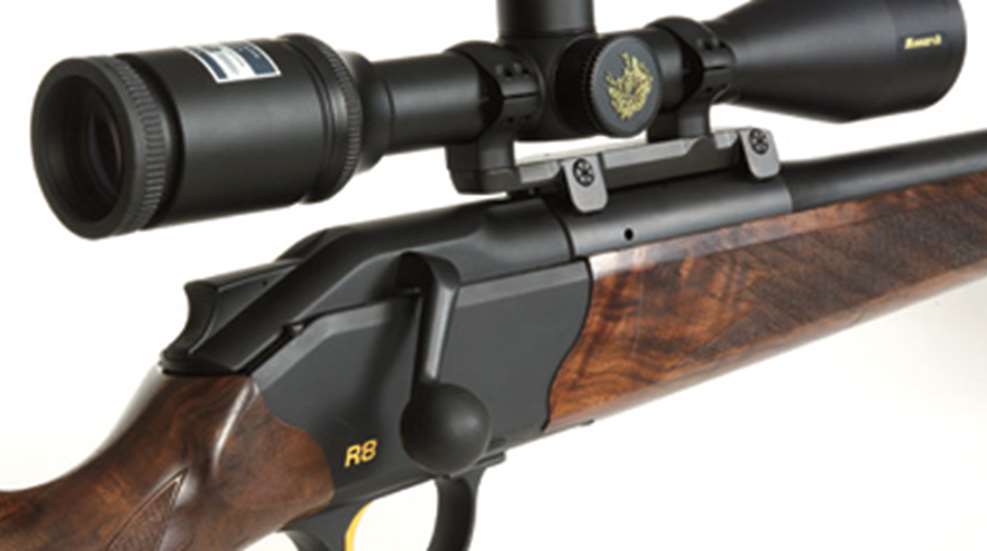
The R8 is Blaser’s newest rifle. While at first glance it looks like a slightly bigger version of the R93, that’s not exactly the case. Blaser USA’s Norbert Haussmann made it clear that the intent of the R8 is not to replace the R93, but to expand on it. The R8 is bigger, stronger and has several new features. One big change is the ability of the R8 to chamber dangerous-game cartridges, such as the .458 Lott and .500 Jeffery.
While in Texas I shot the R8 in a wide range of conditions. It was clear that the Blaser people are gun guys, and they had set up some of the best shooting scenarios I have encountered to evaluate a new rifle. I started on a stage with a European-style running boar target to demonstrate the nice balance of the rifle and how quickly the straight-pull action can be cycled. The 600-yard range was my last of the day. The rifle was dirty from all-day shooting. When I sat down at the bench, the barrel of the .300 Win. Mag. was still too hot to touch from the previous shooter. Even with all that, I shot a five-shot group measuring less than 5 inches.
The R8 uses a wider-diameter barrel and bolt head than the R93 and is a more robust rifle, and it is offered in several barrel lengths and cartridges ranging from .222 Rem. through .500 Jeffery. One receiver will handle any cartridge, so all you need to buy to switch cartridges is another barrel, magazine insert and bolt, if the cartridge head is a different size.
The receiver will accept right- or left-hand bolts. The R8 has a true right-hand or left-hand stock with the cast-on or cast-off of the comb and pistol grip. The wood stocks are two-piece while the synthetic stocks are one-piece.
Just like the R93, the R8 is a straight-pull bolt-action. What has changed is that the R8 has a larger bolt than the R93 and uses different geometry in the locking parts to enhance the strength of the action. The R8 has a collet behind the bolt-head that is slotted into 13 segments and has a raised ridge in the front. As the bolt is closed and cammed shut, the collet is pushed forward against a tapered section at the rear of the bolt head. This causes the front ridge to expand outward and into a groove in the barrel, locking the bolt to the barrel in a full 360-degree contact. The harder the bolt pushes back, the tighter the collet holds.
The R8 uses the same proven Blaser safety system. This allows the gun to be carried un-cocked, which reduces the possibility of a negligent discharge if the gun is dropped. The safety is pushed forward to cock the rifle.
The R8 barrels are hammer-forged, including the chamber. (Except for a few sharp shouldered, small-bore cartridges like the .243 Win., which require a cut chamber.) This keeps the chamber dimensions and alignment with the bore perfect every time and is one big piece of the pie that collectively makes the rifle so accurate.
There are two screws attached to the barrel that are used to tighten the barrel to the action with captured nuts in the fore-end, which allow quick-changing of the barrels.
Two dovetails on top of the barrel are used to mount a scope with the ingenious Blaser quick-release mounting system. The scope stays with the barrel when switching to a new cartridge. In testing this mounting system on several rifles, I have found that it reliably returns to zero each time the scope is removed and replaced.
One new feature is that the R8 uses a detachable magazine. A big complaint, fair or unfair, about detachable magazines is that they can fall out at a critical time. I have used rifles with detachable magazines for years, including for Cape buffalo hunting, without any problems, but will concede that the potential is there for a problem as any mechanical feature can fail. Besides, pointing out the possibility of a malfunction is always part of every review of a detachable magazine rifle ever written in any magazine. It’s part of the gun writer’s code and true or not, it creates a marketing problem.
So, Blaser addressed the issue with a double-release lock. The redundancy of two locks helps to ensure the magazine stays put. For those who still do not trust a removable magazine, there is a switch inside that will lock the magazine to the rifle. The magazine can, of course, then be loaded from the top like a conventional magazine. Or, if even that is not enough, you can simply order the R8 with a fixed magazine.
In order to keep the overall length of the rifle shorter, the trigger group is integral with the magazine box, so when you remove the magazine, you also remove the trigger group. If you wish to switch to another cartridge, however, the insert inside the magazine is easily removed and changed without tools so the trigger group and magazine housing are retained. The trigger connects all parts mechanically and does not use any springs to reset, so reset is positive. The trigger pull was a crisp 2 pounds, 12 ounces.
R8 receivers are offered in black or with several different styles and levels of engraving. Blaser also offers a model with wood overlays on the receiver. The R8 used for this article is the Jaeger Model, with a black receiver with gold R8 inlaid. It has Grade 3 wood, which is absolutely beautiful even though it’s pretty much “entry level” for the wood stocks.
The rifle is available with a synthetic stock for $3,200, but with wood stocks the sky is the limit on pricing.
Specs:
Manufacturer: Blaser Jagdwaffen GmbH; Germany
Importer: Blaser USA, Inc.; (210) 377-2527; www.blaser-usa.com
Caliber: .300 Win. Mag. (tested), .222 Rem. through .500 Jeffery available
Action Type: straight-pull, center-fire repeating rifle
Receiver: aluminum
Barrel Length: 25¾" (tested)
Rifling: hammer-forged, 1:10" RH twist
Magazine: detachable three-round capacity with lock
Sights: none; removable scope mount
Trigger Pull: single-stage; 2 lbs., 2 ozs.
Stock: Grade 3 Turkish walnut: length of pull, 14½"; drop at heel, 1½", drop at comb, 1¼"
Overall Length: 40¼"
Weight: 6 lbs., 6 ozs.
Accessories: extra barrel and magazine: $1,053; Extra Bolt: $298
Suggested Retail Price: $3,769 (tested); $3,200 (Professional Model)
Most Popular