By Major Lee O. Wright, Ord. Dept. U.S.A.
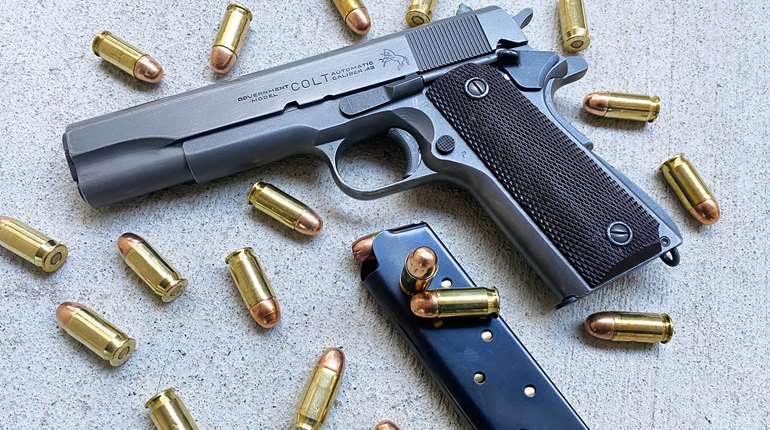
The Colt Automatic Pistol, Model of 1911 was adopted as a result of comparative tests in 1911 to replace the caliber .45 revolver. The behavior of this weapon has been such as to justify the judgment of the Board in recommending its adoption. It is a dependable weapon and stands up well, considering the rough usage to which it is subjected.
Naturally, there have been criticisms of this weapon, but in the majority of cases it has been found that the criticisms were not well founded. Some of the objections raised however, have been pertinent, and an effort has been made to meet them. The most important of these is the fact that when the average man attempts to fire the weapon at an object, as one would point the index finger, the bullet almost invariably goes low. The angle between the grip and the bore is apparently too acute to fit the average man's hand. Another point brought out is the fact that with many men the fleshy part of the hand between the thumb and forefinger is pinched between the hammer and tang of the grip safety when the slide recoils. It is difficult for a man with a small hand to pull the trigger properly, due to the fact that the trigger projects forward so far. With the standard gun, the trigger is usually pulled with the first joint of the finger on it. Also the front sight is rather narrow for use in all conditions of light.
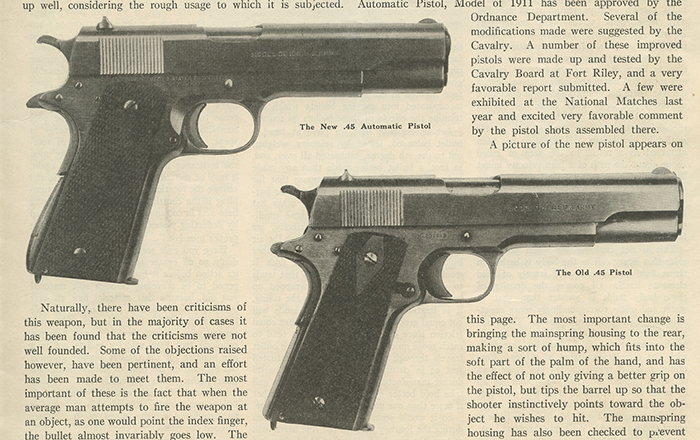
To remedy these defects, an improved model of the Colt Automatic Pistol, Model of 1911 has been approved by the Ordnance Department. Several of the modifications made were suggested by the Cavalry. A number of these improved pistols were made up and tested by the Cavalry Board at Fort Riley, and a very favorable report submitted. A few were exhibited at the National Matches last year and excited very favorable comment by the pistol shots assembled there.
A picture of the new pistol appears on this page. The most important change is bringing the mainspring housing to the rear, making a sort of hump, which fits into the soft part of the palm of the hand, and has the effect of not only giving a better grip on the pistol, but tips the barrel up so that the shooter instinctively points toward the object he wishes to hit. The mainspring housing has also been checked to prevent slipping when the hand is moist. The tang of the grip safety has been brought to the rear, so that it fits over the portion of the hand between the thumb and forefinger and prevents pinching the skin when the slide recoils. The trigger itself has been cut back approximately one-quarter inch, and the sides of the receiver, just back of the trigger, cut away.
This enables the average shooter to grip the trigger with the second joint of his forefinger without assuming a strained position. The front of the trigger has also been checked to afford a better grip. The width of the top of the front sight has been increased from .038" to .058". This width front sight has been placed on National Match pistols for the past four years, but has now been adopted as the standard sight for all future manufacture.
Another change has been made which cannot be shown in the picture. Our tests show that the accuracy of the pistol is improved when the bullet has a slightly tighter fit in the bore than at present. Last year, to accomplish this, the special caliber .45 National Match ammunition was made .0005" larger in diameter than the standard ammunition. In the new pistols, we are accomplishing this result by reducing the maximum land diameter by .002" and increasing the depth of the grooves .0005".