In the history of firearms, the military double rifle invented by British Gen. John Jacob of the Indian Army was probably one of the most ambitious and as the same time one of the most outlandish designs ever devised.
General Jacob was a fascinating person—one of those larger than life mid-19th century characters whose career reads more like a novel than fact. He tamed great portions of India’s wild Northwest Frontier, set up civil administrations and generally did a splendid all-around job of soldiering. A town was even named after him, which still exists in Pakistan.
As an improvement on the British-issue Brunswick Rifle, which fired a belted round ball, he devised a symmetrical conical projectile with studs that mechanically fit in the rifle’s bore, giving far better accuracy than the Brunswick. He continued his work, to include the invention of a bullet with a fulminate nose plug that exploded upon contact that was felt would be great for blowing up enemy artillery caissons at long distances. At about the same time he became infatuated with the idea of the double rifle, and figured that style would perfectly suit his rifling system and would be just the ticket to issue to his troops.
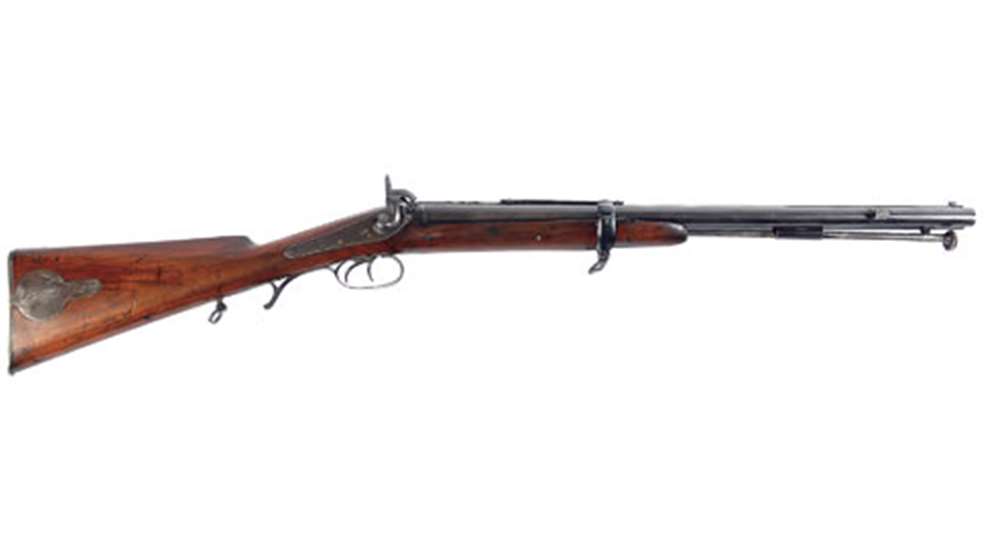
What Jacob finally came up with was a very elaborate and expensive percussion double-barreled rifle of 32 bore (0.524 caliber.) The barrels measured 24 inches and the gun’s overall length was only 40 inches. It weighed 9 pounds and sights were graduated to a very optimistic 2,000 yards. The 6-inch-long rear leaf was so contrived that to use it at an extreme range it had to be fired from the chest. He also designed an elaborate basket-hilted broadsword-style bayonet that was just about as long as the gun. The bayonets are also much sought after by collectors and are actually probably rarer than the rifles themselves.
In the mid-1850s Jacob contracted with British gunsmith Swinburn & Son to make the unusual arms. Each rifle had a special patchbox proudly engraved with the proposed unit’s name, “Jacob’s Rifles.” In 1858 he decided to raise a battalion of native riflemen to be armed with his double gun. “Jacob’s Rifles,” as the unit was to be called, would number about 1,000 officers and men, about 900 of whom would have Jacob’s very expensive and complicated rifles.
Although Jacob died of “exhaustion” on Dec. 5, 1858, Swinburn & Son fulfilled the contract; however, after his death, the rifles issued to troops were put back into stores and the troops were given more conventional longarms. Ultimately the doubles were most likely released from service and sold. The famous American surplus dealer Francis Bannerman even lists them in his early catalogs, calling them “Elephant Rifles.”
Actually, while not particularly suited to military use, they turned out to be pretty good hunting guns, and some sporters on the Jacob system were made by other firms. The explosive bullet idea even flourished for a time for use on thick-skinned game like rhinos and elephants.
The example seen here, dated 1860, is in surprisingly good condition, exhibiting about 90 percent of the original finish on the barrels, a modicum of case hardening and a perfect bore. As some of the guns saw hard use, probably as hunting pieces, it is not unusual to find them in much poorer shape. While not common, military Jacob Rifles do turn up from time-to-time. One in this shape is worth in the $5,500 to $6,500 range. Not bad when one considers the romance, ingenuity and determination involved in getting this gun built in the first place.
Gun: Jacob Rifle
Manufacturer: Swinburn & Son
Caliber: .524oio
Condition: Excellent (NRA Antique Gun Standards)
Manufacture: 1860
Value: $5,500 to $6,500
Serial Number: 251
Most Popular