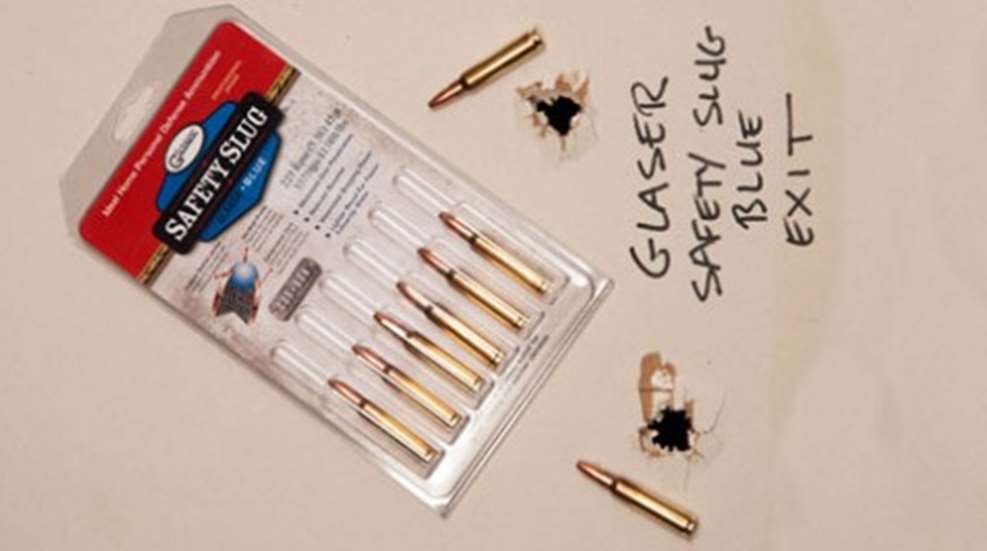
To test the penetration capabilities of various types of 5.56x45 mm NATO/.223 Rem. ammunition, with an eye toward home-defense use, I constructed two simulated wall sections, one consisting of two pieces of 1/2" sheetrock and the other two layers of 1"-thick pine boards. In both targets, the layers were spaced 3 1/2" apart, separated by 2" X 4" studs spaced 12" center-to-center. Nine .223 Rem./5.56 mm loads, including a 40-gr. Nosler Ballistic Tip varmint load from Federal, a 45-gr. Glaser Safety Slug Blue load, 55-gr. FMJ loads from Winchester and PMC, 45- and 55-gr. frangible loads from ICC, a 55-gr. frangible load from Dynamic Research Technologies, a 60-gr. Hornady TAP round, and military 62-gr SS109 ammo—were fired into both targets at a distance of 16', with impact points separated by several inches, and bullet impact angle held to as close to 90 degrees as possible.
All the loads with lead-core bullets easily penetrated through both layers of the sheetrock and wood targets. Both 55-gr. frangible loads showed similar performance, while the 40-gr. Federal Ballistic Tip and 45-gr. ICC frangible load created exit holes around 1/2" to 5/8" in diameter. The most promising performance was turned in by the Glaser Blue load, which consists of approximately 220 No. 12 shot pellets held together in a fragmenting epoxy matrix, covered with a thin copper jacket and a blue polymer tip to initiate expansion. This load showed signs of expansion/fragmentation after penetrating the first sheetrock or wood layer, and gave exit holes in the second layer of material of about 1" to 1 1/4", indicating that the projectile had already become a mass of loosely bound pellets.
But just how much energy did the penetrating projectiles carry? All the loads, including the Glaser, exploded one-gallon water jugs placed 3 feet behind the wall sections. The aftermath of any use of deadly force, no matter how justified, is traumatic and costly. When possible, it is better to avoid or deter an attack than repel it by force. not exactly a precise, scientific demonstration, but a rough indicator of residual energy. But the Glaser seemed to do less damage, and an examination of the jug showed that the pellets were already somewhat dispersed. The Glaser was additionally fired through the wall into a jug 7 ft. behind the entrance/exit points, and the difference was marked. Instead of exploding, the jug was simply leaking from a number of small holes caused by penetrating pellets. A plastic water jug is not exactly a calibrated tissue simulant, but it would seem that a person standing 7 ft. or more on the other side of a wall penetrated by a Glaser Blue projectile would more likely suffer a number of relatively superficial wounds instead of a single, potentially more injurious wound from a deeply penetrating bullet or bullet core.
Additional firing tests threw more light on projectile behavior. Shots were fired at the same 16' distance into the sheetrock wall section at a 45-degree angle, with the trajectory traversing a 2"x 4" stud. All the loads, including the frangible and varmint ammunition, fully penetrated both layers of wall material as well as the stud The aftermath of any use of deadly force, no matter how justified, is traumatic and costly. When possible, it is better to avoid or deter an attack than repel it by force. again, with the single exception of the Glaser Blue round. The Glaser ammunition went into one side of the stud and exited the other side, but the pellets apparently did not have sufficient remaining energy to exit the second layer of sheetrock, and remained contained in the wall. The only sign of the shot on the second sheetrock layer was a slight bulge where the pellets struck.
Finally, several loads were fired at the wall sections end-on, so that the projectiles could traverse three spaced studs. Surprisingly, not even the varmint and frangible loads were stopped; all passed cleanly through, although, after penetrating the first stud, the 45-gr. ICC frangible load seemed to lose some material. Its core apparently continued on, leaving neat holes in the next two studs. Again, the Glaser load was the only ammunition that failed to penetrate all three studs, its fragmenting projectile going through the first stud, leaving a large defect in the wood, and stopping altogether in the second stud.
In fairness to the frangible loads, they are neither designed for, nor advertised as, providing reduced penetration in wood, sheetrock or other similar materials. Frangible bullets are intended to pulverize upon contact with hard, unyielding surfaces, such as steel plates and concrete walls, minimizing the danger of a ricochet. Thus, it was no surprise that they went through softer construction materials.
While these results are suggestive, they are limited. Additional tests are needed, with different impact angles and target materials, and a greater number of frangible and expanding-bullet loads, such as from Cor-Bon, Federal, Fiocchi, RBCD, Remington, Silver State Armory and others (all of which were unavailable when this article was written). A crude measure of terminal effectiveness could be estimated by chronographing bullets both before and after passing through both layers of construction materials, and by placing ballistic gelatin at controlled distances behind the bullet exit points.
Most Popular