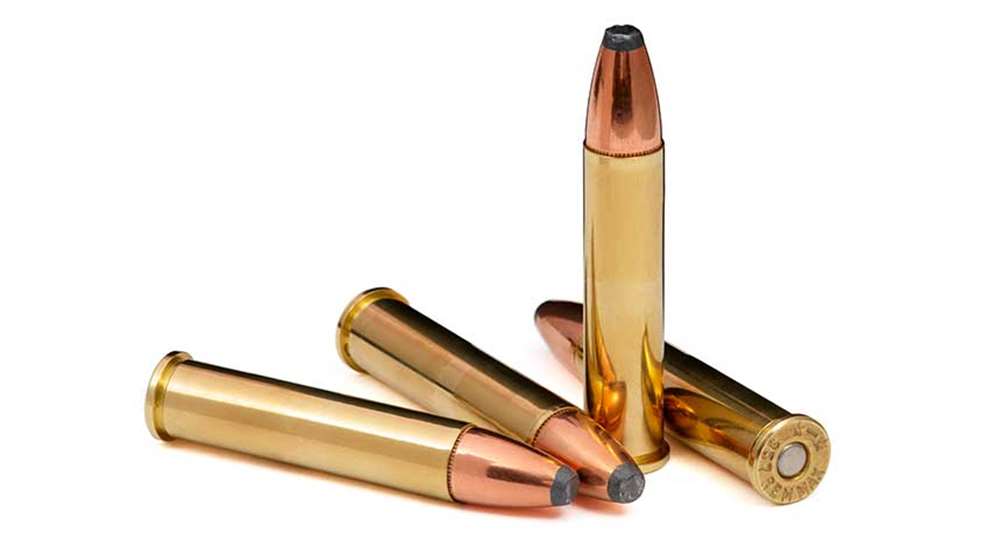
Above: Image courtesy of Steinel Ammunition.
In the early 1980s, the hottest thing going for competitive handgunners was IHMSA. That stands for International Handgun Metallic Silhouette Association. It was a long-range shooting sport in which the targets were the silhouettes of game animals cut from steel plate and placed in banks of five at 50, 100, 150 and 200 meters.
The object was to knock down all five targets in two minutes. The targets were heavy and had to be hit hard and in the right place. IHMSA is still active but nowhere near as popular as it was back then. This was a blue-collar sport that could be pursued at relatively modest cost, using handloads in a rock-bottom minimum battery of one powerful revolver.
As the sport grew, the single shots came into their own as did fancy, short bolt guns, but a quarter of the program was always with a stock revolver. In an effort to keep the playing field dead level for all competitors, they rigidly adhered to the no-modification standard. In this policy, they created a market for a more powerful revolver. We will take a look back at a stock revolver and its misunderstood cartridge called the .357 Maximum.
Originally conceived by the late Elgin Gates and called the .357 SuperMag, the new round was very straightforward. It was simply the .357 case lengthened to 1.60” and used the heavier bullets of 158 grains to as much as 200 grains. Obviously, a longer cartridge had increased powder capacity and greater velocity potential.
When Remington put the special round into production, it got a new (and prophetic) name: .357 Maximum. Such a longer cartridge is a pipe dream until someone steps up and makes a longer revolver cylinder. And of course, such a gun would have to have a longer frame for the longer cylinder for the longer cartridge. The late Bill Ruger got interested and set his people to work. In short order, there was a Ruger Blackhawk Maximum and ammo to go with it.
Ruger was not the only party on the Maximum bandwagon. Some of the smaller single-action companies produced their version. Single shots from Thompson/Center, Wichita and Merrill appeared on the expanding .357 Maximum market. And of course the popular, accurate Dan Wesson revolvers came out with a long frame, long cylinder Max. Seldom has any new gun/ new cartridge combination failed so quickly.
Ruger's long-framed Blackhawk was first to market in two barrel lengths. Within a few weeks, the company got so many complaints, they halted production and never resumed. Somewhere around 7,500 guns were made. Most were returned to the factory and their purchase price refunded.
There were two major complaints with the Max, both having to do with powder gas erosion. When the gun fired, it behaved like all revolvers in that the powder charge in those long chambers burned at a very high temperature. This produced a blue-white ring of fire at the gap where the bullet transitioned the jump from cylinder to the barrel.
This fire also flowed upwards in such a way that it encountered the inside edge of the revolver topstrap. It took only a few rounds to actually erode (read cut) that section. Also, the flame proved to be hard on the rear end of the barrel, rapidly destroying the smooth taper of the forcing cone.
The makers involved cleared their drawing boards and mandated corrections. That never happened with Ruger. Dan Wesson guns had easily-replaceable barrels and came with an extra in .357 Maximum. The company would sell you all you wanted for ten bucks apiece, but a gun that tried to cut itself in half was doomed to failure. The .357 Maximum went away. No one currently makes guns chambered in the cartridge.
Looking back on the whole incident is very interesting, and there is much to be learned. First, I was a guy who dropped the idea, except for a special-purpose handload. I can recall a conversation with John Taffin, a fellow gunwriter of deserved great reputation. John said that he quietly kept on shooting his Rugers in the controversial caliber. The topstrap cutting kept on but eventually stopped. I doubt nothing that Taffin says, but we both know that no gun maker will ever live with that kind of visible damage.
But let's step back and look at what the .357 Maximum was designed to do. It was for long-range pistoleering—the IHMSA challenge of accuracy and power at range. Many shooters used their long-barreled .357 Magnum revolvers but usually longed for a bit more velocity to go with those heavy bullets. There's no doubt but that the .357 Magnum with heavy bullets will do it handily up close.
The .357 Maximum was an effort to give you .357 Magnum muzzle velocity at 200 meters. It didn't quite make it, but still knocked the steel rams down. I would also point out that IHMSA was a handloader's sport. Loading your own was a matter of economic necessity for most of us, and wildcatting was very common. I'd bet you well over 90 percent of all IHMSA ammo was loaded on the shooter's bench. Guys that do this are, shall we say...preoccupied with velocity, which is usually the product of light bullets and fast-burning powder.
I believe that a failure to appreciate the complexities of this cartridge, the bullets available for it and the proper propellants applicable were a major reason why it passed early. I wonder how the rimless version of the .357 Maximum—the .350 Legend—will fare. It's another special purpose cartridge that has an eerie resemblance to the Max.
Most Popular