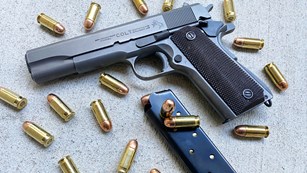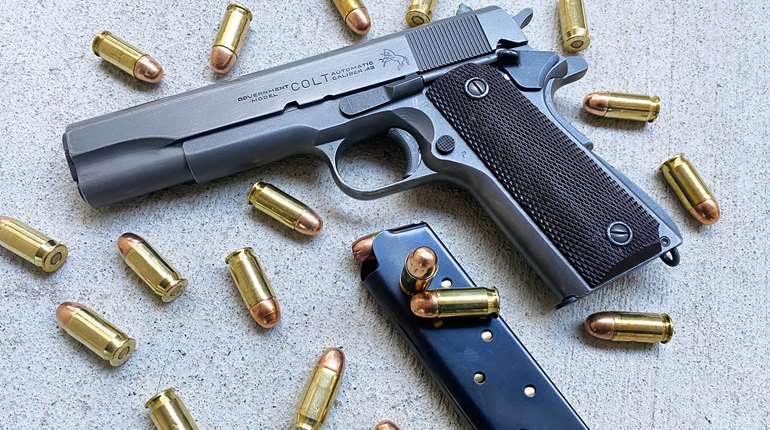
Q. I have a question about the G.I. .45 pistol. Can you tell me when the government started making the improved M1911A1 pistol? Can you also tell me when production stopped?
A. The M1911 pistol remained the standard service handgun of the U.S. Army, Navy and Marine Corps after the First World War. Its success in France during 1917-1918 ensured its continued prominence as the standard American military sidearm, and there was no real developmental work on another pistol during that period.
A few minor problems noted during World War I led to changes in the configuration of the trigger, hammer and grip and slight modifications to the frame. These changes were incorporated in new production pistols, and, in June 1926, the nomenclature was changed from “M1911” to “M1911A1.” The OCM Item 5453 dated May 17, 1926, stated, “as means of ready distinction between the two models, it is agreed that all pistols bearing serial numbers under 700,000 should be designed M1911 pistols, while pistols bearing serial numbers beginning at 700,000 should be designated M1911A1 pistols.” In the years between the wars, however, few M1911A1s were made because there were sufficient stocks of M1911s on hand to meet the limited demands of the peacetime military.
Of course, this situation quickly changed when America entered World War II. Colt stepped up production of the M1911A1, and contracts to produce the pistol were awarded to several other companies. Below are the firms that made the M1911A1 pistol during the war and their approximate production totals during that period.
Ithaca Gun Company: 400,000
Remington-Rand: 900,000
Colt: 400,000
Union Switch & Signal: 50,000
In addition, the Singer Company received an Education Order for the production of 500 M1911A1s, but the firm never produced the .45 in quantity. Older M1911 pistols still in inventory were inspected and issued. Many of those guns required some refurbishing to make them serviceable. This refurbishing, known as C&R (Cleaning & Repairing), rebuilding or overhaul by the Ordnance Department, generally consisted of replacing worn or unserviceable parts and refinishing the pistols with the standard parkerizing. The initials of the ordnance facility that performed the rebuilding were stamped on the frame of the pistol. While, officially, the carbine was supposed to be the .45’s replacement, the total number of M1911A1 pistols procured during World War II was 1,878,742. The .45 automatic was the most widely issued United States military handgun of the Second World War.
After World War II, the M1911A1 stayed on in the government’s inventory. It is interesting to note that no government contract .45 handguns were made after 1945, and most of the ones that saw service later in the 20th century have been rebuilt several times.
—Bruce N. Canfield
This “Questions & Answers” was featured in the June 2005 issue of American Rifleman. At time of publication, "Questions & Answers" was compiled by Staff, Ballistics Editor William C. Davis, Jr., and Contributing Editors: David Andrews, Hugh C. Birnbaum, Bruce N. Canfield, O. Reid Coffield, Charles Q. Cutshaw, Charles M. Fagg, Angus Laidlaw, Evan P. Marshall, Charles E. Petty, Robert B. Pomeranz, O.D., Jon R. Sundra, Jim Supica, A.W.F. Taylerson, John M. Taylor and John W. Treakle.
To subscribe to the magazine, visit the NRA membership page here and select American Rifleman as your member magazine.
Most Popular