With the rise of the Beretta, Glock, SIG Sauer and Smith & Wesson double-action or striker-fired semi-automatic pistols, the era of the sixgun as the dominant sidearm in American law enforcement was coming to a close. For nearly a century, the double-action, swing-out cylinder revolver dominated the holsters of police officers, starting in 1890s. Two basic, yet similar, forms with similar operation but different lockwork evolved, as represented by Colt and Smith & Wesson. With rare exception, if you were a cop, one of those two brands would ride in your duty rig. But by the 1990s, nearly every major agency had either transitioned to a semi-automatic pistol or was trying to decide which one to adopt. And Colt’s manufacture of such guns from the 1889 Navy Double Action, to the Police Positive Special to the Python was over. Magazine capacity had much to do with law enforcement adoption, but oft overlooked are the improvements made in semi-automatic pistol design and reliability.
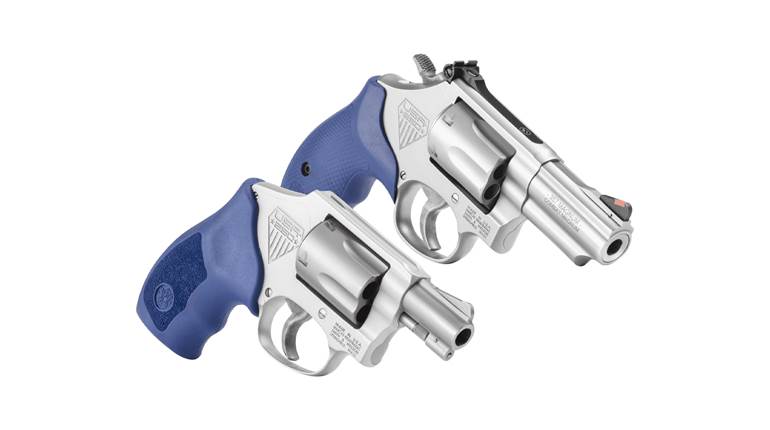
But just because the majority of law enforcement officers no longer carry revolvers as their primary service sidearms does not mean they do not have a role to play. For many, they are a joy to shoot at the range, offer simple operation, are capable of impressive accuracy and still are a viable choice for personal protection. Too, there have been new materials and manufacturing techniques applied to revolvers, as evidenced by the Ruger LCR, the S&W Bodyguard and one of the most unusual revolvers introduced, the Chiappa Rhino.
Smith & Wesson and Ruger still make a surprising number of double-actions in the United States, and Rossi and Taurus continue to make huge numbers of them in Brazil. There are others, such as Dan Wesson, Italy’s Chiappa and Germany’s Hermann Weihrauch (you may know it as EEA’s Windicator). Many of these guns are short-barreled snubbies, but quite a few are mid-sized, what used to be considered “service revolvers” but are now often referred to as “house guns,” as they have moved from duty holsters to lock boxes.
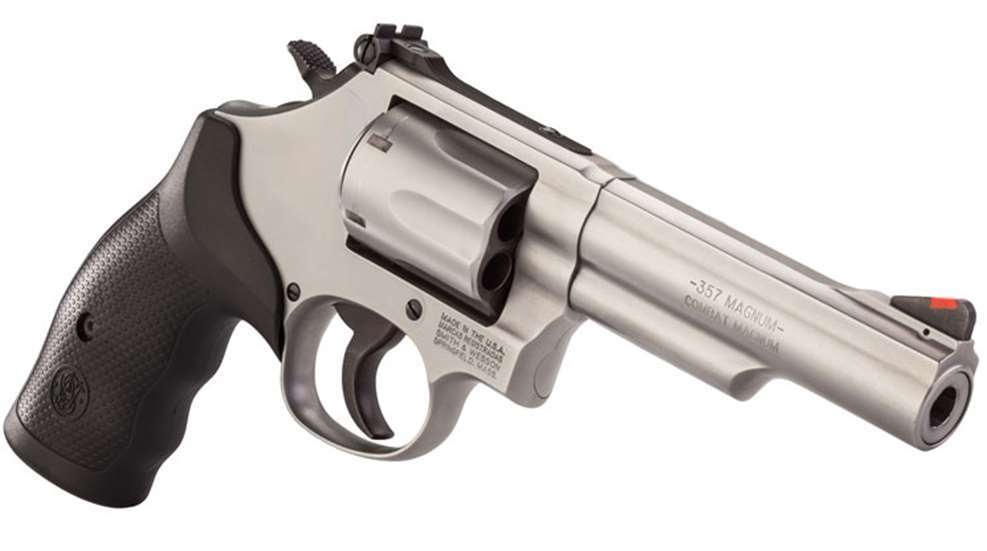
And then there are the big bores and the magnums. Typically, the attribute revolvers retain over semi-automatics is power. Although there are pistols designed to fire revolver cartridges—the Desert Eagle, Automag and Coonan come to mind—cartridges in the power range of the .357 Mag. .41 Mag., 44 Mag. tend to be revolver territory. There are times one just needs a big, powerful handgun. Few with sense declare the 9 mm Luger the ideal sidearm for bear country. The .44 Mag.? Well, that’s a different story.
There is a nostalgic streak to shooters, and the five-shot .44 Mag. Model 69—and its .357 Mag. cousin the Model 66—appeal to it. You can read about these two in the December issue of American Rifleman, or see them posted on this site in late November. There is something simply retro and cool about the big stainless Smiths with their fully lugged barrels. Legislation, particularly in California, has led to renewed interest in revolvers, but for many of us they never went out of style.
Most Popular