Photos courtesy of FN Herstal, Ars Mechanica Foundation
What are the odds of finding an-all original M1 Garand or M1 carbine actually used on the battlefront to liberate Europe? Not as good as you might think. And you have Fabrique Nationale to thank for that. Collectors of World War II U.S. military arms usually know little about FN’s history. And that’s a mistake. Didn’t think there was a connection between the M1 Garand and carbine and the renowned Belgian gunmaker? M1 Garand and M1 Carbine collectors have seen the evolution of a cottage industry of dealers selling and assembling components for the purpose of recreating factory configurations by matching, pairing, and marrying parts by the markings. But a collectable is only original once. The question should be asked if factory original guns really survived the war.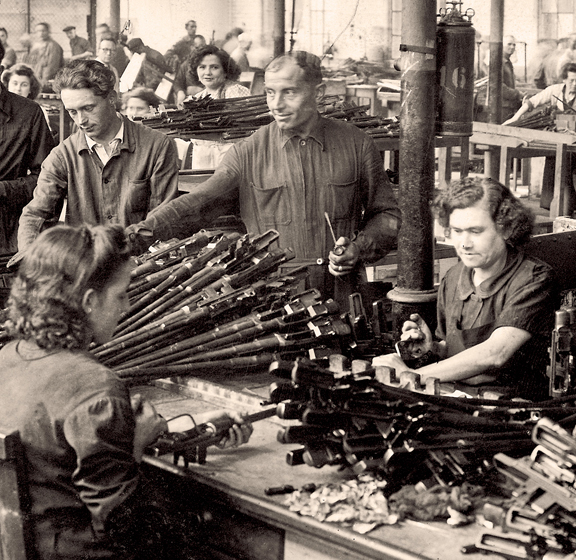
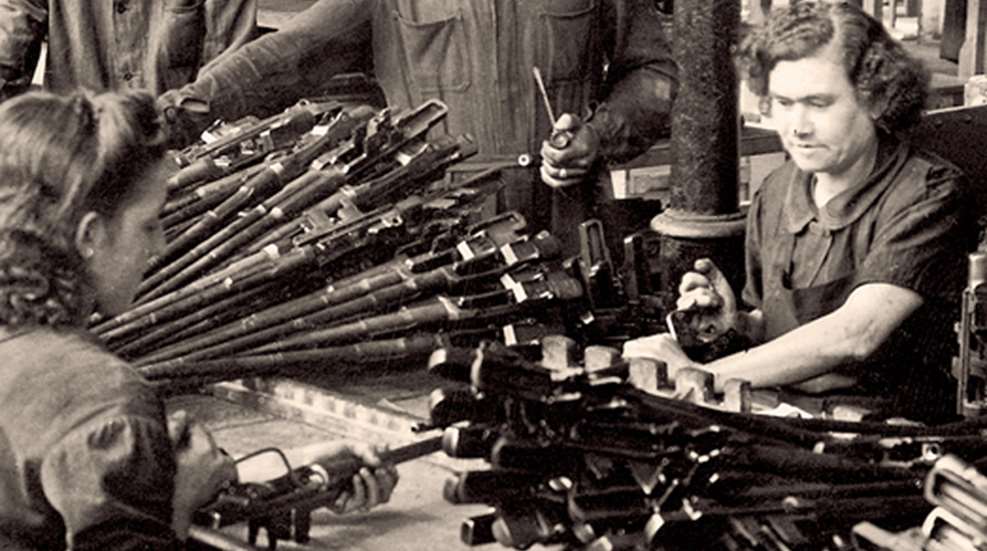
FN workers assemble or disassemble M1 Garand rifles.
One rather inconvenient truth for some of the M1 rifle and carbine parts assemblers of today is that FN was actually contracted by the U.S. government to rebuild all of U.S. small arms utilized in the European theatre at war’s end. And FN did it while leaving only photographic evidence but not a trail for collectors to follow.
The Fabrique Nationale factory at Herstal, near Liege, Belgium, was liberated by Allied troops in September 1944, and despite losses in manpower and equipment—as well as later ”buzz bomb” attacks—FN went back to work. The U.S. Army first contracted with FN during the Battle of the Bulge, and 400,000 mud-grips for Sherman tanks were cast in FN’s foundry. Other orders included manufacturing 5,000 sheet-metal gas cans, which were in short supply and urgently needed.
The U.S. military recognized FN’s capability to rebuild most of its small arms, with the possible exception of the U.S. Model 1911A1 pistols. This may have been a legal restriction as FN and Colt shared worldwide production rights.
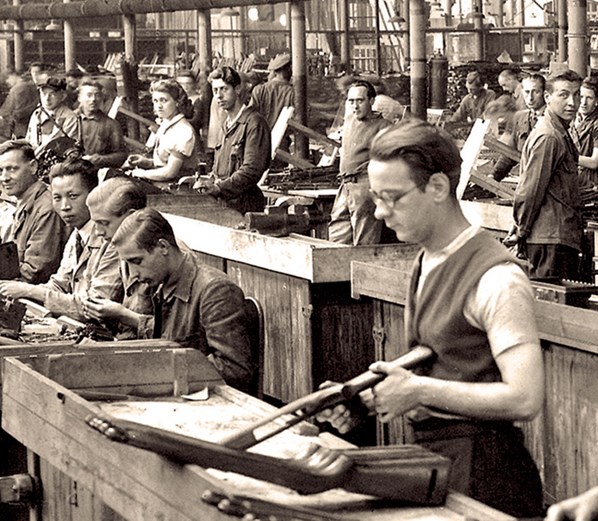
A newly made FN M1 Carbine stock is visually inspected by a worker.
After the fall of Berlin and Japan’s surrender, the U.S. military contracted with FN to repair, refurbish and package all the small arms used in the European theatre. More than 2.1 million American military arms made their way to FN, including M1 Garands, M1 Carbines, Thompson submachine guns, M3 “grease guns,” Browning .30-cal. and .50-cal. machine guns, as well as others.
Fabrique Nationale’s s task was to strip all components, inspect parts, check for wear and re-assemble the arms with new replacement parts (when needed) before packing and crating. The spare parts were supplied by the U.S. military or made at FN. Countless new walnut stocks were made for M1 Garands and carbines—including M1A1 paratrooper stocks.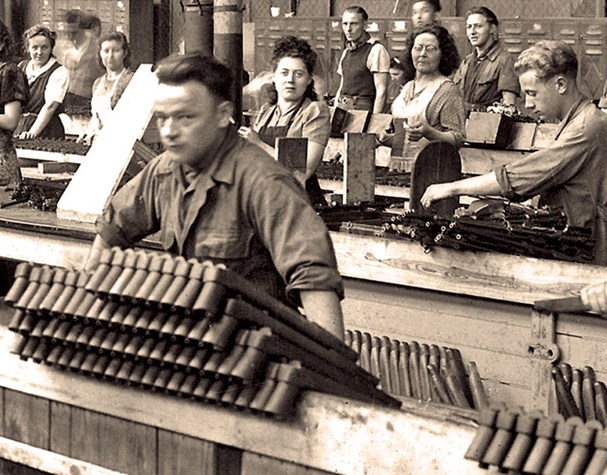
FN-made M1 Carbine paratrooper stocks are ready for assembly.
Guns were not disassembled and reassembled one at the time, instead parts were stripped and piled into large wicker baskets. No attention was paid to parts markings—only to functionality. Fabrique Nationale did not add any known markings, even some markings found on postwar M1 carbine magazines and generally attributed to FN manufacture are questionable at best. It is likely that the U.S. military specified that no markings be applied, as FN historically marked parts for quality control in its own production.
The FN program was called the “redeployment” program and lasted from June 1945 through June 1946. It was a tremendous economic boon for a company struggling to restart production of new goods in the immediate post-war economy. Period photos indicate that most of the work was done by hand, even the shaping of walnut stocks. This is logical as FN would not have invested in mechanization for a single contract, especially in those difficult times when labor was readily available but machinery was expensive to acquire.
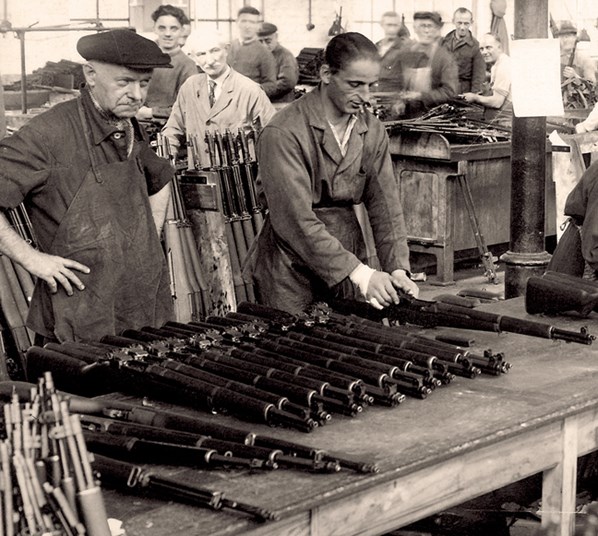
An FN worker checks the actions of newly assembled M1 Garand rifles.
The FN workers and locals were always grateful to the U.S. Army, not only for liberating the entire region but also for creating jobs and restarting the economy. The 1945 contracts were the first of a long standing relationship between FN and the U.S. military. Today FN America supplies small arms to the U.S. military, including the FN-designed M240 and M249 machine guns.
For collectors seeking to buy an all original World War II M1 Garand or Carbine, FN’s redeployment program is something to keep in mind when considering originality. There are, however, many ways of interpreting originality. For some collectors, a piece is collectable if it is period correct, that includes arsenal reworks and even field modifications. Others are more selective, seeking out only factory original guns, those that have never been arsenal refurbished or upgraded.
Most Popular