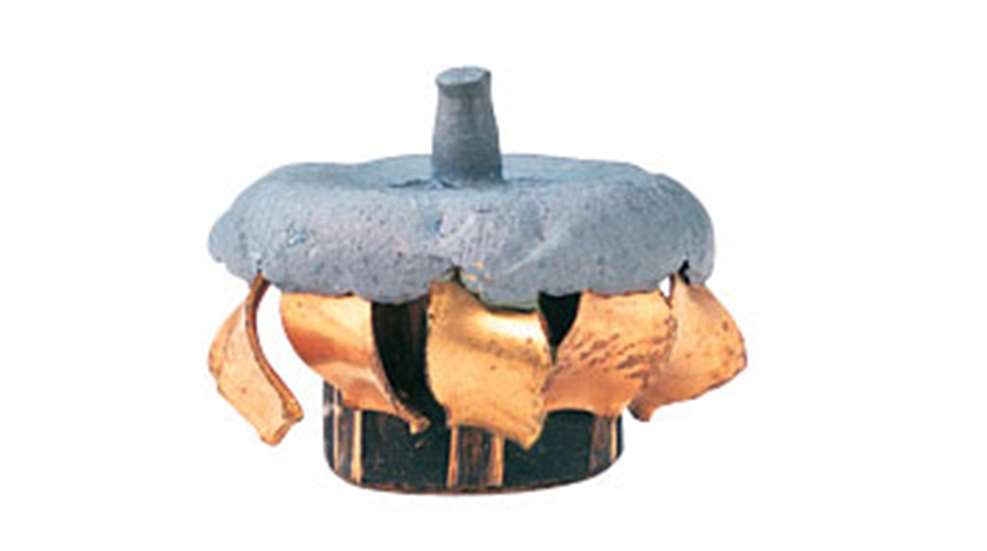
The above photo is a Federal Hydra-Shok hollow point.
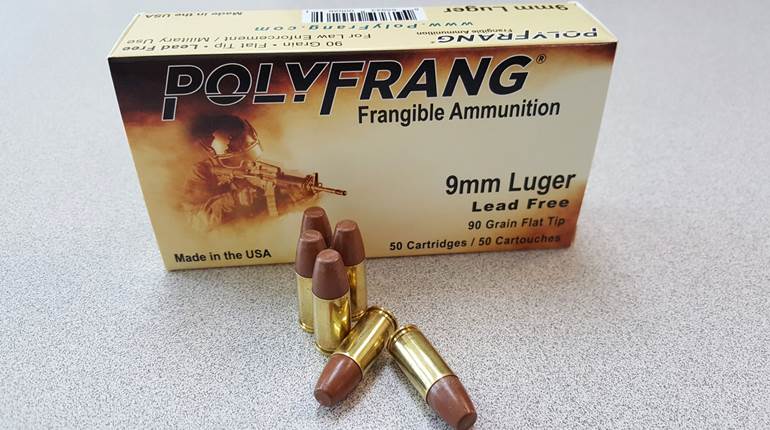
I shot special frangible ammo in military training as far back as 1956. As I recall, the ammo was not very accurate, but did allow us to fire M1s on a small-bore range. It was a good way to get beginners familiar with the handling of the service rifle. Over my following years of military service, I was infrequently aware of frangible ammo use for special purposes. Mostly, we used the real stuff, because we had the ranges that would handle it. What I am saying is that my personal experience with frangible ammo is limited. But a while back, I fired about a 100 rounds of frangible ammunition in a series of indoor and outdoor steel-target exercises at Gunsite. It performed flawlessly. As it's made of powdered metal, the bullets fall apart on impact with hard surfaces like Gunsite's steel-plate targets. This virtually insures no ricochets, and sharply reduces wear on the steel. That is precisely what this ammo is designed to do—produce a particular terminal effect. It may very likely be lethal, but that is not what it's intended to do. What surprises me is that there are enough brands of the stuff that you can go comparative shopping. It has moved that much into the handgun scene.
Apparently, there are some shooters, who are understandably concerned about over-penetration, that have concluded that this kind of ammo might be just the ticket for shooting attackers in the house. Please don't do this—it is not a good idea. The best ammo for home-defense is still a well-designed jacketed hollow-point round. Invariably, this kind of ammunition is developed to deliver the JHP bullet at a speed that will cause that hollow point to open and expand, assuming normal (short) combat distances and a center of mass hit. By the way, a seldom-appreciated benefit of a hollow point is enough expansion to increase the bullet's frontal diameter. This gives a greater braking effect in tissue and the bullet stops sooner than hard, non-deforming solid or FMJ bullets. If you should be so unfortunate as to be faced with a home invader in a justifiable shooting situation, the idea is to stop the attack quickly. The best bullet for the job is the aforementioned JHP. You should not expect the ammo maker to protect you with a disintegrating slug that breaks up on hard surfaces in the event that you miss. That's even truer when a hit with this stuff produces no better effect than a good JHP.
Modern frangible ammunition is a boon to the shooting schools and police agencies that use reactive steel targets. The target reacts as designed, but the bullet becomes a spoonful of harmless, non-toxic powder.
Most Popular