September will always be the National Preparedness Month and—despite the Federal Emergency Management Administration launching the annual observance in 2004—the message doesn’t seem to be resonating within local governments. This year, there’s even more reason they should heed the warning. August 29 was the 20th anniversary of Hurricane Katrina, which the National Oceanic and Atmospheric Administration (NOAA) estimates claimed 1,833 lives in Louisiana and nearby states. In 2005 dollars, not adjusted for inflation, damage was estimated at $108 billion.
There have been improvements since then, however. The levees that failed and flooded huge section of New Orleans have been rebuilt, improved and upgraded to modern engineering standards. During that disaster, some law-abiding citizens also had their firearms confiscated by local officials. It left many largely defenseless at a time when calls for help were either delayed for hours or response was impossible. The ability for a local government to temporary suspend the right to protect yourself and loved ones was later remedied in most areas of the country by the tireless efforts of NRA-ILA and others.
Unfortunately, the financial impact of natural disasters continues to be felt across the country. “The U.S. experienced 28 separate billion-dollar weather and climate disasters in 2023, surpassing the previous record of 22 events in 2020 since the metric was introduced in 1980,” according to the 2024 National Preparedness Report [PDF], issued by the Federal Emergency Management Agency (FEMA) in December 2024. The study only includes incidents up to 2023, none of 2024’s disasters.
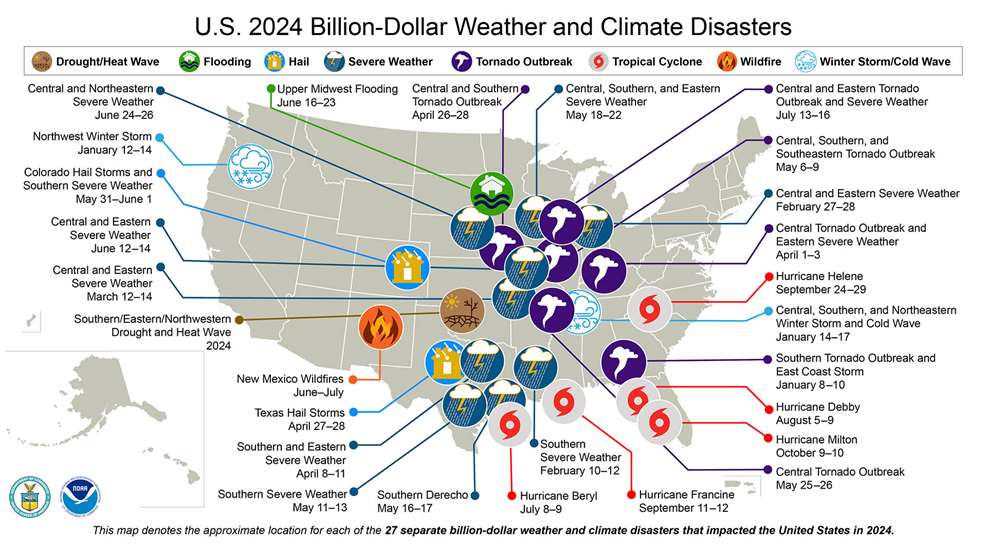
According to NOAA, last year narrowly missed the record. It came in with 27 natural disasters with damages at more than $1 billion, a figure that includes Hurricane Helene. NOAA’s website puts the long-term trend into perspective. From 1980 to 1989, there were 33 disasters that met the $1 billion mark. In the 1990s, there were 57, 67 from 2000 to 2009, 131 from 2010 to 2019, and in the last five years alone, we’re already up to 115.

There’s no doubt inflation pushes more storms, fires, earthquakes and other catastrophes past the $1 billion than in the ’80s, but another FEMA observation is cause for further concern: local governments are falling behind in their ability to aid residents if the unthinkable strikes.
FEMA’s Preparedness Findings
“When storms and other disruptive incidents occur, communities must be ready to respond,” the above-linked FEMA report explains. “Still, 2023 THIRA/SPR (Threat and Hazard Identification and Risk Assessment/Stakeholder Preparedness Review) submissions indicated an average target achievement of just 59 percent for reporting jurisdictions Mass Care Services capabilities.”
Two areas of the nation suffered the most significant decline in preparedness. “Communities in FEMA Regions 3 and 10 reported the largest decreases in capability for sheltering and relocation assistance from the beginning of 2023 to the end of the year,” it states. “Region 10 communities reported a 31 and 30 percent decrease, respectively, in their capability to provide people with temporary, non-congregate housing, as well as their capability to provide accessible, temporary, non-congregate housing for people with AFN [Access and Functional Needs]. Communities in Region 3 similarly reported an 18 percent decrease in their capability to provide people with temporary, non-congregate housing. These low achievement estimates demonstrate a need for focused planning and funding.”
Region 3 includes Maryland, Pennsylvania, Virginia and West Virginia. Region 10 encompasses Alaska, Idaho, Oregon and Washington.
Be Your Own First Responder
“FEMA’s 2023 National Household Survey found that 51 percent of adults believed they were prepared for a disaster, which is a 9 percent increase in preparedness perception from 42 percent in 2017,” the report states. The high water mark for that figure, however, came in 2019 at 59 percent.
Seventy-two percent of respondents in FEMA’s 2024 survey said they expect aid from family and friends after a disaster. Only 53 percent expected anything from local, regional, state or federal government entities.
Readers are encouraged to visit Ready.gov for tips on preparedness, or the American Red Cross “Make a Plan for Emergencies” webpage.
Most Popular