On June 17, 1775, British infantrymen assembled at the base of Breed’s Hill, one of two promontories that comprised the Charlestown Heights outside of Boston. The other, Bunker Hill, saw little fighting, yet lent its name to the battle that began 250 years of illustrious history for one of the world’s greatest fighting forces. The clash that afternoon marked the first major engagement for the colonial militiamen besieging the city, all of whom were, only three days earlier, officially inducted, by an act of the Second Continental Congress, into the newly formed Continental Army.
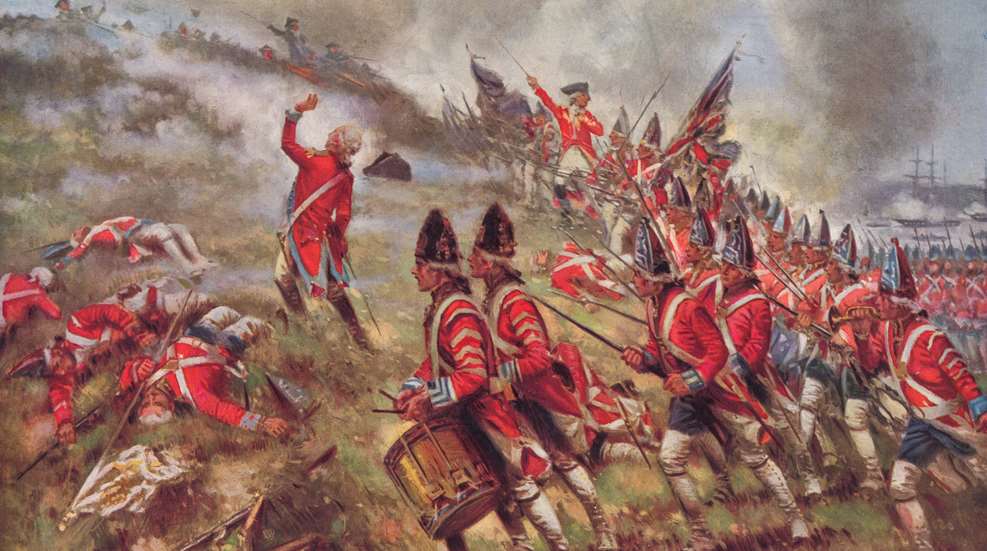
At the top of the hill waited more than 2,000 fighting men, all volunteers from surrounding towns, counties and colonies who had marched in response to the alarm raised after the “shot heard round the world” was fired at Lexington nearly two months before. The previous night, they had dug defensive positions in anticipation of the assault, which began in the late afternoon with the beat of drums and the shrill whistle of fifes as nearly 2,000 red-clad British regulars, led by bearskin-capped grenadiers at their center, began a cadenced climb toward the entrenched colonials.
An apocryphal story holds that the order, “Don’t fire ’til you see the whites of their eyes!” was shouted out to the defenders at the hill’s peak. But regardless of whether or not such exact words were ever uttered, the stalwart defenders held their fire until the British assault wave closed in. Finally, the first order to fire given to the new American army echoed down the line, opening a violent volley of musketry that swept like a scythe across the advancing attackers.
After two hours of heavy fighting, during which time the British assault waves ebbed and flowed around the Breed’s Hill redoubt, the colonials had exhausted nearly their entire supply of ammunition. A third and final assault by British infantry and Marines, with their bayonets charged, cleared the Army from its defenses, but at a heavy cost. More than 1,000 British soldiers lay dead and wounded on the sloping hill. American losses totaled about 450 men, including 34-year-old Maj. Gen. Joseph Warren, one of the most talented young leaders among the founding generation. For the British army, Bunker Hill proved to be a pyrrhic victory, as it suffered more casualties in that single afternoon than it would in any engagement during the rest of its war in America. What’s more, the battle proved that Americans had the resolve to fight, even in the face of tremendous odds.
Most Popular