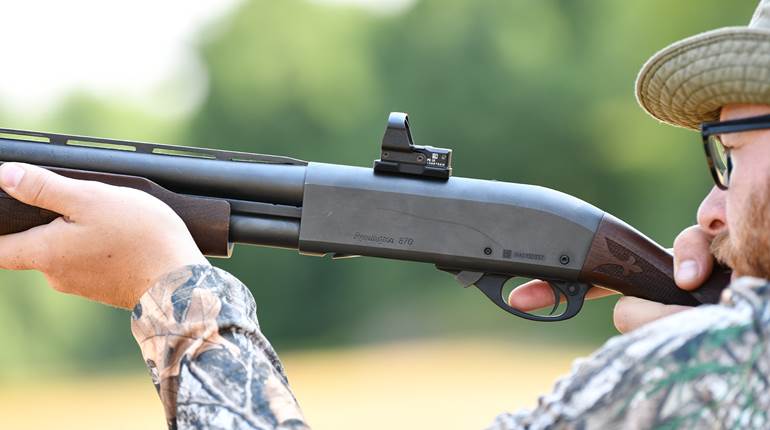
Introduced in 1967, the gas-operated Browning BAR has proven to be a reliable and very successful semi-automatic sporting rifle. But, with development of the Winchester Short Magnum family of cartridges, Browning has made some radical aesthetic and ergonomic changes to the venerable BAR.
The standard Safari and Lightweight Stalker BARs are still offered, but the new LongTrac and ShortTrac bring modern European styling to the design. The ShortTrac (designed for short-action length cartridges) is offered in .243 Win., .308 Win., .270 WSM, 7 mm WSM and .300 WSM, while the LongTrac handles the longer .270 Win., .30-'06 Sprg. 7 mm Rem Mag. and .300 Win. Mag.
The European-style walnut fore-end and contoured buttstock differentiate the ShortTrac from more traditional American-style BARs. The .270 WSM we received has a more angular fore-end that extends farther to the rear, covering the front of the lower receiver. There are pronounced ascending thumb grooves on either side of the fore-end, and the belly is checkered in an angular pattern. A sling swivel stud protrudes from the front of the fore-end.
The buttstock has a full pistol grip, again with fine checkering, and seemingly arbitrary angular lines on its surface. A user-adjustable shim system (as is often found on shotguns) allows the shooter to tailor the gun to his or her dimensions. Each gun includes six spacers that install between the buttstock and receiver, allowing adjustments to the drop of comb, drop at heel and cast on or off. The 1-inch soft rubber recoil pad is radiused at its top to aid in rapid mounting and is contoured to the lines of the butt.
The BAR's basic operation remains unchanged. The seven lugs of the bolt head rotate 60 degrees to engage recesses in the barrel, providing steel-on-steel lock-up. The head is rotated by a cam pin in the bolt sleeve, or carrier, after that part has moved rearward about 3/16 inches. The spent cartridge case is withdrawn by a hook extractor on the right side of the bolt head and ejected by a plunger ejector on the left.
The short-stroke piston system operates much like that of the M1 Carbine. On firing, propellant gasses pass through a hole in the barrel and drive a captive piston rearward. This in turn strikes a heavy inertia piece that, working through the action bars, unlocks the action. Gas is regulated by a screw passing diagonally into the right side of the cylinder.
The bolt-release lever is at the right front of the receiver, and it has been extended and recontoured due to the lengthened fore-end. After the last round of a magazine is fired, the magazine follower presses the lever up into engagement with the right slide bar, locking the bolt assembly open. Pressing the lever down disengages it from the slide, allowing the bolt to slam home.
The trigger assembly, riding in a polymer housing, is removed by driving out a pair of pins. The floorplate and trigger guard, too, are of molded composite, and the three-round-capacity magazine can be loaded simply by pulling back on its catch in front of the trigger guard and inserting ammunition. The box may be separated from the floorplate by pulling up on its rear end. The safety is a trigger-blocking crossbolt at the rear of the trigger guard.
All ShortTrac barrels are produced by Fabrique Nationale in Belgium (Browning's parent company) and are of hammer-forged, blued steel with a high polish. This is in contrast to the attractive matte-anodized finish of the rifle's receiver. No iron sights are supplied, but the receiver is drilled and tapped for scope mounting.
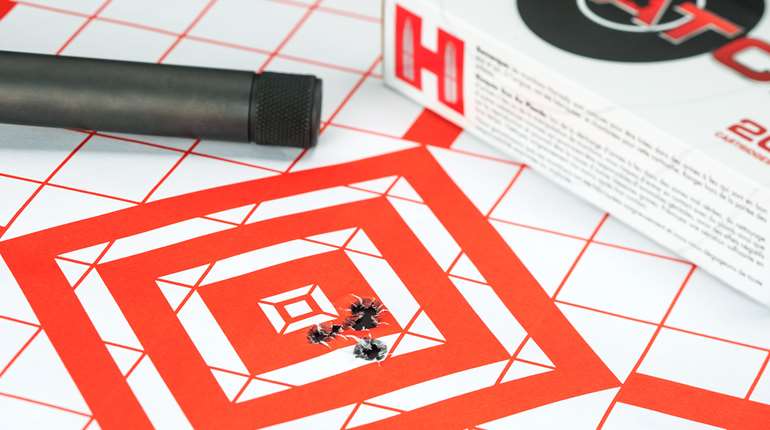
Our sample .270 WSM was rifled with a 1:10-inch right-hand twist and featured a slight recess at the muzzle crown to protect the rifling. It was function-fired and shot for accuracy with results shown in the accompanying table. There were no failures of any kind.
The ShortTrac is a handsome, if non-traditional looking, addition to the BAR line. It brings clever features from the company's shotgun side into a lightweight, handy-and thanks to its WSM chamberings-powerful rifle that we would take afield anytime.
Most Popular