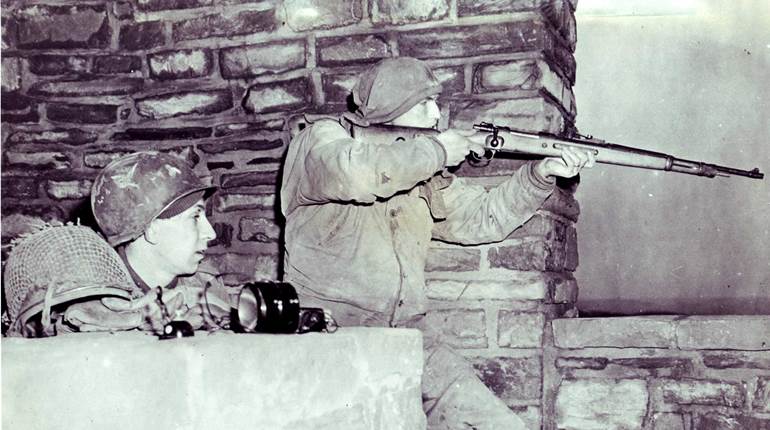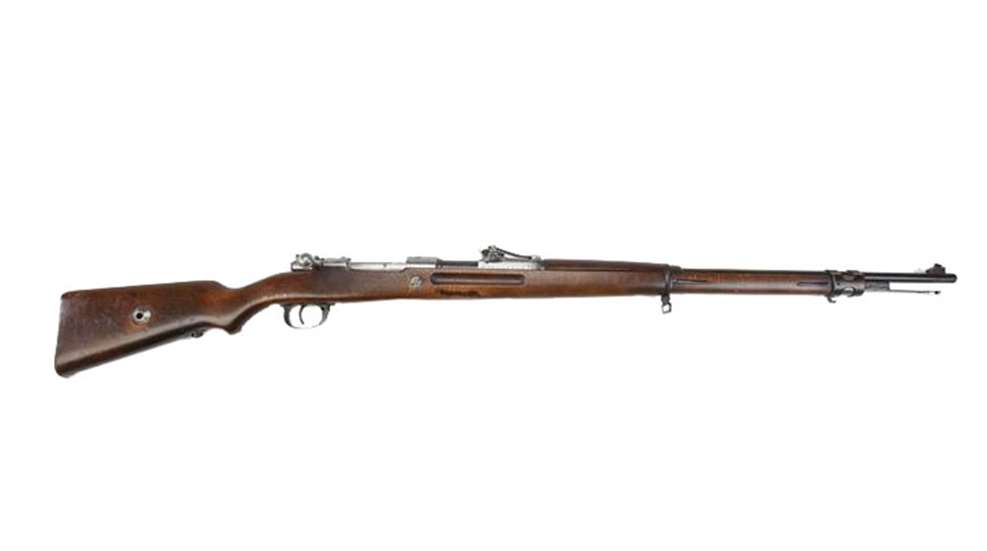
The Mauser 98 is a manually operated bolt-action rifle fed from an internal, staggered column magazine. Its bolt features a non-rotating claw extractor and a spring-loaded blade-type ejector. Lockup is accomplished with two opposing lugs at the front of the bolt that engage an internal boss located inside the front receiver ring. The bolt handle root serves as a safety lug in the case of primary lug failure. Cartridges are fed from the magazine to the receiver and chamber via the forward motion of the bolt. As a cartridge is stripped from the magazine, its rim slides under the extractor and is restrained by the bolt face. From this point until ejection, the cartridge remains under the control of the shooter, giving rise to the term “controlled round feed.” The trigger is two-stage with considerable take-up before engaging the sear. A three-position, wing-type safety blocks the firing pin with the mid position allowing the bolt to be opened. Sights are open, ladder-type with adjustments from 400 to 2,000 meters.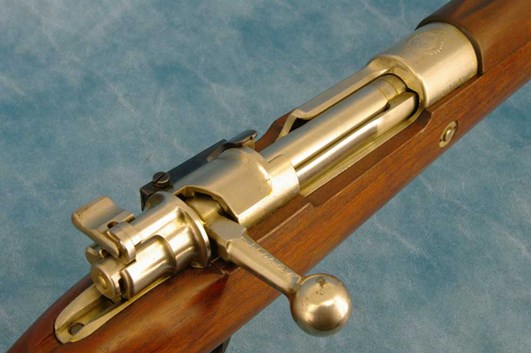
An oiled walnut stock with a handguard shroud and semi-pistol grip cradles the rifles metalwork. A singular lug forged on the underside of the receiver ring transfers the recoil impulse from the barrel/receiver to the stock. Late wartime production rifles (1918) had stocks of stained beechwood due to a lack of suitable walnut. The 98 Mauser was the culmination of nearly 75 years of bolt-action rifle development. Let’s take a quick look at that history.
The first use of a rotating bolt used to close and seal the breech of a breechloading rifle was the Dreyse needle-gun, invented by Johann Nikolaus von Dreyse (1787–1867) in 1824. Like all first inventions, it needed improvements, but it did establish the notion of a bolt-action rifle. The Dreyse needle-gun saw service from 1841 until about 1873.
Paul Mauser was just 4 years old when the needle-gun first saw service. Paul, the youngest of five brothers would, along with those brothers, develop into gunsmiths of their own. Along with his brother Wilhelm, they began to develop a bolt-action rifle in 1867. By 1871, their design had outperformed trials of other military rifle submissions. On February 14, 1872, it was formally adopted as the German Empire’s Infanterie-Gewehr 71 (Infantry Rifle Model 1871), after the wing safety was perfected. The Mauser 1871 differed significantly from the Dreyse needle-gun in that it used a blackpowder cartridge with a metallic case, the 11.15x60 mmR ignited by a firing pin instead of a paper cartridge pierced by a fragile needle and ignited by a percussion cap. Bolt lockup was accomplished via a bolt guide rib engaging forward of the receiver bridge.
The 1871 was originally a single-shot, and in 1884 a tubular magazine was added to make it a repeater. These rifles were designated as Model 71/84, and are beautiful pieces in terms of their craftsmanship. After acceptance of the Model 71/84, the Mauser brothers set their sights on perfecting a smallbore repeating bolt-action rifle capable of handling the new higher energy smokeless powder cartridges.
Wilhelm Mauser died unexpectedly in January 1882, causing the Mauser firm to not be able to furnish a shooting example for testing, thus triggering the formation of the Gewehr-Prüfungskommission (German Rifle Test Commission). The commission decided to design its own rifle and got Paul Mauser to build it. Mauser offered two samples, one of which was of existing design parameters and resembling the Model 1871; the other including a barrel shroud that help strengthen the stock. These rifles became known as the Model 91 Argentine—which followed the lines of the 1871—and the 89 Belgian that included the shroud. Both rifles used a box magazine fed via stripper clips and chambered for the rimless 7.65x53 mm Argentine cartridge.
Improvements on Mauser’s designs started coming at a relatively rapid pace, often fueled by the country or empire seeking a new rifle. What would become the famous no-rotating claw extractor was introduced in the 1892 model. The Model 1893 Mauser, a.k.a. the Spanish Mauser, was the first to offer a shorter magazine containing the cartridges in a staggered column and allowing for a sleeker design as well as a better protected magazine. A year later, the Model 1894 Mauser featured a shoulder at the rear of the receiver to engage the root of the bolt handle and provide additional protection in the event of the bolt lugs failing. The Model 1895—better known as the Chilean Mauser—was the first to be chambered in the 7x57 mm Mauser cartridge. The following year, the Model 1896 was a result of a contract with Sweden to produce rifles for its military. There were no major design changes, but the Swedes insisted that Mauser use their steel for manufacturing of its rifles. What became known as Swedish steel is an alloy that is very strong and corrosion resistant, due to its trace metals in the alloy.
The Model 1898—now more commonly known simply as the 98 Mauser—brought together all of these improvements and added a larger forward receiver ring for strength. A better porting system to vent away gases in the event of a ruptured case or primer was also included. The 98 Mauser was chambered in 7.92x57 mm Mauser, featuring a 227-gr., round-nose FMJ bullet at 2,000 f.p.s. from a 23.62" barrel. Later this would be changed to a 153-gr. spitzer bullet at 2,700 f.p.s. Patented by Paul Mauser in 1895, it became the Gewehr 98 (Rifle 98) of the German military three years later.
Production started in 1898, but the first rifles issued did not occur until 1891 to the East Asian Expeditionary Force, the navy and three premier Prussian army corps. The rifle was first used in combat in the Boxer Rebellion (1899–1901). By the time of World War I (1914), the German army stores of 98 Mausers was just a bit more than 2 million. Another 7 million were produced during the war.
Although Mauser offered sporting guns on the M98 action, John H. Rigby & Co,. of London was the importer of M98 sporting and actions rifles into the United Kingdom starting before World War I. In typical British fashion, Rigby used Mauser actions to build some fabulously opulent rifles for the field featuring the finest European walnut, metal finishing, engraving and checkering. Chamberings ran the gamut of what could be stuffed into a standard M98 receiver. Rigby contracted for a M98 Magnum to accommodate some of the powerful English cartridges popular for big game hunters in Africa and Asia. Rigby continues to produce the most elegant M98 Mauser rifles for sportsmen well-heeled enough to afford one (think five figures).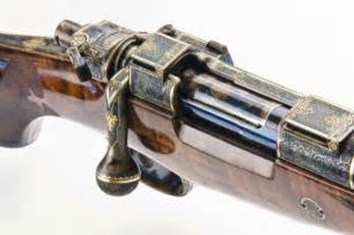
Many German military rifles imported to the United States got the sporterizing treatment from all kinds of gunsmiths from shade tree to highly skilled. A cottage industry of gunsmithing tool and accessory manufacturers popular today owe a large part of their early success to the Mauser 98 and its derivatives, like the 1903 Springfield.
Dozens of countries have used the Mauser 98 for their militaries. Between the military and sporting markets, the Mauser 98 was the most copied rifle platform until Mikhail Kalashnikov’s Avtomat Kalashnikova 47 rifle. The vast majority of bolt-action rifles on the market today can trace much of their lineage to Paul Mauser’s Model 1898 rifle.
Most Popular