From the August, 1938 issue of American Rifleman
For more than thirty years the Ordnance Department endeavored to obtain a satisfactory semi-automatic or self-loading rifle to replace the bolt action Springfield. These efforts were not confined to the development within the Department. Invitations were extended periodically to gun designers in this country and abroad to submit weapons for test, and tests were made of those received which showed any promise of meeting the specifications prescribed.
During this period of thirty odd years many rifles were received and tested. Mechanisms embodying every known principle of operation were represented in the many types submitted.
After many tests of various calibers, it was decided that the caliber .276 cartridge developed sufficient power for a shoulder weapon and that the use of this smaller cartridge would facilitate the design of a reliable and durable self-loading rifle within the prescribed weight limit and would also reduce the load of the individual soldier due to the lighter weight of the cartridge. Of the several rifles in this caliber submitted for test, two were outstanding: the Pedersen; and the Garand, designed and developed by Mr. John C. Garand. Both Mr. Pedersen and Mr. Garand carried on their development work at the Springfield Armory.
A number of each of these types were manufactured and submitted to the services for test. Both rifles performed very well. However, to adopt a weapon of this caliber involved further complication of the supply problem by the introduction of another type of ammunition.
In the meantime, Mr. Garand, who has been in the employ of the Ordnance Department at the Springfield Armory for the past eighteen years as a designer of automatic weapons, completed a test model of a semi-automatic rifle designed to function with either the Caliber .30, M1, Model 1906, or the caliber .30, M1, service cartridge. This rifle appeared so promising in its preliminary tests that decision to adopt the caliber .276 was held in abeyance. The results of continued tests of the caliber .30 weapon were so excellent that the caliber .276 project was abandoned altogether and the caliber .30 weapon as developed by Mr. Garand was adopted as the standard shoulder weapon of our Army. This action was taken in January, 1936.
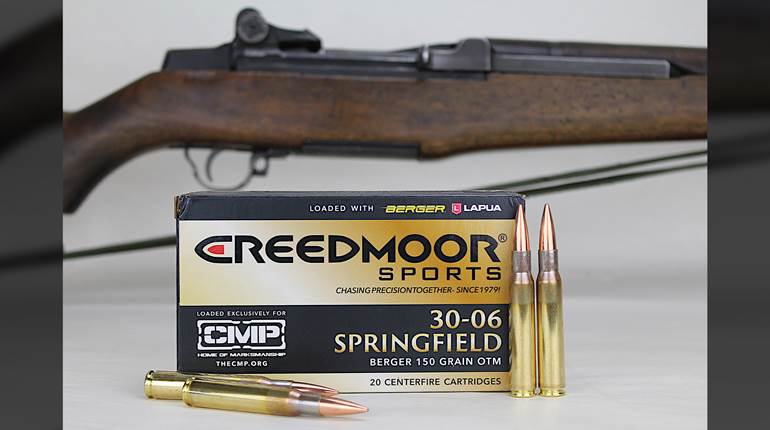
The new rifle, with which our troops are to be equipped, is officially known as the “U.S. Rifle, Caliber .30, M1,” and popularly as the “Garand Semi-Automatic Rifle.” It is of the gas-operated type and employs an en-bloc type of clip holding eight rounds. It varies somewhat from the conventional type of gas-operated weapon in that there is no hole drilled in the barrel is provided with a sleeve and just as the base clears the muzzle, a small amount of gas is diverted through a port at the muzzle into a cylinder where it impinges upon the piston of the operating rod, driving it to the rear. The location of the port at the muzzle rather than at some point nearer the breech permits the use of gas at a lower pressure, thereby decreasing the stresses on the operating parts of the rifle.
The rifle has seventy-two component parts, which include springs, pins and screws; weighs about nine pounds; is forty-three inches overall in length; has a pistol-grip type stock; and provision is made for attaching a bayonet.
The rear sight is mounted on the receiver as close to the eye as possible and is of the aperture being seven-hundredths of an inch. The front sight is of the blade type protected by guards similar to those on the U.S. Rifle, Caliber .30, M1917.
The first production models were completed and delivered to troops in August, 1937. Since that time a small but constant monthly production, limited by the equipment available, has been maintained.
The total number of rifles for which funds have provided to June 30, 1938, is approximately 7500, and it is expected to complete the delivery of these during the current calendar year. For the fiscal year beginning July 1, 1938, funds have been provided for the manufacturer of and additional quantity of rifles, and funds have also been provided to greatly increase the equipment, such as new and more modern machines, tools, jigs, fixtures and [gages], required in the production of this weapon. These additional facilities will permit a much greater daily production rate than is now available.
In the meantime, the rifles which have been delivered to troops continue to give excellent service. Every organization so far equips has submitted enthusiastic reports of their performance under all conditions which have been encountered. Demands for this rifle to replace the Springfield are increasing tremendously as its superiority is realized from actual experience with it. This undoubtedly will result in greatly increased yearly appropriations for the production of larger quantities. Even so, it will take several years to complete the rearming of the Regular Army and the National Guard, and as priority will undoubtedly be given to equipping these organizations, it will probably be many years before any of these rifles will become available for other purposes.
Note: The present Springfield rifle will probably not be declared obsolete and sold at a reduced price for some years to come.—Ed.
Most Popular