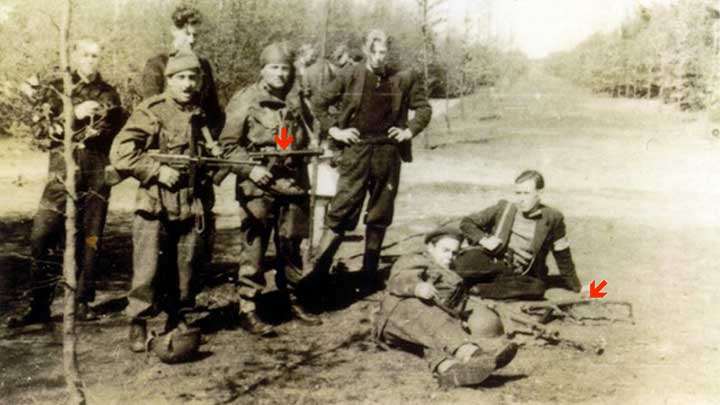
During the closing weeks of World War II, Free French and British SAS troops carried out an operation in the Netherlands code-named Operation Amherst. The mission had the objective of attacking and capturing a series of airfields, bridges and canals in an area 80 miles northeast of Amsterdam. The men who participated in this operation carried two submachine guns– the venerable M1928A1 Thompson and a new design presenting a bold new look.
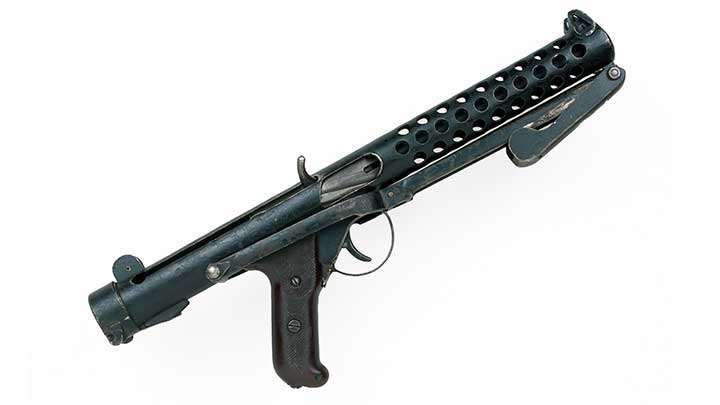
This new submachine gun, featuring a unique under-folding stock and a straight, side-feeding detachable box magazine, can be seen in at least one photograph snapped during a lull in the fighting in Holland. The design came from the mind of George William Patchett, the chief engineer at the Sterling Armaments Company of Dagenham near London.
It fired the 9 mm cartridge from an open bolt, and weighing in at just 6 lbs., lighter than either the Thompson or the STEN gun. Because it was only 18.6" long with the stock folded, the Patchett was more compact as well. In addition to that, it produced greater accuracy than the STEN and used existing STEN magazines.
It was clearly an improvement in every category. But, the Patchetts used during Operation Amherst were from a pre-production batch of just 120 examples, and the end of the war was approaching quickly. With plenty of STENs already on hand and the suddenly reduced need resulting from the post war peace, George Patchett’s new submachine gun was not officially adopted during World War II.
However the end of the conflict did not produce peace or political stability, and the need for weapons remained even after 1945. Consequently, guns produced during the war quickly made their way to the conflict zones of decolonization and to flashpoints of the new Cold War. With that being the case, the United Kingdom was soon in a position to upgrade its small arms in all categories.
In 1951, they adopted an improved version of the Patchett submachine gun under the designation L2A1. Although it looked mostly just like the World War II Patchett, the model that went into full-scale production incorporated a redesigned detachable-box magazine. Since the STEN’s double-column single-feed magazine was less than ideal, the L2A1 was paired with a curved 34-round, double-column double-feed magazine that significantly improved functionality.
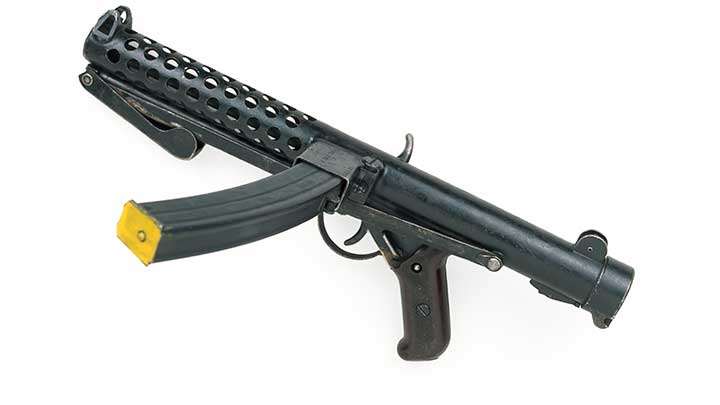
To reduce cartridge friction inside the new magazine, the conventional follower was replaced with a pair of rollers – an innovation that produced excellent reliability. Soon after the gun went into production in Dagenham, the corporate name of the manufacturer began to eclipse the designer’s name and the innovative little 9mm SMG inevitably came to be known as the Sterling Mk. 2.
By 1953, the L2A1 was beginning to replace the obsolescent STEN guns that had fought World War II. By 1955, another modified version was introduced under the designation L2A2 Sterling Mk. 3. Then in 1956, still another modification went into production at Dagenham, the L2A3 Sterling Mk. 4, which would remain in production for the next three decades. In 1966, Sterling produced an integrally suppressed version of the L2A3 under the designation L34A1 Mk. 5 to provide special operations forces with a stealthy entry weapon.
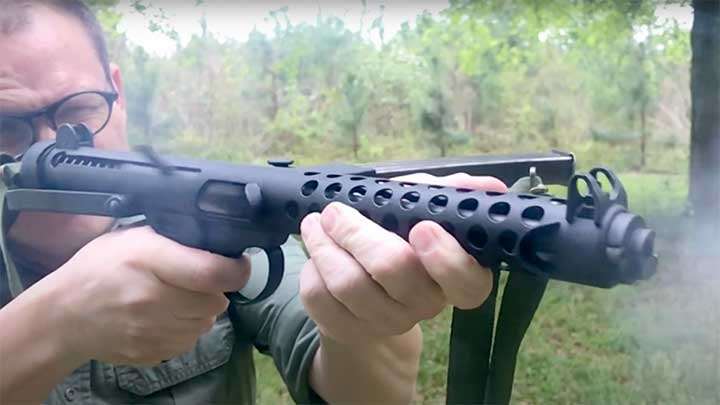
Through the years of its U.K. military service, the Sterling submachine gun stood out as a paragon of rugged reliability. This is the primary reason why it lasted as long as it did in service. During a time when most militaries began turning away from pistol-caliber open-bolt submachine guns, the Sterling soldiered on from the Suez Crisis in 1956, to the Falklands War in 1982.
In fact it was during that conflict that the Sterling fought for both sides, with U.K. troops using the L2A3 and Argentine Navy Commandos using the L34A1. Over 50 nations, from Australia to Zimbabwe, have issued the Sterling to their military forces and police, and in some places the gun continues to serve to this day. In the United States, it enjoys popularity among recreational shooters and collectors. NFA registered select-fire Sterlings are available, as well as a variety of closed-bolt, semi-automatic only pistols and carbines.