The Webley revolver in .455 caliber was first adopted by the British military in November 1887 with the Service Mk I. This new pattern offered many innovations in revolver design. Many experts felt that hinged-frame actions could possibly blow open with the new higher-pressure smokeless cartridges. Changes in the design included a near-solid frame locking device that held up under the most strenuous combat conditions through two world wars.
Of the six standard Webley service revolver "Marks" adopted between 1887 and 1915, Webley made fewer Mark V revolvers than any other, and collectors consider them among the rarest in standard form. The British adopted the Mk V in December 1913, and it represented the last revolver change before the start of World War I.
Twenty thousand were ordered and delivered to the British military, beginning in September 1914. In its standard-issue form, the Mk V had a 4-inch barrel and weighed just a half-ounce more than the Mk IV, which had been in service since 1899. The extra weight was due to the increased mass of the cylinder, which was beefed up to withstand the pressures of non-blackpowder cartridges.
All Webley service revolvers offer the collector a myriad of modifications and markings. Most Mk V revolvers can be found with the standard 4-inch barrels, but there are also 6- and 7.5-inch barrel lengths. A wide variety of military and unit markings aid the collector in making the revolver talk about its rich history and use.
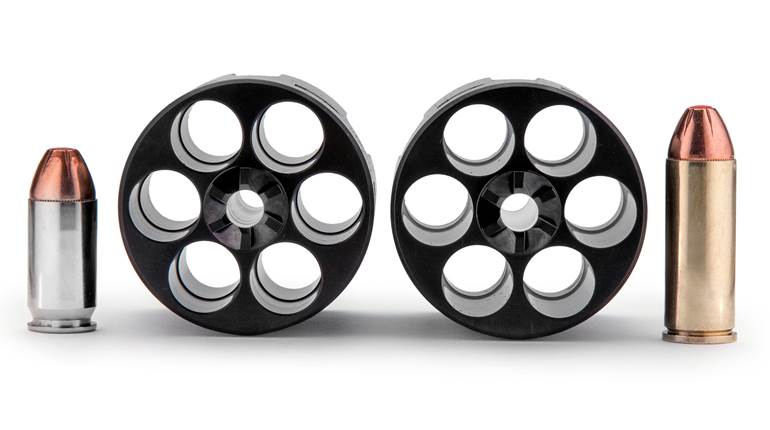
Before the 1968 Gun Control Act prevented importation, tens of thousands of Webley service revolvers were offered in the pages of American Rifleman for prices as low as $19.95. Thousands were cut to accept the more prevalent American .45 ACP cartridge, which was used with half or full moon clips to hold the rimless rounds. This cutting was a relatively easy procedure to perform and involved turning a few millimeters off the face of the cylinder to allow space for the .45 ACP cartridge and its moon clip to clear the frame.
Cut Webleys do not bring the collectors' premium that uncut examples fetch. One can identify a shaved cylinder by inspecting the face of the chambers. The face of an uncut cylinder presents an inspector's view mark, broad arrow and/or inspector's proof in-between the chambers. All Webleys were issued with matching frame and cylinder serial numbers. The cylinder serial number is found on the outer edge of the cylinder side. An uncut cylinder displays a full number without any erosion to the full figure of the number.
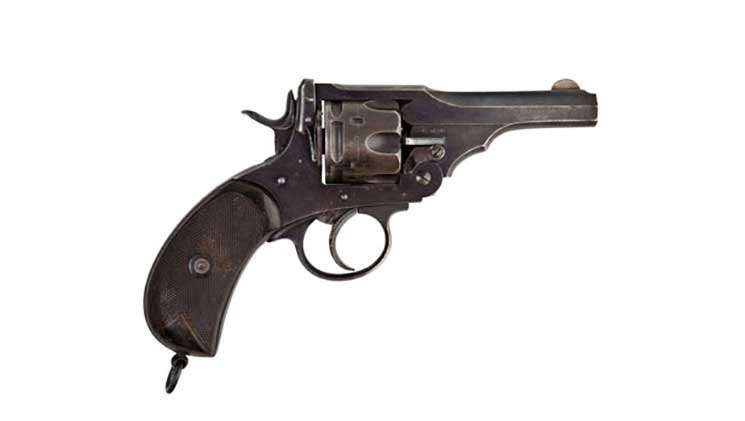
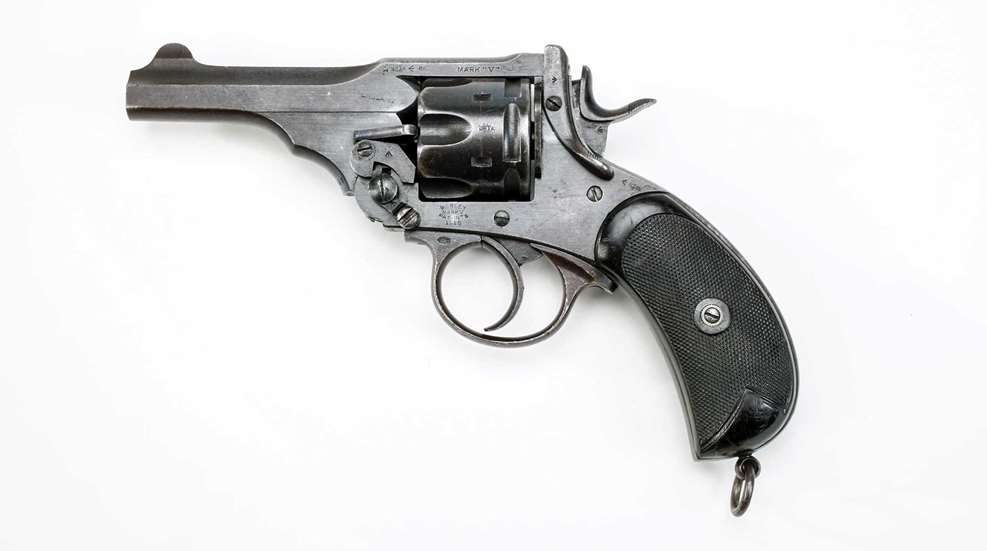
The particular specimen shown above is a standard-issue military revolver marked "MARK V" and dated "1914" on the frame. It is uncut, bearing an official military de-accession mark of two broadhead-tipped arrows closed point to point. A unit marking on the backstrap indicates issue to the 2nd Royal Engineers, and it has approximately 75 percent of its original blue finish. Webley Mk V revolvers were manufactured between 1913-1915 and appear in a serial-number range between 129,900-215,000.
According to the 40th Edition Blue Book of Gun Values, Mk V service revolvers range in value from $500 in 60-percent condition to $1,800 or more in 100-percent condition. Add 10-percent value for 6" barrel service revolvers and 20-percent value for commercial revolvers, distinguished by a "C" in a square box on the left side of the frame.
Related Reading
The Keefe Report: The Guns of "1917"
I Have This Old Gun: Webley Mk VI
Handguns of the Great War: Webleys, Fosberys and Colts
Most Popular