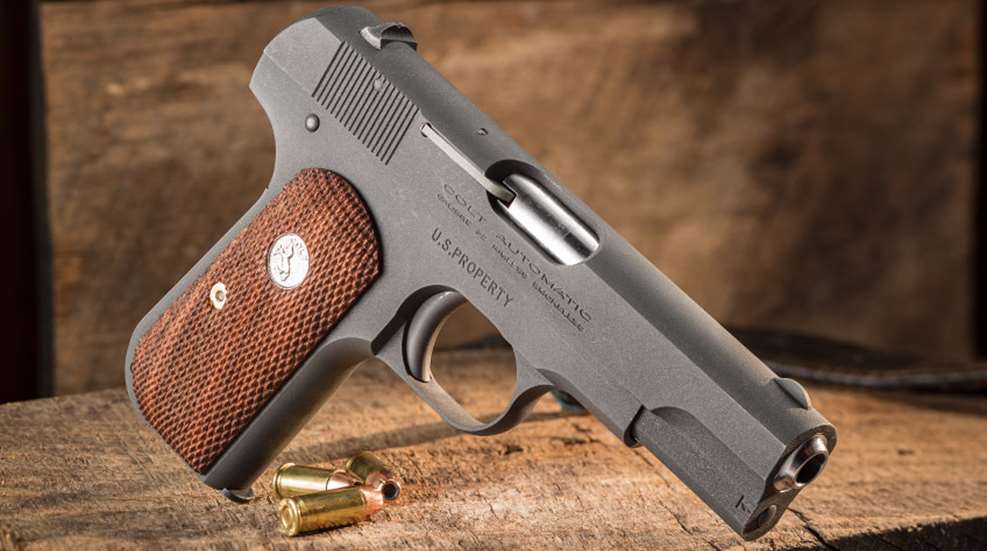
The original Colt Model 1903 Pocket Hammerless hails from the very earliest days of the semi-automatic pistol. It was a time when John Browning and his peers were striving to define how these new firearms—the first guns to automatically re-load their own chambers—should look and act. And while many of these early designs appeared awkward or unfinished, Browning’s 1903 was sleek and efficient. Now, thanks to an arrangement between Colt’s Mfg. Co. and Pennsylvania-based U.S. Armament Corp., modern shooters can purchase a brand new rendering of this classic pocket pistol from the Colt 1903 Re-issue Series at a reasonable price.
Best known for its reproduction of the Bulldog Gatling gun in .45-70 Gov’t, U.S. Armament specializes in the manufacture of classic firearms, and Colt is permitting the company to manufacture a limited quantity of 1903 Pocket Hammerless pistols, complete with original-style Colt markings in either Blue, Parkerized, Nickel or Royal Blue finishes. This gives modern shooters a chance to own one of the all-time Colt classics, a pistol with an immense history as well as contemporary appeal.
The Colt 1903, also known as the Model M, was built from its introduction in 1903 until sometime during World War II. Although that was a century past, the principles and concepts developed by Browning remain sound. In the first 20 or so years of the 1903’s service life it established a clear superiority over its domestic competitors. The guns were favored by police and military users, from Shanghai Municipal Police constables to general officers of the U.S. Army. Even the Office of Strategic Services, the precursor to today’s CIA, had the pocket guns in its armory. And the guns were likewise very popular with the general public, people who wanted them for personal concealed carry—a role for which they were particularly well-suited. And in most ways, they still are.
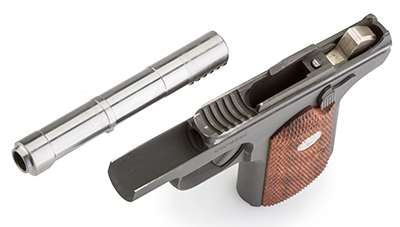
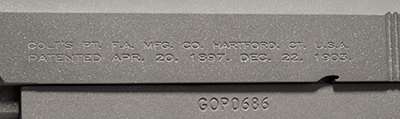
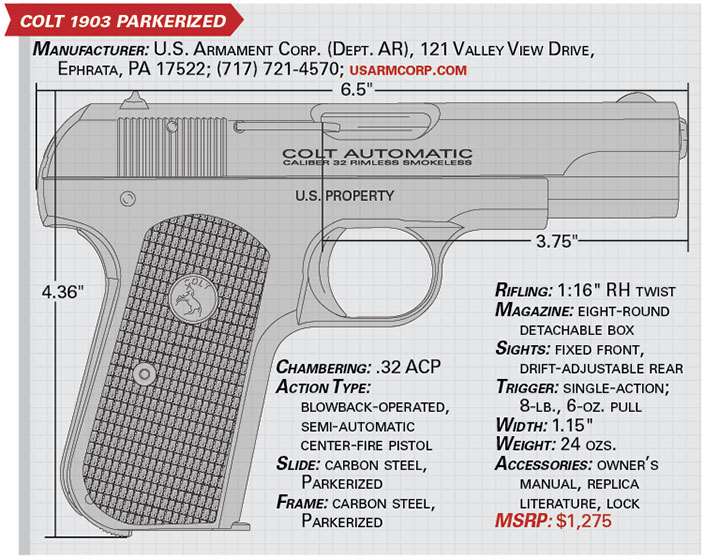
The pistol was chambered in .32 ACP, although a .380 ACP version was also introduced in 1908. Despite its name, the gun was not truly hammerless, as it did possess an internal hammer concealed within the slide. The 1903 offered by U.S. Armament Corp. is a replica in every sense of the world; it wears the same markings as the original guns made under the old blue dome in Hartford. The gun is an all-steel, magazine-fed, semi-automatic pistol that works on the blowback-style operating system. The .32 ACP cartridge works at relatively modest pressure levels, so a locked-breech, recoil-operated design is not needed. This contributes to a generally smaller gun—in this case, one measuring 6.5" long, 4.36" tall and 1.15" thick. The barrel is 3.75" long.
As with the original, the reproduction uses a single-action trigger system, where trigger pressure performs the single function of releasing the hammer to fire, and the hammer is subsequently cocked by the rearward movement of the slide. Made of carbon steel, the new 1903 weighs 24 ozs.
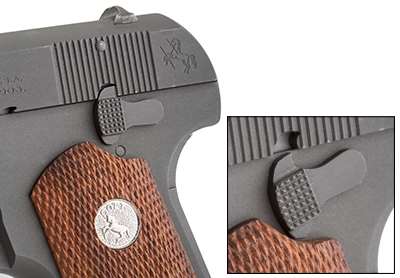
True to the originals, the sample gun, which bore a gray Parkerized finish, had both a thumb safety on the left side of the receiver and a grip safety incorporated into the backstrap. Another historically accurate touch was the magazine catch, which is of the so-called “European” style—mounted in the heel of the butt. Right and left stock panels, made of checkered walnut, sport Rampant Colt medallions. It is an exceptionally handsome little semi-automatic.
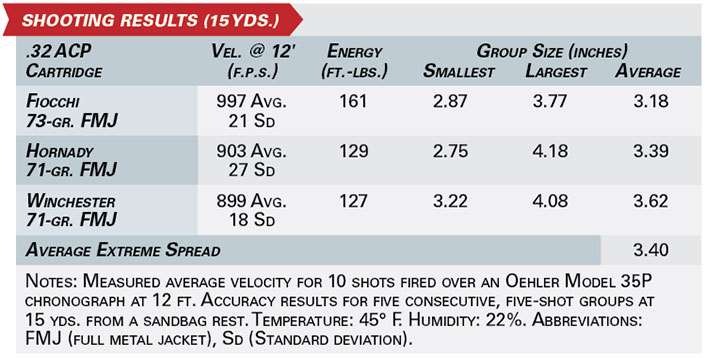
Shooters of a century past must have had superior eyesight, because the tiny sights of this firearm bear little resemblance to today’s relatively huge units. A fixed post front matched with a drift-adjustable notch rear sight, they were very hard to shoot with, which may have contributed to the less-than-stellar accuracy results tabulated nearby. The trigger pull measured 8 lbs., 6 ozs., of pressure after slight take-up, however, fully compressing the grip safety requires a very aggressive grip on the pistol. Given that the Colt Model M was designed to be carried inside a pocket and not in a holster, the extra precaution was probably a very wise idea. Most modern defensive pistols have rounded corners and are devoid of buttons, levers and knobs that might catch while being drawn, and this century-old classic is as snag-free as anything being offered today.
In a very real sense, the Colt Model 1903 Pocket Hammerless was history’s first sensible autoloading pocket firearm, and this reproduction does the original justice. It is a virtually perfect rendering of an American classic.
Most Popular