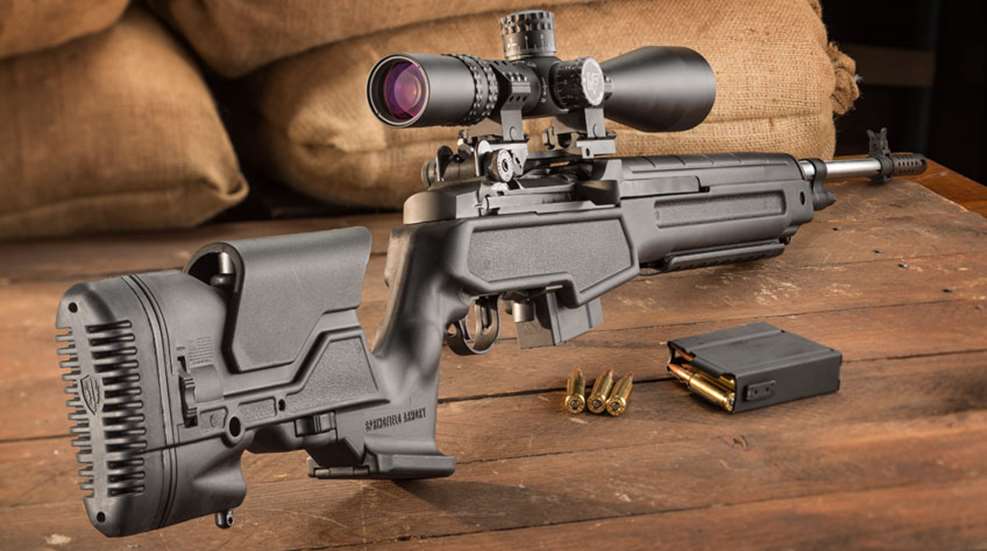
The Springfield Armory M1A is an iconic rifle in the minds of many American shooters. Based on the M14, this semi-automatic rifle is known for its robust construction, long-range performance and its 7.62x51 mm NATO chambering. Though the 7.62 mm NATO cartridge has served the M1A faithfully for nearly five decades, the rifle has been chambered for other cartridges in that family, such as the .243 Win. and 7 mm-08 Rem. In 2018, Springfield Armory announced yet another chambering for its M1A Loaded model: the 6.5 mm Creedmoor. This new combination of the M1A’s time-tested attributes and the 6.5 mm Creedmoor’s ballistic capabilities promise to offer strong commercial appeal.
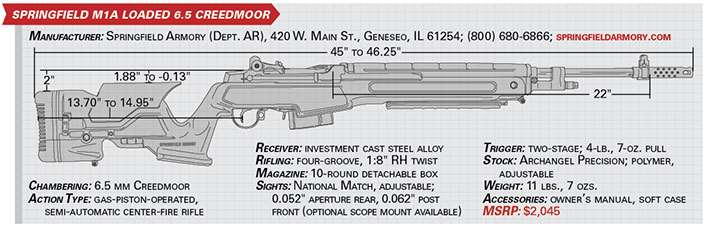
The M1A Loaded 6.5 Creedmoor is available in three different configurations; our test sample was set in the black Archangel Precision Adjustable Stock and had a 22" stainless steel barrel. Like all M1As, it is a gas-operated semi-automatic that feeds from a detachable box magazine. With the exception of the military rifle’s select-fire capability, the M1A’s internals mimic those of the M14 and are very similar to those of the M1 Garand: A gas piston located inside the cylinder below the barrel moves the reciprocating operating rod that, in turn, cycles the rotating bolt inside the receiver. The system is simple, proven and robust. The M1A’s beefy receiver and nearly all of its working parts are made from steel, which makes for a rifle that is both strong and somewhat heavy.
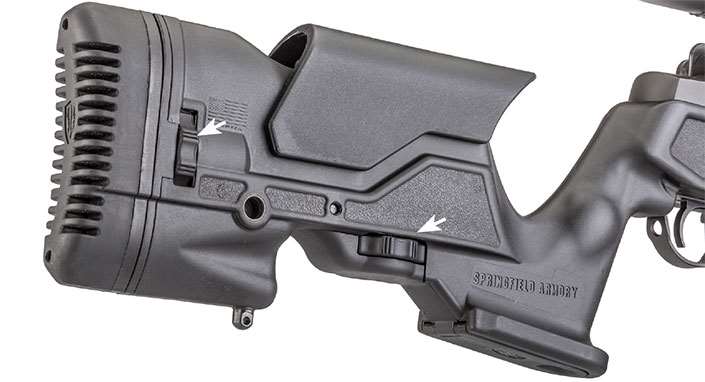
Apart from the new chambering, the most significant feature of our test rifle is the adjustable, black synthetic Archangel stock. Unlike traditional M1A stocks, the Archangel has a nearly vertical pistol grip that is well-suited for prone or bipod-supported shooting. Using thumbwheels, the stock’s length of pull is adjustable by 1.25" to accommodate different body and clothing types, and, similarly, the comb height is adjustable by 2", which allows shooters to achieve proper position and cheek weld, whether they are using the iron sights or an optic. A Picatinny rail, ideal for mounting a bipod or light, is integrated into the 6-o’clock position of the stock’s fore-end and comes with a polymer cover. The stock also allows for some flexibility when it comes to sling mounting: in addition to four flush-cup sockets, two on each side, traditional sling swivel studs are located under the fore-end and at the butt. Overall, this stock is both comfortable and functional.
As part of the Loaded series of M1As, this rifle is equipped with a medium-weight, 22", stainless-steel National Match barrel. The barrel’s 1:8" rifling twist should stabilize virtually any 0.264"-diameter bullet on the market—certainly any that would fit into the rifle’s magazine. A multi-port muzzle brake also serves as the dovetailed base for the rifle’s 0.062"-wide National Match front sight, which is protected by a pair of steel ears. The 0.052"-diameter rear aperture is click-adjustable for both windage and elevation in half-m.o.a. and one-m.o.a. increments, respectively, using the turrets on either side of the receiver. Not only are the sights on the M1A of excellent quality, they can be used even when a scope is mounted.
Operation of this, or any, M1A is relatively straightforward. The steel detachable box magazine is seated into position in the underside of the receiver using a rearward rocking motion. The charging handle, when pulled fully to the rear and released, loads a round into the chamber. A Garand-type safety is located at the front of the trigger guard: The “safe” position is back toward the trigger, and the “fire” position is forward. The bolt locks to the rear on an empty magazine, and a bolt stop on the left side of the receiver can be used to lock the bolt to the rear in other circumstances. The rifle’s two-stage trigger broke at 4 lbs., 7 ozs., with no discernible creep.
Fieldstripping the rifle is a straightforward process, but the manufacturer recommends against disassembly unless it is absolutely necessary so that the relationship between the receiver and stock does not loosen excessively, particularly in the glass-bedded National Match and Super Match rifles. The gas system can be cleaned as part of normal maintenance procedures by removing the gas cylinder plug and piston, and doing so does not require fieldstripping the rifle.
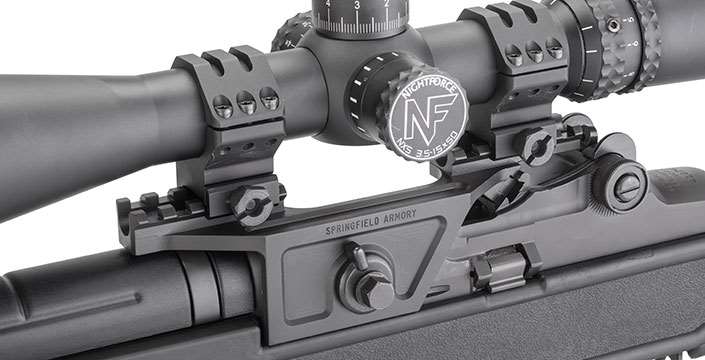
The task of mounting a scope onto an M1A is more challenging than doing so on an AR-style rifle, but far simpler than a top-loading Garand. We used a Springfield Armory scope mount, which is available as an accessory, to secure a 16X test scope to the rifle for our accuracy evaluation. This mount secures to the left side of the receiver using a bolt, and also dovetails into the action just forward of the rear sight.
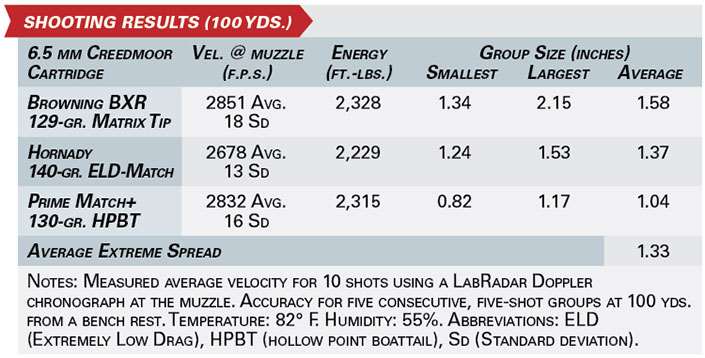
We fired the rifle extensively with three different types and brands of ammunition. Accuracy was good and generally consistent, with Prime Ammunition’s 130-gr. HPBT Match load printing the best five-shot groups with an average of just over 1" at 100 yds. The adjustable stock made finding a comfortable and stable shooting position an easy task, and, thanks to the rifle’s weight and gas operating system, recoil was very mild. We found the two-stage trigger on this rifle to be very conducive to making hits both on paper and steel targets.
We experienced two malfunctions during the course of our testing. The first was a failure to fire caused by a light primer strike (the cartridge in question fired when it was re-cycled through the rifle). The second malfunction was a bit of a mystery, but was most likely caused by an ejecting case impacting the large windage turret on the scope and bouncing back into the receiver, interrupting the bolt as it returned to battery. Both malfunctions cleared easily, and neither appeared specifically related to the 6.5 mm Creedmoor cartridge’s design.
Though the 7.62x51 mm NATO has served shooters and soldiers well for decades, it has its limitations. The 6.5 mm Creedmoor offers superior performance in terms of both wind drift and trajectory, and affords a noticeable reduction in recoil. At extended ranges, its long bullets with high ballistic coefficients have a clear advantage over the 7.62x51 mm NATO. The M1A Loaded 6.5 Creedmoor combines all of the attributes that have kept this enduring design relevant while offering increased ballistic performance. This additional chambering should be a welcome update for fans of the M1A, particularly those who shoot at longer distances.
Most Popular