Marble Arms Celebrates 125 Years

by
posted on December 11, 2017
** When you buy products through the links on our site, we may earn a commission that supports NRA's mission to protect, preserve and defend the Second Amendment. **
sightr.jpg

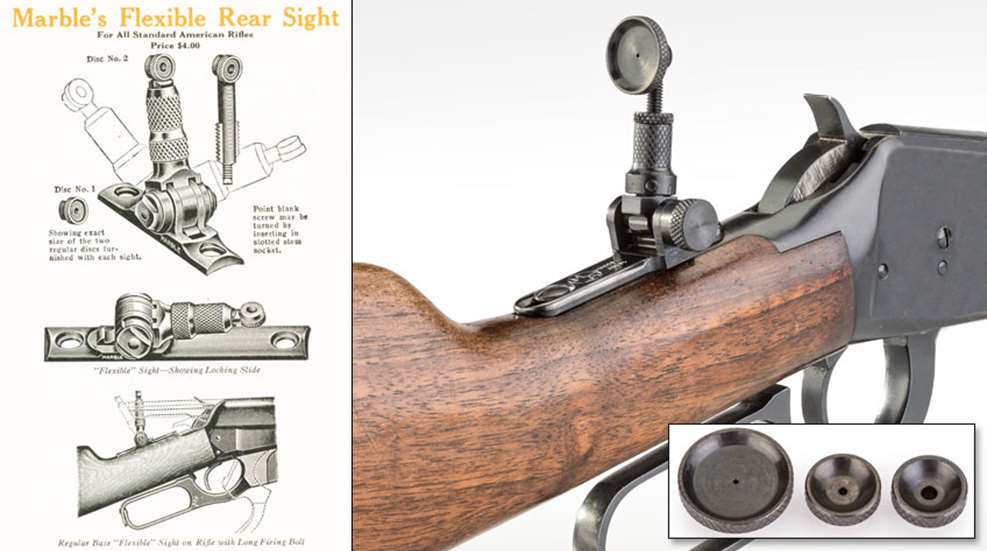
It was 1892 when Webster Marble began manufacturing his Universal Rifle Sight, in the original Marble Arms & Mfg. Co.’s Gladstone, Mich., factory. Made on turn-of-the-century, belt-driven equipment by skilled craftsmen, the unit was a beautiful tang-mounted affair that increased sight radius and provided the shooter with an aperture nearer to the eye that allowed quick and intuitive centering of the front sight.

According to the company’s official history: “By 1905, Marble’s tang sight was available in 37 sizes to fit Winchester, Marlin, Savage, Stevens, Remington, Colt, Hopkins and Allen, and Ballard rifles. Marble quickly added more sights to his line: a Standard post and bead along with the patent Triple Bead in 1904, Marble’s Reversible in 1906, the Simplex (a lower priced tang sight for .22s), an array of Sheard’s Gold sights in 1907, the Duplex with flip-up bead in 1913, the Vickers Maxim globe sight in 1916, and elegantly fashioned ivory and Pope’s Island Gold shotgun sights.” In the years that followed, Marble would also become famous for a variety of other items, including its Game Getter firearm and the Safety Axe.

The company is still in business today, manufacturing firearm sights under the Marble name in Gladstone, and it even still makes beautifully finished tang sights, like the one shown here, for all manner of antique and modern reproduction rifles. It also supplies a wide array of modern sights as original equipment for numerous well-known pistol and rifle makers. To read the complete company history, and to explore the full portfolio of Marble products, visit marblearms.com.

Latest

Federal 7Mm Backcountry Rifleman Review 2

Federal Signs Agreement With U.S. Army to Improve Ammo Performance

Federal Ammunition announced this week that it has entered into an agreement that allows the U.S. Army to utilize its patented Peak Alloy ammunition case technology for use in multiple cartridges and weapon systems.

Four Armed Citizen Stories That Tell us a Lot

Each self-defense case is different. As we read them, we find ourselves wondering what we would have done, and then asking if the citizen made the best decisions possible in the worst-case scenario.

The Three Rs of Performance Shooting: Rise, Return & Realignment

Way back in the day, the three Rs of learning were colloquially known as "Readin’, Rightin’ and Rithmatic." In today's modern performance shooting, the three Rs become Rise, Return and Realignment, the core mechanics of recoil control.

Subsonic Ammo 101: Everything The Suppressor Shooter Should Know

Slower-than-sound rounds are an art as much as a science. For target shooting, bullet upset is not important, but if you’re using subsonic loads for hunting or self-defense, it becomes critical.

I Have This Old Gun: Model 1874 Gras Rifle

Following the Franco-Prussian War of 1870, the French military were in desperate need of a new service rifle. Their answer was the Model 1874 Gras, which was largely an update to the earlier Chassepot design.


Compact & Quiet: CMMG's ZEROED Banshee

CMMG has expanded its Banshee line of AR-style rifles with the ZEROED, a firearm that is optimized for suppressor use.

Interests


Get the best of American Rifleman delivered to your inbox.