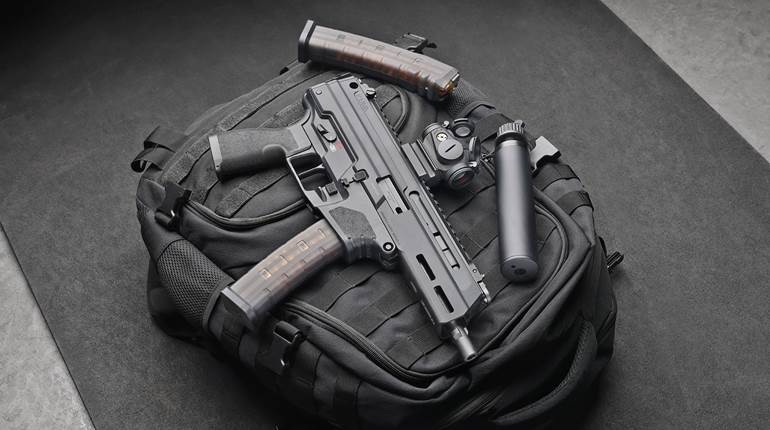
There is a variation of the basic pistol that is worthy of a quick look, but is a variation that most of us will never fire, much less own. It’s called a machine pistol, which means a full-auto pistol—illegal without federal registration and tax stamp. Less there be confusion in terminology, understand that the abbreviation MP is sometimes used to describe them, but the Germans use that same abbreviation to describe the submachine gun—MP38, MP5, etc. In common use, the submachine gun is a compact full-auto firearm that fires pistol cartridges. It has a buttstock for support and is very effective in trained hands. In most cases, submachine guns are not easily concealed. Machine pistols, on the other hand, are full-auto guns firing pistol cartridges and having fairly concealable characteristics. More often than not, they do not have stocks or other support devices. I do not believe the machine pistol has characteristics that make it an effective firearm for anything but highly specialized roles.
The basic problem with this type of firearm is simple. Pistols light enough to be carried (2 to 3 pounds) produce recoil that raises the gun’s muzzle upon firing. Second and subsequent shots only increase the recoil and muzzle rise. Even a short burst usually drives the gun well off target. Much of the time, all but the first shot is a miss. You get much noise with repeated shots, lots of muzzle flash and golden streams of brass in the air, but only an occasional hit. You could slow down the rate of fire with more mass to the recoiling parts or more strength to the recoil spring, but there are limits to this approach. One of more familiar versions of the machine pistol is the C96 Mauser in the later Schnelfeuren version. I fired one of these once and found it tough to manage. My late pal, Chuck Karwan, chuckled when I repeated this story, and commented on the utility of the Spanish Astra copy. The gun’s designers worked a rate-of-fire reduction system into the searage, making it much easier to shoot. In handgun history, there have been several machine pistols that have enjoyed modest popularity, such as the Mac-10, Beretta 93R, HK VP70Z and the Russian Steckchin. In prowling around references for these things, I found information on several makers who tried to improve full-auto firing by using less powerful ammo—.380 Auto, .32 ACP and even .25 ACP.
As much as the concept seems attractive to modern firepower enthusiasts, it just never went much of anywhere. While they are certainly powerful enough in most versions and the designs are usually acceptable, the guns are so hard to control as to make them impractical. They’re ingenious solutions to imaginary problems. However, I did encounter a bit more grudging approval for one model in my casual telephone surveying. Originally conceived as a dignitary protection firearm, the Glock G18 can be managed fairly well with practice. They are still made.
Most Popular