In the Marine Corps, we grew accustomed to the term “snapping in,” meaning practice firing without the use of ammunition, or dry firing. In view of the cost of ammunition in these troubled economic times, many of us are forced to dry fire in order to develop handgun marksmanship. I have personally spent hundreds of hours in dry fire, and have developed basic competence with the pistol, maybe a little more. It makes me wonder what might have happened if I had spent thousands, but I digress....
I am absolutely certain that this is a necessary part of the game. I would go so far as to say that if I were given unlimited ammo to teach a group of neophytes, I would still use dry firing as part of the instructional program. There are skills to be learned with an empty gun that cannot be learned with a loaded one. Buz Mills' Gunsite Academy still assigns students night homework of snapping in and gives them emphatic instructions on how to do this safely. Basically, they are taught ways to self-emphasize shooting in safe directions and always, always, ALWAYS with an empty gun with no ammunition anywhere near the gun.
Dry fire practice needs to be done in short, intense periods of no more than 20 minutes long. No distractions permitted—TV, radio, conversations, etc. Never snap in at a mirror or at the TV set. An improvised target is OK. Much can also be learned by dry-firing at a blank piece of paper. When the allotted time is over, put the gun away and cease all practice. This is usually the time when the Negligent Discharges occur. A budding shooter gets to thinking about it and wants to do a few more cycles, but forgets (a) he reloaded the gun and (b) he always needs to perform a press-check. There is something important to be learned and formed into habit by perfect dry fire practice.
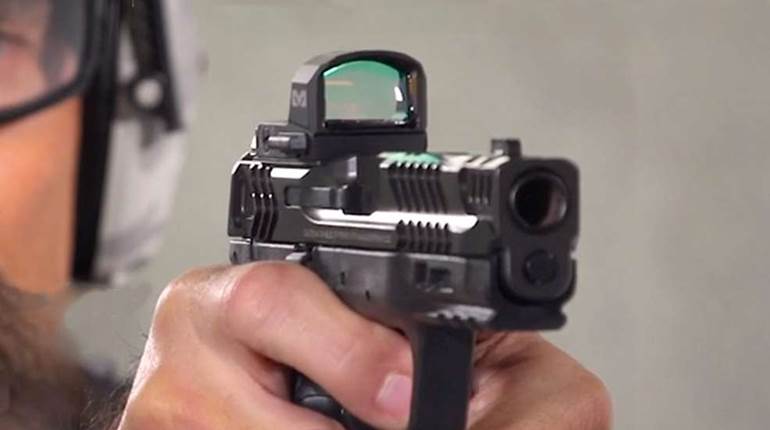
Do it like this. Check to be sure there is no ammo in the room where you will spend a focused quarter hour of practice. Pick up your service handgun and ensure it is not loaded. Assume a firing grip, cock the action, take a deep breath and aim in on your point. When sight alignment and sight picture are perfect, apply straight-back pressure to the trigger until the hammer or striker drops. Hold the trigger all the way back and slowly release to the point where the action resets for another shot. On many guns, this can't happen until you re-cock the action. Think perfect sight alignment and repeat.
I also recommend an additional extension of the basic dry fire cycle. Do about five reps of this one at the end of your session and do it with a blank target. Everything is the same until the hammer falls. At this point, continue to hold the trigger back with the sights in perfect alignment. Hold the gun steady, sights aligned and trigger back, until it becomes uncomfortable, almost painful—no less than a minute. This drill develops the muscle groups necessary to hold a heavy pistol still. It also develops patience and the ability to work the trigger. The last step before you lower the gun and rest the aching muscles of your arm is to reset the trigger and resume proper sight alignment. When shooting live, any given shot ends with proper trigger reset and a new sight picture, not when the hammer falls. Shooting multiple shots is a linked chain of events always ending in reset and re-align.
Most Popular