Tactical holsters include such a variety of styles, materials and features that the term is almost too broad to define. Unlike other general classifications such as inside-the-waistband holsters, shoulder rigs or ankle-carry designs, tactical holsters can’t be pigeonholed based on where on your anatomy they’re worn.
So what is a tactical holster? In a nutshell, a tactical holster securely retains a handgun that’s intended as a secondary, not a primary, firearm. Now, before we go too far with this definition, we bump into pocket holsters and ankle rigs that also carry a back-up pistol, but the difference is that a back-up pistol is normally used in the context of the primary weapon also being a handgun. Police Officers often carry a J-frame in a pocket or on an ankle in case they lose their primary sidearm.
But in the case of the tactical holster, the primary is a long gun, not another handgun, invariably of military or SWAT persuasion such as an AR, MP-5 or combat shotgun. The tactical holster, then, exists to fill in when a long gun goes down from a malfunction, runs empty or can’t be accessed for whatever reason.
Resorting to a handgun when a long gun fails is known as a “remedial action drill,” and it’s practiced strenuously by anyone who trains for close-quarters battle (CQB) be they police, military or armed citizen.
Archetype Holster
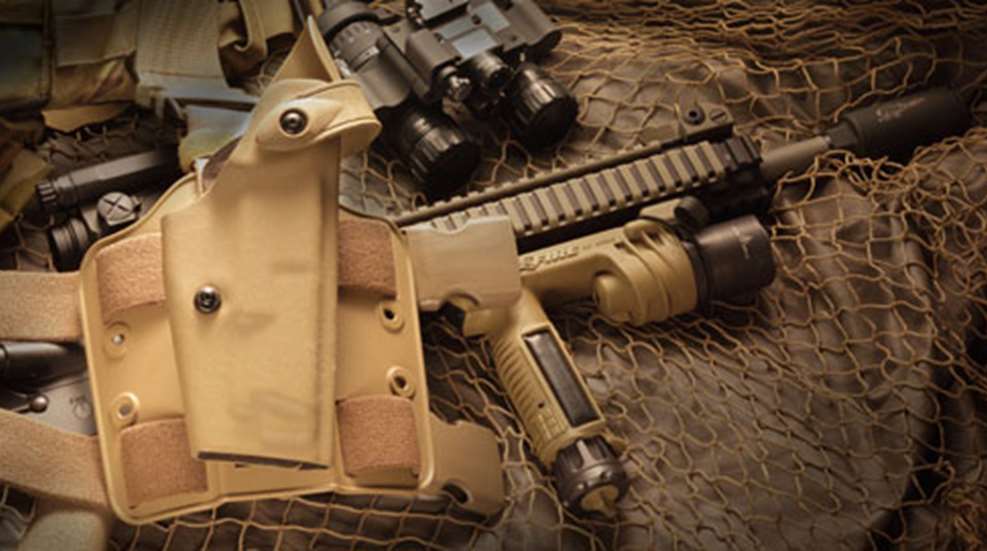
Until the War on Terror began and we learned some interesting lessons in the sandbox about holster placement, it used to be that a tactical holster was synonymous with several terms that all mean the same thing: drop-holster, thigh-holster or leg-holster. The archetype is the Safariland 6004, which is worn on the thigh, level with your shooting hand as your arm hangs naturally at your side.
The 6004 (pronounced “six-double-oh-four”) comes with a wide, U-shaped plastic backing that matches the contour of your quadriceps. A retention holster is attached to the backing and the whole thing is suspended, or “dropped,” from a strong belt by a length of nylon webbing. The backing also features two elastic straps that encircle your thigh snuggly and keep the holster from shifting.
It’s widely assumed that the thigh-holster’s placement is to drop the gun down and out of the way of body armor, but that’s not true according the inventor of the tactical holster, Bill Rogers of Safariland. Bill told me that he designed his first thigh holster for a Navy SEAL who needed a holster that wouldn’t interfere with a high-speed pick-up at sea from a Zodiac watercraft.
“A belt holster would snag on the gunwale as the operator tried to roll into the boat. I worked with a Navy SEAL and came up with the idea of dropping the holster down onto the thigh so it wouldn’t interfere,” Rogers said.
The result eventually became the Safariland 6004, which, if there was a Holster Hall Of Fame, would be the first entry into the tactical section. It’s by far the most popular of any tactical holster out there, and is issued to military and law enforcement by the tens—if not hundreds—of thousands.
Chest Rigs
We could stop right there and leave the rest of this treatise on tactical holsters to nothing more than a quick rundown of different versions of thigh rigs, but it’s not that easy. Going back to our definition that a tactical holster serves to provide a remedy when a primary long gun can’t be used, we find another circumstance in which a handgun needs to be accessible—inside a vehicle.
Operators in Iraq and Afghanistan have found not only an urban battlefield with tight alleyways, narrow streets and cramped confines, but also a war conducted from vehicles such as HUMVEEs, Strykers and even Chevy Suburbans. Roadside ambushes are the primary weapons of the enemy and often troops have to fire immediately upon exiting a vehicle.
Even a short-barreled carbine like an M4 (14.5-inch barrel) or Mk 18 (10.5-inch barrel) can snag and otherwise be slow to deploy from a vehicle, so operators began to wear a holster attached to their body armor, usually in a cross-draw position at chest height.
I have considerable qualms about chest-mounted holsters because it’s impossible to draw from such a rig without “sweeping” (pointing the gun’s muzzle) at some part of your body. Be that as it may, if I were on a personal protection detail in the sandbox and knew that my blacked-out Suburban could be attacked suddenly and viciously, I would wear a chest-rig inside the truck. I’d just be double-darn careful about drawing my pistol—finger out of the trigger guard, safety on.
Chest holsters are almost universally made of Kydex or molded plastic. Eagle Industries makes a line called the G-Code that can be ordered with a special mount to attach to the PALs webbing of military body armor carriers. It’s an excellent rig for this type of use.
Belt Holsters
I was once a model on a “tactical” photo shoot where I was wearing a Safariland 6004 thigh-holster among other “high-speed, low-drag” gear. Another of the models was an active duty Navy SEAL from Coronado Island, home to the West Coast SEALs. He ribbed me mercilessly about my “tacti-cool” holster, saying no one in the “teams” wears a drop-holster anymore.
“Dude, that thing will snag on everything. I’m telling you dude, no one wears a pistol on his thigh anymore,” the SEAL snickered.
Duly embarrassed, I endured his jibes for the rest of the photo shoot, but it was all good natured. He explained that, if you think about it, body armor barely comes down to waist level, so there’s no need to drop a holster onto your thigh where it scratches against walls, whacks into furniture and snags on anything sticking out. Instead, the SEALs wear their SIG P226s on belt holsters.
Seated in a vehicle, a belt holster is less likely to hang up when exiting. It’s faster to draw from because it’s the same practiced motion that you’ve done countless times, instead of a relatively alien position on your thigh. I was convinced.
“While you’re at it, dude,” said the SEAL, “Shed all that other junk you got on. The only things we carry are water, bullets and comms [a radio].”
So how does a conventional belt holster differ from a tactical belt holster? Rather than say what it isn’t, I’ll say what it is: made of Kydex, often brown in color, secured with a strap or tight pressure fit, usually on a belt attachment that slightly lowers the ride of the holster—like a “low ride” police duty holster. A number of makers offer suitable rigs such as BladeTech and Safariland.
Other Options
So back to a tactical holster that’s not even worn. I refer to a vehicle-mounted holster. Because of the high incidence of road ambushes, some tactical practitioners in either body guarding work or military occupations carry a handgun in a Kydex holster secured under the dash, on the door, next to the driver’s seat or otherwise immediately accessible.
The tactical holster has evolved during The War on Terror because of the tight confines of CQB on an urban battlefield, otherwise known as “military operations on urban terrain” (MOUT). If we enter another conflict with different requirements, the tactical holster will morph to fit those needs. That’s the great thing about tactical gear—it’s always improving.
Most Popular