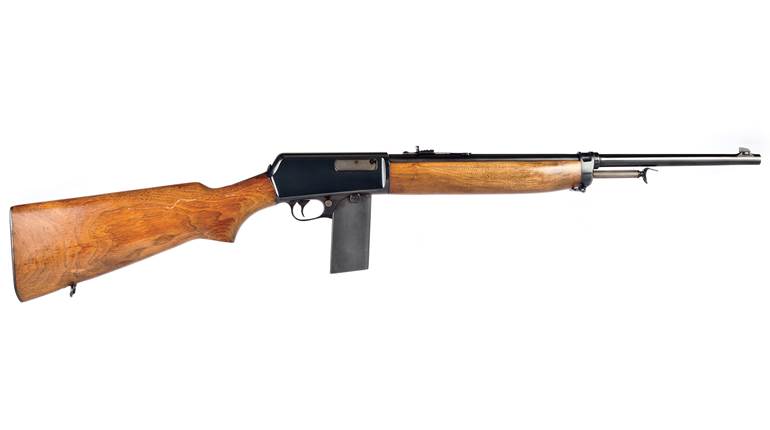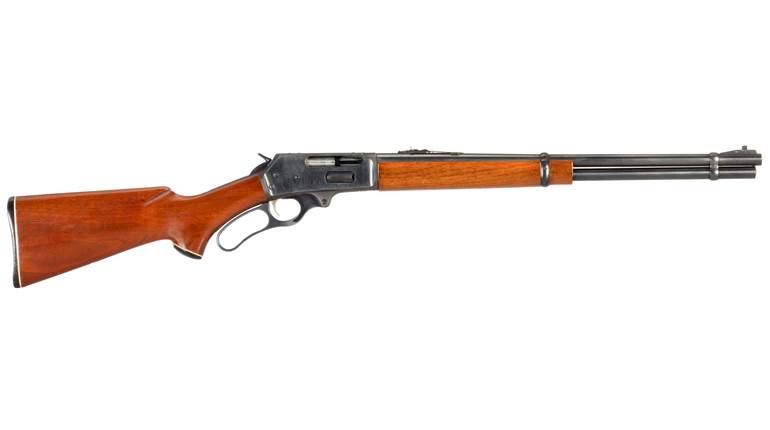
In 1958, as a junior NRA member, I read an article in American Rifleman announcing the discontinuance of the Winchester 71, thus ending a 23-year legacy with 47,254 rifles produced. I still recall the writer referring to this lever-action as “businesslike”—an apt description.
The Model 71 began as the John Browning-designed Model 1886, but the beefy big-game rifle was updated and reintroduced as the Model 71 on Nov. 2, 1935. The fortress-like receiver, with twin vertical locking bolts that slid into both sides of the bolt, was retained, and with improved metallurgy the action was simplified and strengthened. Plus, flat springs were replaced by coil springs, the crescent buttplate became a checkered flat configuration (with optional recoil pad), and checkered, varnished stocks had pistol grips and semi-beavertail, steel-capped forearms.
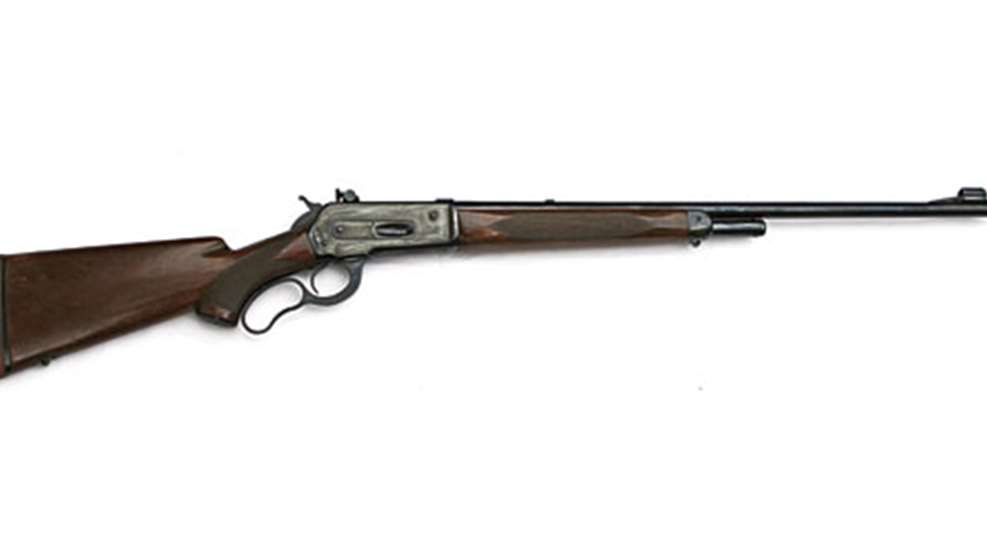
A tubular four-shot, three-quarter magazine and 24-inch barrel with hooded ramp front sight were standard. Purchasers had a choice of a semi-buckhorn Lyman 22K open rear sight or a bolt-mounted peep, which was changed post-war to a Lyman Number 56 peep fitted to the receiver. But most dramatic was the proprietary new chambering of .348 Win., the only standard chambering for the Model 71. This “deluxe model” was augmented from 1936 to 1947 with an uncheckered 20-inch barrel “carbine” variant without the pistol grip cap. Guns up to approximately serial number 15,000 sported “long tangs” that measure 3 7/8 inches. Subsequent rifles had so-called “short tangs” that measure 2 7/8 inches.
This Winchester 71, made in 1948, is a “short tang” deluxe model with factory Lyman 56 peep, and it has been professionally restored. Unfortunately, the stock, with period Noshoc recoil pad, bears some hunting scars. Even so, this 95 percent rifle, which was purchased for $125 in the 1970s, has a value of $1,200. Were it all original in this condition, it would easily fetch $1,800 to $2,000.
Caliber: .348 Win.
Condition: 95 percent (NRA very good, as restored)
Manufactured: 1948
Value: $1,200
Most Popular