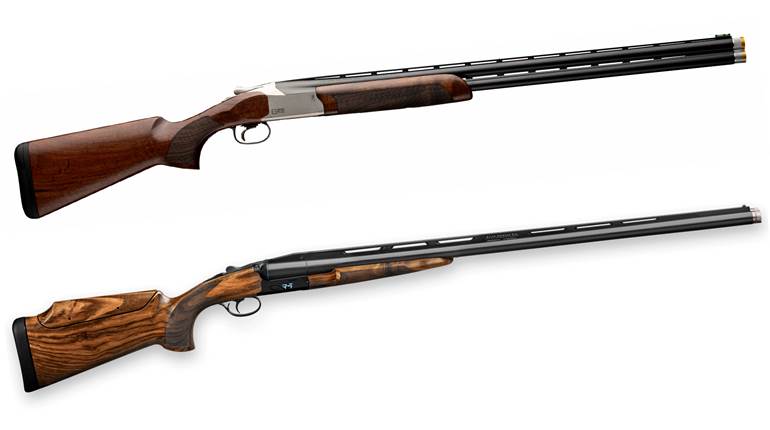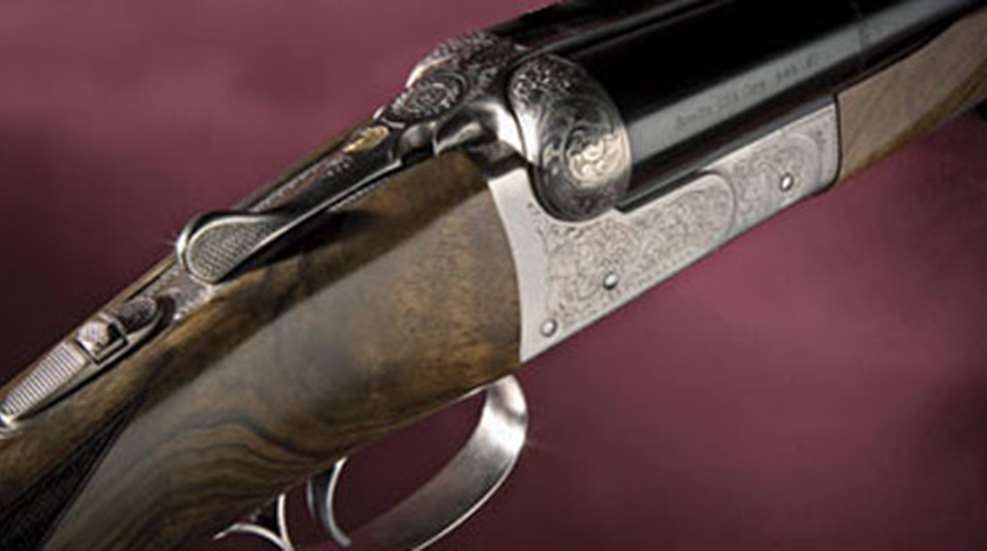
When it comes to side-by-side shotguns, there are basically two schools of thought regarding stock design: a straight wrist and splinter fore-end in the English style or a pistol grip stock and a beavertail fore-end in the American fashion. Mind you, there are variations on these themes, such as semi-beavertails and Prince Philip grips, but most guns fall into the two aforementioned general categories. Thankfully, Beretta offers its Model 471 Silver Hawk side-by-side in both variants.
The 470 was released in Europe in 1996 to commemorate the firm's 470th anniversary and made it to the States in 1997. It has since been updated with new features and finish options under the Model 471 designation. We elected to evaluate the pistol grip-equipped 471 in 12 gauge.
The Silver Hawk is a boxlock, in which all the fire-control parts are attached to the action. The receiver is of nickel-chromium-molybdenum steel with an attractive satin-nickel proprietary finish. The receiver's sides have half, false sideplates machined as a part of their contours. Both sides-as well as the underside-feature tasteful, hand-chased scroll engraving. The bolsters, too, have deep scroll engraving, and the nickel trigger guard exhibits modest scroll ornamentation as well.
Lock-up is by the proven Purdey double-underlug method-with a slight twist. Beretta angled the lugs slightly to keep the gun tight even as surfaces wear. The lugs are manufactured by electric discharge machining (EDM), and the barrels are fused to the monobloc with a laser-making this classically styled side-by-side utterly modern in its manufacture. The surfaces of the breechface and receiver under the barrels are jeweled.
The barrels are cold hammer forged, and the 3-inch chambers are chrome-lined. Beretta's interchangeable Optimachokes came with our sample, and the 2 3/4-inch-long tubes feature an elongated cone for the choke constriction. The exterior bluing of the barrels is smooth and even.
The stock is of European walnut with a semi-gloss finish, and our sample exhibited nice figure on both sides. The stock's wrist and fore-end are hand-checkered in a 20-line-per-inch, bordered point pattern with only a few flattened points and no overruns. Wood-to-metal fit was excellent around the trigger guard, but left intentionally proud at the receiver and fore-end.
The butt is topped by a blue Beretta Gel-Tek recoil pad, which has a silicon center to better distribute recoil. The outside surface is smooth, and a slight radius at its top makes the pad unlikely to hang up on the shooter's clothing as the gun is mounted. Two lugs projecting from the rear of the buttstock engage recesses in the pad's interior. When the wire retainer at its bottom is pulled down, the pad slips off easily – allowing replacement with a pad of a different size or color.
An Anson push rod serves as a retainer for the fore-end. Depressing the grooved button at its front moves the retaining iron out of engagement with the fore-end hanger. A small, white metal diamond-shaped insert is visible on the fore-end's underside within the checkering and serves as a retaining nut for the fore-end iron. Interestingly, a small selector mounted in the fore-end iron's left allows the shooter to choose between selective automatic ejection or extractors only.
As befits a gun with a pistol grip stock, the Silver Hawk has a single, selective trigger, which has an inertial block that sets the second barrel to fire. The steel trigger blade is left in the white, and it broke at 4 lbs., 12 ozs. for the right barrel, and 5 lbs., 12 ozs. for the left. Barrel selection is made via a button mounted on the tang safety. Pushing it to the left reveals a single red dot, and the right barrel fires first. Pushing it to the right selects the left barrel, and two red dots are revealed. Operating the selector moves the inertial block into engagement with the selected sear, even if the gun is already cocked.
Pressing the automatic safety forward disengages it. Moving the top tang lever to the right withdraws the two locking bolts to the rear, allowing the gun to be opened.
The Silver Hawk was function-fired at Shady Grove Hunt Preserve and Sporting Clays in Remington, Va., with 2 3/4-inch Federal and Winchester loads and patterned at 40 yards. The 471 proved surprisingly lively for a gun with this style of stock and fore-end. Its 28-inch barrels aided a smooth swing and follow through. Once it was moving with the bird, the 471 was steady and smooth.
While straight stocks and splinter fore-ends are preferred by many upland hunters, others, including dove hunters and waterfowlers, like the reassuring weight and feel of a beavertail fore-end and pistol-grip stock. Those looking for an American-style stock in a modern, quality side-by-side with enough ornamentation to impress their friends in the field or blind (without being ostentatious) need look no further than the 471 Silver Hawk.
Most Popular