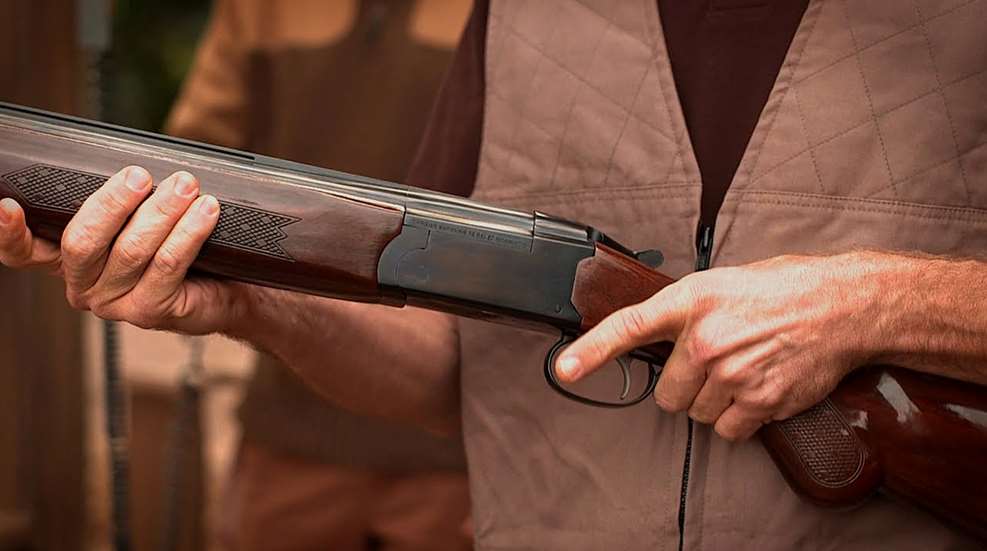
Stoeger’s Longfowler is an old-school side-by-side shotgun whose new owner isn’t going to shed any tears if it gets beat around a boat, blasted with salt water or even temporarily dropped into a muddy marsh. Nostalgic, perhaps, but describing the Longfowler as anything but utilitarian is like calling Boom Boom Mancini beautiful.
Stoeger is owned by Beretta Holdings but operated by Benelli USA out of its Accokeek, Md., offices. Known for reliable, price point autoloading and over-under shotguns, the company saw room for a working man’s side-by-side; a throwback to utilitarian fowling guns reminiscent of white-capped and duck-cotton days past, when a bag of ducks meant good fun and food for the family.
To achieve its sub-$500 price, Stoeger sourced its Longfowler 12- and 20-ga. guns from Brazil, as indicated by the “E.Z. Amantino” etched into each receiver. Located in Brazil’s southernmost state, Rio Grande do Sul, E.Z. Amantino is a 59-year-old gunmaker that markets its own guns and also produces products for international arms sellers. Employing 270 workers, it makes about 6,000 shotguns per month, many of which are shipped to Stoeger Industries.
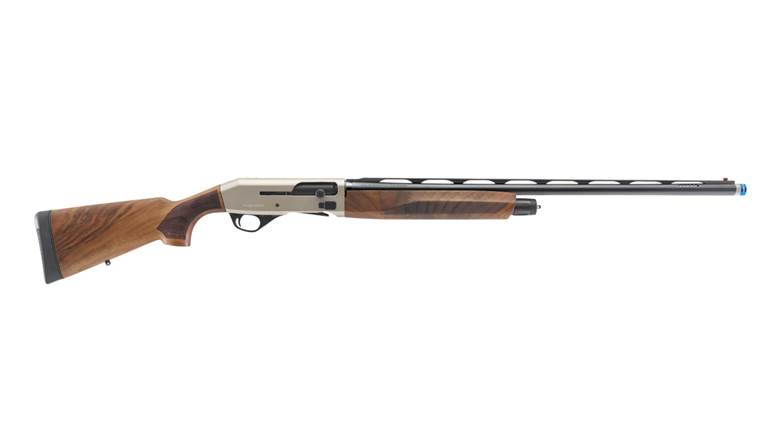
The 12-ga., 7-lb., 8-oz. Longfowler is essentially a modified version of its Uplander Supreme shotgun. Modifications include a single trigger rather than double, 30" barrels, extended choke tubes and a dull matte, corrosion-resistant finish rather than bluing. Mechanically it’s identical.
Its classic box-lock receiver is investment-cast, finished by CNC-machine and then hand-fitted to the barrel unit. The action is cocked by leverage applied to the cocking arms via the Anson-style fore-end anchor as the gun is broken open to load. Within the action, mechanical-style trigger sears connect to a single, non-selective, investment cast trigger that fires the right barrel first. The trigger pulls measured 6 lbs., 4 ozs. and 9 lbs., 11 ozs. for the right and left barrels, respectively. They are prevented from firing by an automatic tang safety, measuring 1" in length. It is ridged and serrated for purchase even while wearing gloves on extreme weather “duck days.”
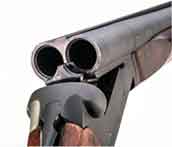
The shotgun’s barrels are attached to the receiver by a monobloc system common to many side-by-sides. Dual lumps forged integrally to the 3" chambers feature underlugs that give the Longfowler robust strength to handle magnum loads, as does the fore-lug’s hook that rotates on the receiver’s 1/4" trunnion. A 2"-long, spring-less steel rod runs through a channel bored under the lumps to push the extractor from the chamber face as the action is opened. The Longfowler has no ejectors, so spent shells must be manually plucked from their chambers and discarded. But because litterers are rightly looked down upon these days, modern waterfowler-conservationists won’t mind that. Tests with multiple plastic-hulled shells from different makers resulted in no empties that were overly difficult to remove.
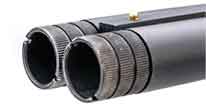
The Longfowler features 30" barrels made of SAE 1045 steels that are threaded to accept choke tubes. The gun comes with modified and improved cylinder tubes that extend 0.80" beyond the barrel ends and are knurled for easy hand-removal. A 3/8"-wide serrated rib rides in the seam atop the barrels and is studded by a single brass bead a half-inch from its termination. It provides ample sight plane, which side-by-side shooters generally prefer. Underneath, a vented barrel separator is brazed onto the barrels to lend rigidity. A lump brazed aft of it provides the stud onto which the fore-end is attached.
Measuring a full 2½" wide, the A-grade walnut beavertail fore-end certainly lends as much grip area as it does credence to its name. It is removed via a spring-loaded Deely and Edge latch that is pulled rearward by a fingertip.
Matching the wood on its fore-end, the Longfowler’s buttstock is a beefy piece of lumber featuring an open semi-pistol grip, shallow, laser-applied 18-line-per-inch checkering and a 3/4" black rubber buttpad. This is a thankful departure from thin plastic or skeleton buttplates of yesteryear, what with today’s heavy waterfowl loads. The buttstock’s dimensions are standard one-size-fits-all, owning a 14½" length of pull and standard drop-at-comb measurement of 11/2". Whatever the reason, shooting a limit of ducks provided multiple testers with rosy cheekbones where the buttstock left its mark. On the positive side, the gun’s robust barrels lend the piece a weight-forward balance that for most waterfowlers (as opposed to upland point shooters) is desirable. Without a doubt, once a shooter begins to swing the Longfowler, the gun flows through the target zone smoothly.
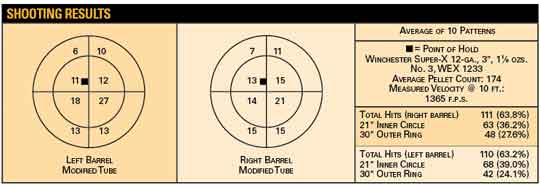
Sure, stock-to-metal fit leaves something to be desired, but this is to be expected on a side-by-side workhorse costing less than $500. With price and five-year warranty factored, the test gun’s only real negative is that at 40 yds., both barrels patterned slightly low and to the right of the point of aim. Our sister publication, American Hunter, however, reported no such point-of-aim/point-of-impact disparity. A lead engineer from the Amantino factory, Rolf Muzzel Paul, assured us that guns are tested for barrel regulation before they leavethe factory.
What is clear is that all reviewers found the Longfowler to be tough-as-nails, reliable and readily capable of downing ducks and geese at long range through a range of less-than-ideal conditions. In the end, that’s what matters.
Most Popular