10/17/2012
While it is an uncomfortable fact to enthusiasts of German, British and American firearms, one of the most influential nations in the development of military arms and equipment in the 19th century was France. The French were among the first to adopt a cartridge handgun—the Model 1858 Lefaucheux pinfire—they perfected the Minié projectile and, at a time when U.S. inventors were still trying to put together decent self-cockers, France came up with one of the best double-action revolvers of its time—the Model 1873.
This extremely robust six-shooter was the principal Gallic sidearm for non-commissioned officers, cavalry troopers and gendarmes throughout the colonial wars of the late 1800s. Also it was a substitute standard arm during the Great War, and even saw service in World War II. Though perfectly serviceable in its original form, military rank distinctions being what they are, an officer’s model was introduced a year later. The main differences between the Model 1874 and the Model 1873 were the former’s blued finish and fluted cylinder.
Until the last few years, the Model 1873 has been largely ignored by collectors on this side of the Atlantic, but when, in the film “The Mummy,” star Brendan Fraser brandished a brace of ’73s, Americans began to take notice of this much-neglected revolver, and prices and demand began to rise.
Measuring 9.5 inches overall, with an unloaded weight of 38 ounces, the Model 1873 has a decidedly blocky European look about it. It could never be mistaken as a product from New Haven or London. Its mechanism is a variant of the very sturdy Chamelot-Delvigne system that was also adopted by several other countries for their service revolvers. It had the advantages of being relatively simple, rugged and reliable, and could be used either single or double action.
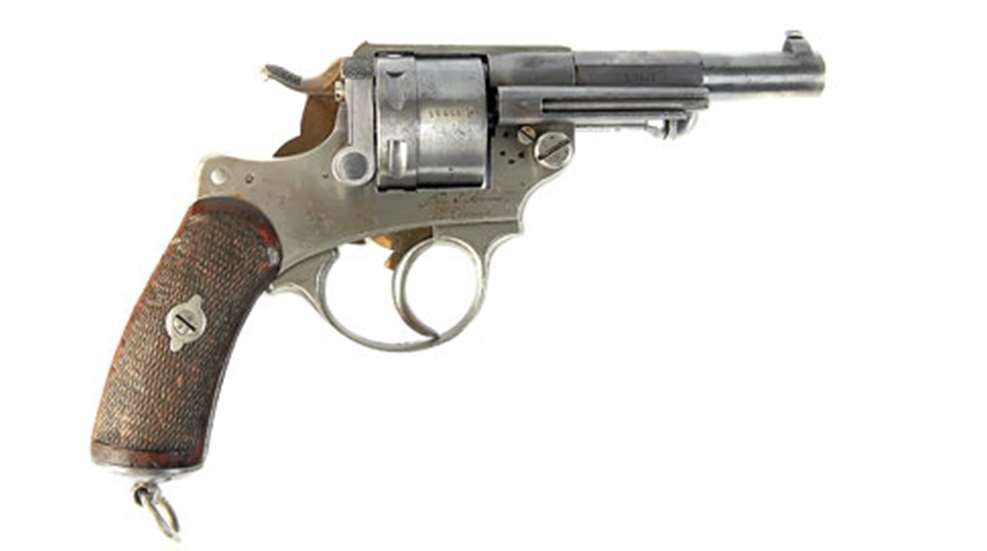
Finished in the bright, with straw-colored trigger and hammer, the 1873 had a solid frame. Cartridges were loaded into the cylinder through a rearward rotating loading gate and empties were poked out by means of an ejector rod on the right side of the barrel. When not in use, the head of the rod tucked up out of the way beneath the barrel, held in place by a rear coil spring and stud on the front of the cylinder pin.
One great feature of the Model 1873 was a sideplate that could be easily removed to provide access to internal parts for servicing and repair. Each component was meticulously stamped with the gun’s serial number. Sights were rather basic and typical of the period, involving a simple notch rear cut into the topstrap and a non-adjustable blade front brazed just behind the muzzle of the 4.5-inch half-round, half-octagon barrel. Stocks were checkered walnut and the gripcap, finished off with a lanyard ring. Date of manufacture was stamped on the right side of the barrel. Some 334,784 were eventually produced between 1873 and 1886. As well, 13,888 “Marine” (Navy) models were made from 1877 to 1886. Too, unknown numbers of civilian 1873s (and 1874s) were sold by French and Belgian makers.
Built at the government facility, Manufacture d’Armes St. Etienne, the Terre (land) Model 1873 was chambered for a proprietary blackpowder 11 mm center-fire cartridge, which propelled its 180-grain bullet at 804 fps, resulting in a muzzle energy of 253 ft.-lbs. This was slightly less than its contemporary, the much-vaunted .44 Russian, but certainly enough to slow down rampaging Tauregs at reasonable ranges.
The revolver seen here is in excellent condition, its bright finish having few nicks or blemishes and the hammer and trigger retaining a considerable degree of straw color. It is mechanically perfect, the bore is pristine and, in fact, I have fired it a number of times. As such it would easily bring between $700 and $800.
Gun: Revolver Modele 1873
Manufacturer: Manufacture d’Armes St. Etienne
Serial Number: H43223
Condition: NRA Excellent
Caliber: 11 mm
Manufactured: 1881
Value: $700-$800
Most Popular