This article appeared originally in the December 1954 issue of The American Rifleman. To subscribe to the monthly magazine, visit NRA’s membership page.
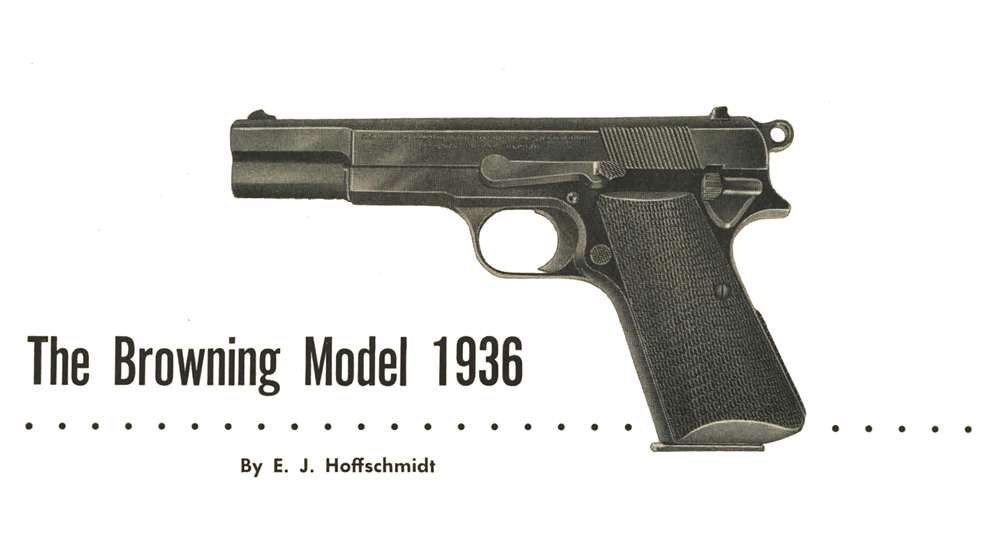
The so-called small version of the Browning Hi Power Model 1935 has come to be almost a legend among automatic pistol collectors.
Story has it that the gun was manufactured for the French by Fabrique Nationale of Belgium, and that it is a small scale version of the 1935 HP. But that is where the story ended. Or at least it ended that way until an original test model, Serial No. 7, turned up on this side of the Atlantic.
The pistol pictured there was 'liberated' from the Fabrique Nationale company museum by either German or Allied troops. Ten years later, it turned up in a Washington, D.C., gun shop where it was purchased for a nominal sum by a pistol collector.
 The knurled plug in the base of the grip is a combination hammer spring guide and screwdriver.
A letter to Fabrique Nationale via their American representative, the Browning Arms Co., brought a prompt informative reply:
"This model was actually never manufactured. There were a few made in 1936 for French government trials. The exact quantity is not known. It was designed for the French 7.65 Long automatic cartridge (page 28 of Centerfire Metric Revolver Cartridges by White and Munhall) which, being considerably more powerful than the regular .32 caliber automatic pistol cartridge, required a locking system.
"FN presented its models at the French trials through FN's subsidiary at that time which was known as the Manufacture d'Armes de Paris and explains the marking on the right-hand side of the pistol.
"The tests were held at Versailles and Chalon; and according to FN, they clearly emerged the victor in the competition. In any case, the pistol gave good results; however, the French considered it too complicated. They then proceeded to make their own pistol at St. Etienne which in some respects was a copy of the FN model and which was never very successful as made by the French.
"The changes made on the mechanism with respect to the present 9 mm. HP model were partly made to satisfy French specifications (caliber, single row magazine, front sight and angle of grip), and partly for simplification and economy (recoil spring guide, ejector mounting, hammer and sear) and partly as necessary adaptation to the different caliber."
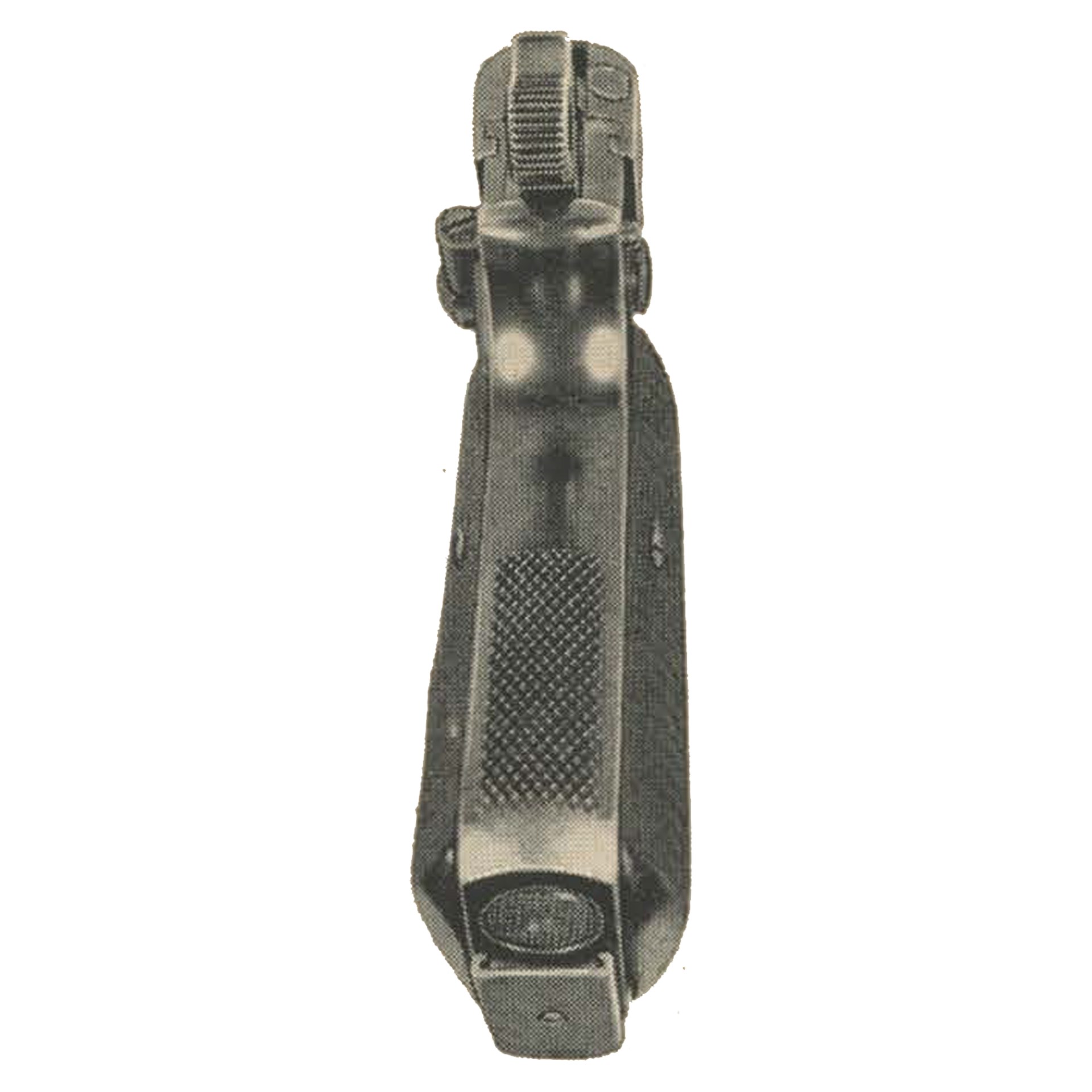 The knurled plug in the base of the grip is a combination hammer spring guide and screwdriver.
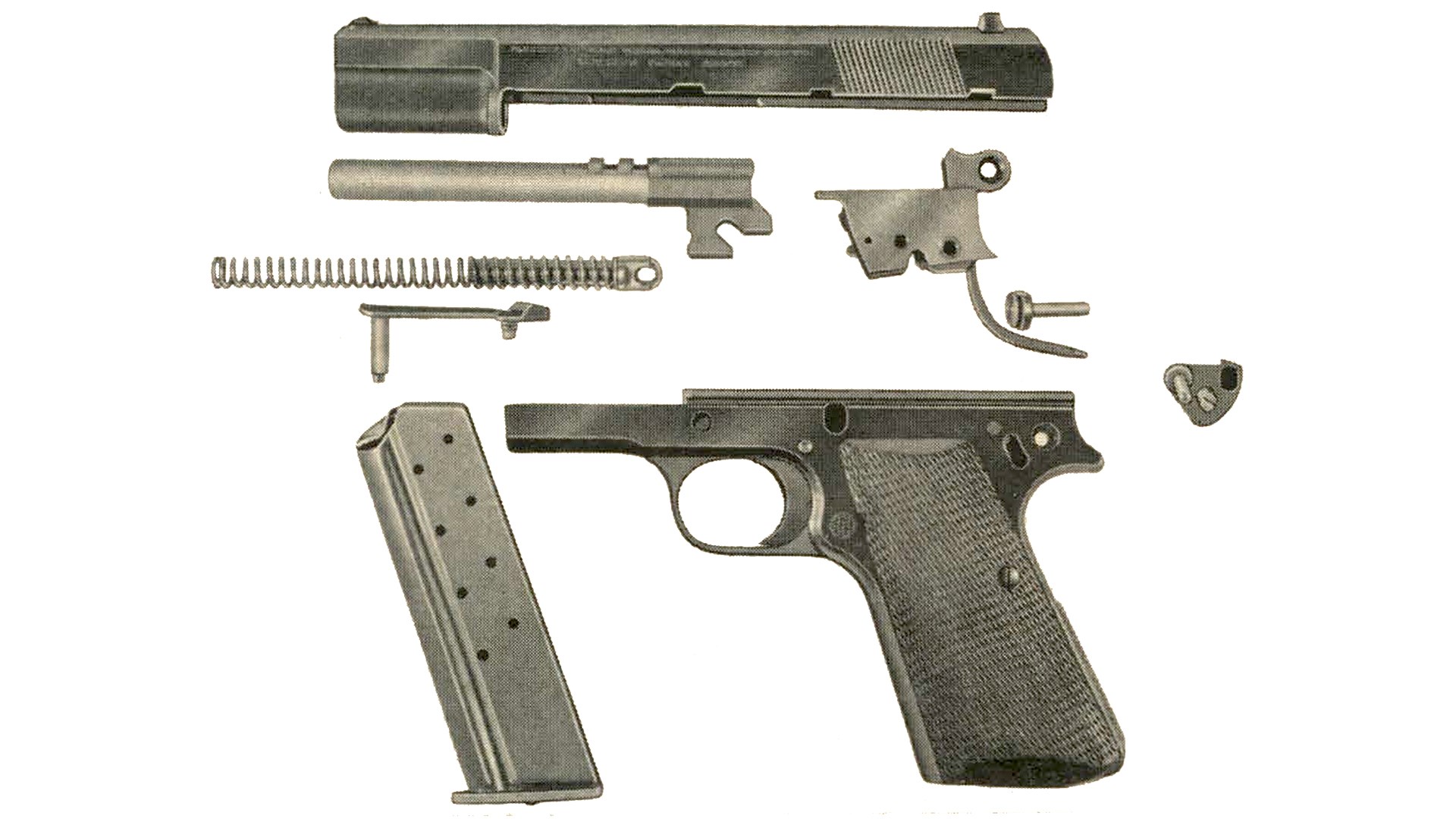
While the 1936 model may look, operate and field strip like the 1935 HP, the resemblance is only skin deep, for it has many unique and original features. Probably the greatest point of difference between the 1935 HP and the 1936 is in the hammer and sear mechanism. This new mechanism is a removable assembly, similar to the Swiss Neuhausen SP47/8 or the Russian Tokarev. It is held in the frame by a large-headed pin and the safety catch. A cartridge case is the only tool necessary to remove the large-headed pin.
When the pin is pried out, it frees the safety catch so that it can be removed. Then the entire sear mechanism can be lifted out of the frame. This is truly a simple, rugged and compact sear mechanism assembly. It contains the magazine disconnector that prevents the gun from being fired when the magazine is out of the gun. It contains the firing disconnector that prevents the gun from firing before it is fully locked or from shooting full automatic, and also contains the hammer and sear-all in one block and all in relative operating positions ready to be repaired or adjusted.
Another interesting feature is the inclusion of a small screwdriver in the butt. The large knurled plug doubles as a hammer spring guide and a screwdriver. This screwdriver is just the right size to fit the screw slot in the magazine catch. The only rub is that you must have a screwdriver to begin with to remove the walnut grips and get at the pin that retains the screwdriver.
Shooting this pistol is a distinct pleasure. The cartridge is not too powerful and the excellent grip shape gives the pistol a feel that is second to none. It weighs 28 ounces empty, is 8-1/8" long, and has a magazine capacity of eight rounds, so when we compare this information with the information on the 1935 HP, we see that the so-called "small model," although thinner and lighter, is actually 3/8 of an inch longer.