More than 100 years after its inception, the pistol of choice for many defensive-minded individuals and recreational shooters is still the M1911. And it’s likely that even more shooters would select the revered workhorse if not for its limited capacity, expensive ammunition and snappy recoil. Known for its quality, yet affordable, M1911 pistols, Rock Island Armory offers a counter to those shortcomings with its new XT 22 Magnum (our test sample is an early model marked “XTM-22” on the slide, but the designation has since been changed).
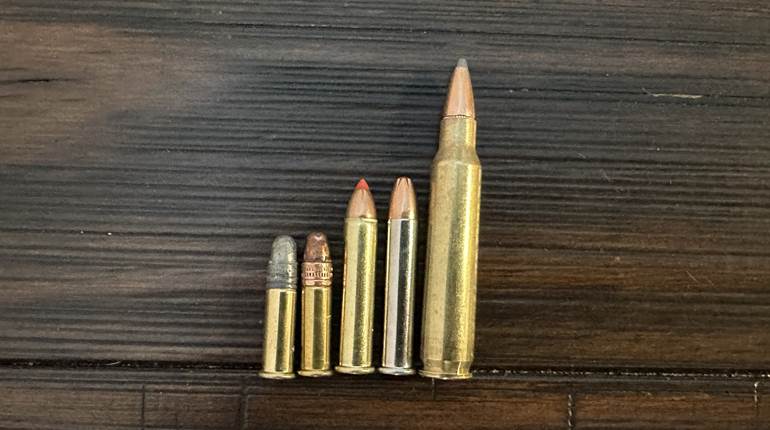
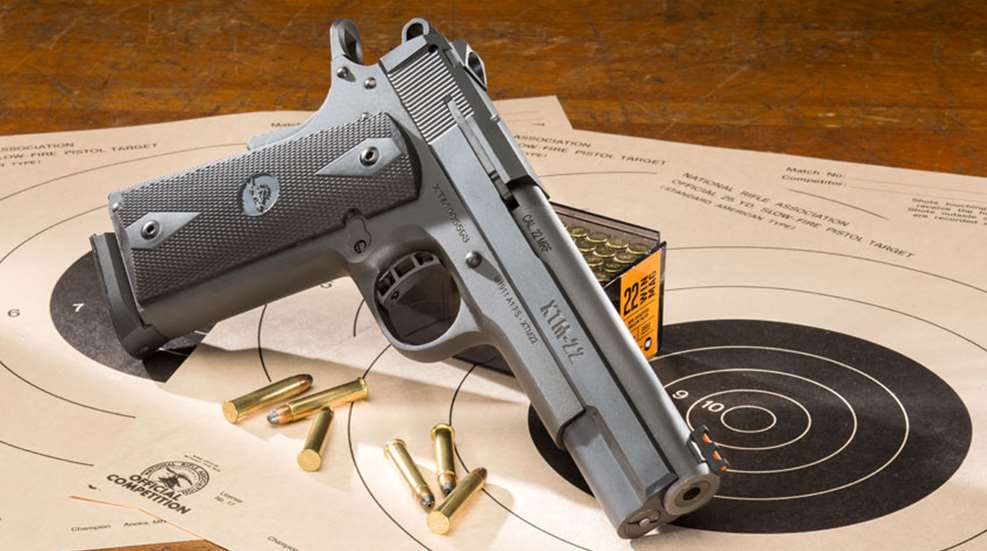
At a cursory glance, the delayed-blowback XT 22 Magnum appears to be a standard .45 ACP-chambered M1911A1; however, there are significant differences between the two. For instance, the XT 22 Magnum is uniquely chambered for the .22 WMR cartridge, which generates less recoil and offers increased magazine capacity relative to its single-stack, .45-cal. counterpart. Accommodating the cartridge, however, required notable changes to John Browning’s design.
Feeding the XT 22 Magnum are steel, single-feed, double-stack magazines that, according to Rock Island Armory, hold 14 rounds of .22 WMR. Two accompany the gun, and interestingly, one of the magazines sent with the sample pistol easily held 15 rounds, while we struggled to fit 14 into the other. A full-size handgun, with a steel slide over a steel frame, the XT 22 Magnum weighs in at 35 ozs. The frame, slide and barrel are Parkerized, lending the gun a utilitarian appearance and functional durability.
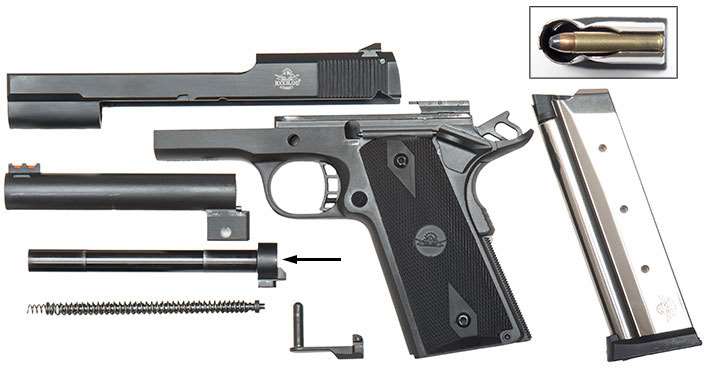
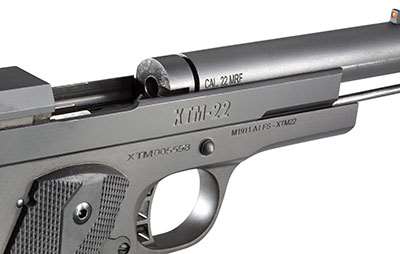
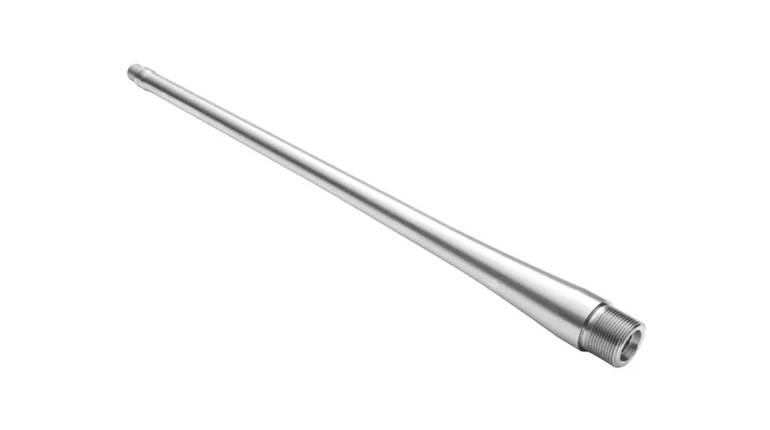
The XT 22 Magnum’s 4.75" barrel assembly consists of two pieces; inside a 0.696"-diameter steel sleeve, or shroud, is a 0.440"-diameter steel insert that contains the chamber, rifling and integral feed ramp. The tube-within-a-tube design is accompanied by a spring-loaded plunger that cushions the impact between the two when lockup occurs.
Unlike a traditional M1911 slide, that of the XT 22 Magnum is an open-top design similar to the Beretta Model 92 and its clones. Therefore, the fiber-optic post front sight is dovetailed into the barrel, while the low-profile, snag-free notch rear is secured via a dovetail to the slide. The notch measures 0.110" wide. It must be noted that, according to Rock Island Armory’s website, the front sight has now been changed to a non-fiber-optic, low-profile, snag-free design, too.
Since the XT 22 Magnum is chambered for the low-recoil .22 WMR cartridge, the nested recoil springs require significantly less force to compress than those on a .45 ACP. That is great news for individuals with limited hand strength. Still, grooves are added on the rear of the slide to enhance purchase. Unlike a center-fire M1911, the slide doesn’t lock back after the last round is fired. Extraction is by way of a sizable claw extractor, and a fixed ejector expels spent cases from the pistol.
From backstrap to frontstrap, the XT 22 Magnum’s grip measures 2.260"—and as such, it requires long fingers to fully encircle it. Purchase is aided by well-executed and aggressive checkering on the backstrap and the rubber stocks. The magazine well is beveled slightly.
To enhance comfort and safety, the pistol has an extended beavertail grip safety; unless a firm grip is taken, the trigger cannot be pulled. It also eliminates the risk of hammer bite. Additional safety features found on the XT 22 Magnum include: a left-side-only thumb safety; a half-cock notch (note, it’s not meant to be carried in this position); an inertia firing pin; and a disconnector.
The slide stop and magazine release button are, like the thumb safety, non-bilateral in design and are traditionally located on the left side of the gun. The grooved, skeletonized trigger broke at an average pull of 4 lbs., 6 ozs., with no discernible creep. Trigger reset was exceptionally short, too. All in all, the gun had a remarkable trigger.
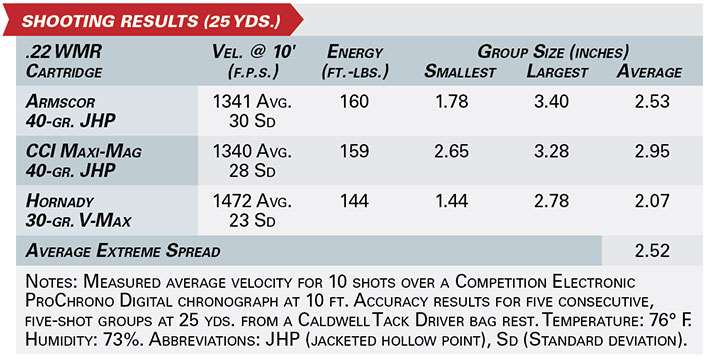
To test the XT 22 Magnum, we gathered loads from three manufacturers and proceeded to shoot five consecutive, five-shot groups with each from a sandbag rest at 25 yds. The loads included: Armscor 40-gr. jacketed hollow point (JHP); CCI Maxi-Mag 40-gr. JHP; and Hornady 30-gr. V-Max. Armscor recommends nickel-plated ammunition for best performance, as well as a 500-round break-in period.
Of the three loads, the most accurate proved to be that from Hornady, averaging slightly more than 2" for all 25 shots; however, all provided accuracy sufficient for plinking and pests at pistol distances. During the course of accuracy testing, there were two failures to fire with the CCI load and one with the Armscor. Deep indentions were noted, and subsequent attempts to fire the faulty loads were unsuccessful, so the pistol wasn’t to blame.
Predictably, ammunition loaded for rifle-length barrels produced considerably diminished velocities through the XT 22 Magnum’s 4¾" barrel. Both 40-gr. loads averaged around 1340 f.p.s., and the lighter 30-gr. load attained 1472 f.p.s. For this reason, there was a significant loss in energy; too much propellant was left unburned. In fact, unburned propellant clung to oiled portions of the action, and while firing with the CCI load, blowback occurred on several occasions.
Don’t let the abovementioned observations detract from the pistol; the range session with the XT 22 Magnum was tremendous fun. With minimal felt recoil, follow-up shots were remarkably fast, and even after expending more than 300 rounds, shooter fatigue wasn’t an issue—the same cannot be said of the .45 ACP.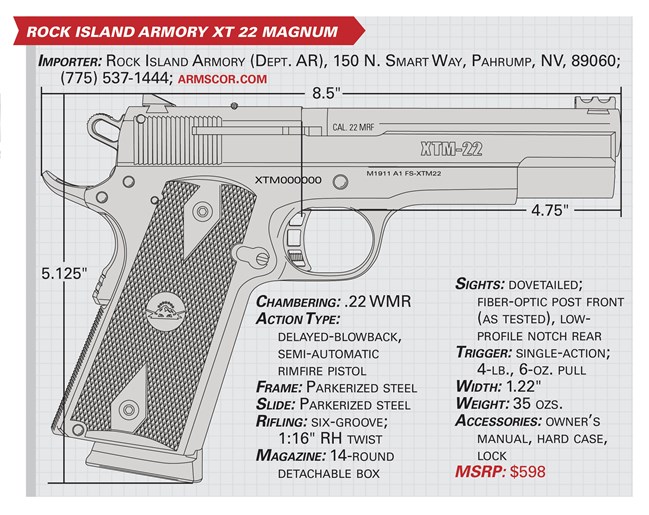
Perfect for the home, at the range and roaming the pasture, the XT 22 Magnum offers the benefits of the M1911 design without many of its drawbacks. In fact, many .45 ACP owners might find it a welcome trainer for building familiarity at reduced cost and recoil, or as a starter gun to help “work up to” a .45. Regardless, Rock Island Armory appears to have hit a home run with this one.
Most Popular