Few names communicate instant confidence in a company’s products, and Smith & Wesson is a member of that elite group. The firm has maintained that status by building solidly on a foundation of quality, lifesaving reliability and long-lasting value. Even the modern innovation it brings to its latest guns exhibit the kind of performance that silences today’s critics.
Smith & Wesson officially launched in 1852, when Horace Smith and Daniel B. Wesson joined in a partnership to develop a gun to run a fully self-contained cartridge. By 1854, the pair, working in Norwich, Conn., had designed the .41 Magazine Pistol, better recorded in history as "The Volcanic." The lever-action was the first repeating pistol to successfully use the new style of ammunition.
Despite the success, profits failed to materialize. The firm that had become Volcanic Repeating Arms sold to Oliver Winchester—a shirt manufacturer at the time, long before his name became indelible in gun lore—in 1854.
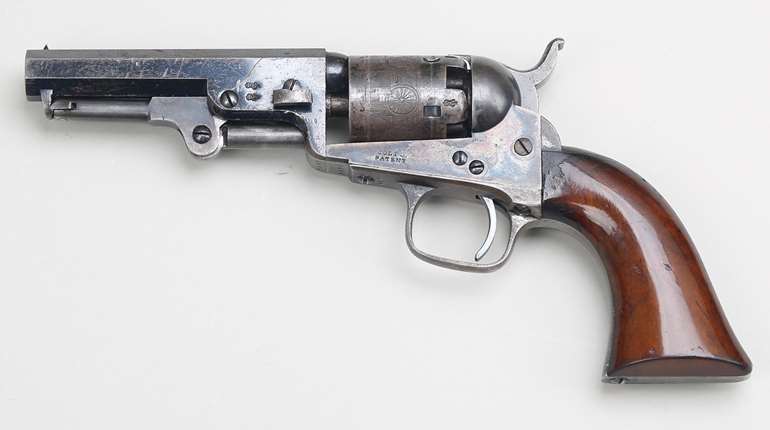
Wesson stayed on as plant supervisor after the sale, though, and while there, continued work on another repeater design. This time, he focused on a revolver. Unfortunately, a patent held by a Colt employee covered gun-cylinder designs that were bored from end to end—a feature Wesson recognized as critical for reloading.
The partnership between Wesson and Smith resumed on Nov. 18, 1856, in a small shop in Springfield, Mass. After legally securing patent rights, production of what would become known as the Smith & Wesson Model 1 began.
It wasn’t long before the company’s 25 workers couldn’t keep up with orders. Smith & Wesson moved into a larger factory in 1860.
Sales were brisk as soldiers made private purchases during the Civil War, but the firm shifted focus afterward to models more suitable for those settling the western frontier. That called for developing more powerful revolvers, which led to the introduction of the Model 3. It was good, so good that in 1870, the U.S. military adopted the top-break, single-action revolver as its first standard-issue pistol chambering a self-contained cartridge—the .44 S&W American.
The .38 Military & Police (M&P), which became standard in most United States police departments, was introduced in 1899. The first gun to chamber the .357 Mag. was the Smith & Wesson Model 27. In 1955, the Model 29 appeared, chambering the .44 Mag., Inspector Callahan’s favorite cartridge in the “Dirty Harry” movies.
Controlling interest in the company was sold by the Smith family in 1965. The company sold again in 1987 and, in 2000, management succumbed to political pressure and made announcements many law-abiding gun owners found offensive. A boycott followed, stock prices plummeted, and the CEO resigned. An established company in the firearm industry finally bought the company, righted the course, and the Smith & Wesson Holding Corporation launched in 2002.
A thriving, expanding company today, Smith & Wesson has reclaimed its historic glory, and it continues to introduce innovative models. One of its latest is the sleek CSX semi-auto pistol, which is new for 2022. It’s also stayed true to its roots, with new M&P models ideal for law enforcement and civilian self-defense. And as for its revolver legacy, the company has never lost sight of it. They are still some of the most popular on the market today, with good reason. Here’s a look at how it’s done at the factory today.
Most Popular