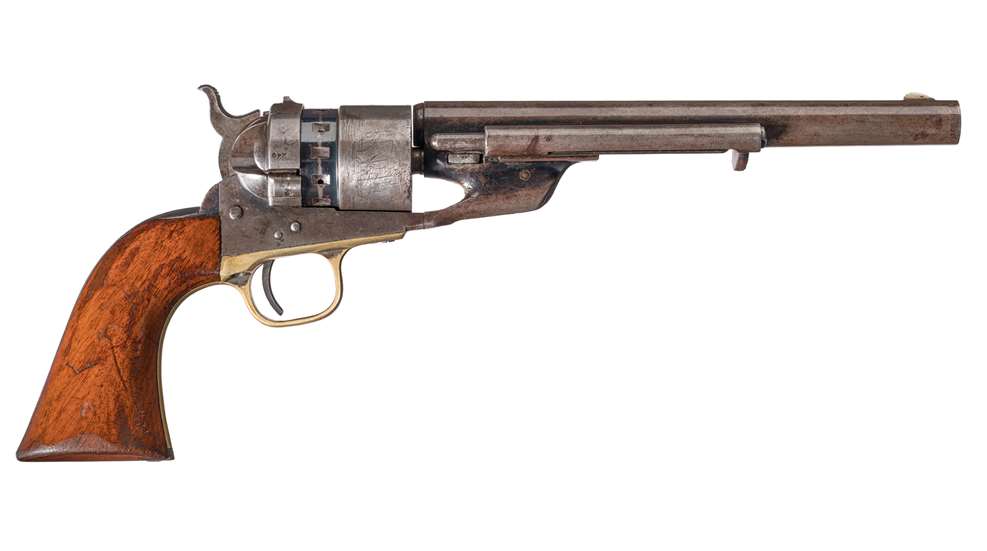
Q. At a gun show, I saw a Colt 1860 Army Richards Conversion with 12 cylinder notches instead of the usual six. The dealer was not sure whether this was original to the gun. Were these extra notches a factory variation or just some frontier gunsmith’s backroom project?
A. What you saw was a rarity within a rarity. In 1871, Charles Richards patented a system that enabled Colt to transition from cap-and-ball to self-contained metallic cartridge revolvers utilizing Colt’s surplus Civil War Army parts. A new—albeit short-lived—safety system was devised to prevent the hammer from resting over a loaded chamber.
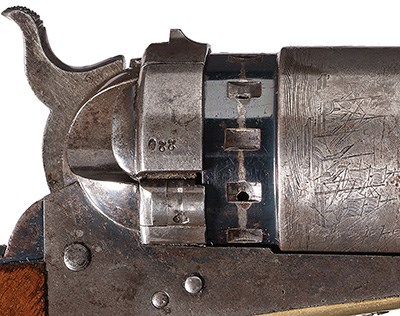 Perhaps as an experiment, an extra “safety notch” was cut between each of the 1860’s cylinder bolt notches, making it a 12-notch gun. With the hammer brought to half-cock, the bolt, as before, would drop down into the frame. Then, with the user depressing the trigger while slightly pulling the hammer back before lowering it from half-cock, the bolt would rise up into the safety notch, securing the cylinder with the hammer resting between two loaded chambers.
Unfortunately, the 12-notch system seemed to be doomed from the start. It added to the conversion’s manufacturing costs, and the effectiveness of the safety notches depended upon a perfectly timed gun. Finally, the safety notches were falsely blamed for rupturing cylinders, as, in some instances, a small chunk of metal seemed to be “blown out” from the original cylinder notches.
Some incorrectly theorized that the new safety notches were the culprit. However, those notches were cut between the chambers—the thickest part of the cylinder. Conversely, the guns with “blow-out holes” show them at the bottom of the original cylinder notches, where the cylinders are the thinnest.
Nonetheless, the 12-notch system was discontinued. Of approximately 9,000 1860 Richards Conversions manufactured between 1873 and 1878, fewer than 120 factory 12-notch versions were produced, making them highly sought after today. Beware of fakes, though, as Colt also produced 12-notch cylinders for separate sales and, more recently, unscrupulous individuals have created spurious versions.
Most Popular