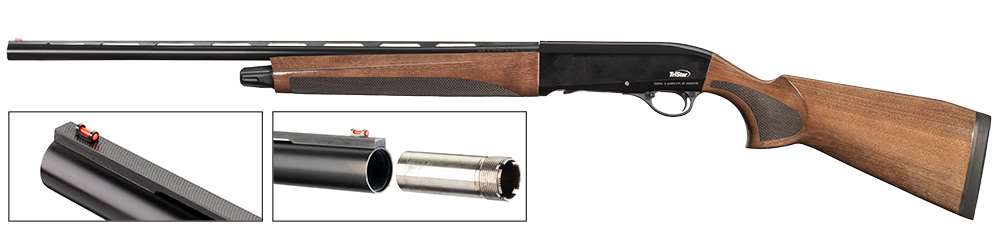
TriStar Arms offers an extensive variety of cost-effective shotguns ranging from traditional side-by-sides and sporty over-unders to trap-specific models and semi-automatics. Among the latter is the subject of this review, the walnut-stocked, second-generation Raptor, which retails for a little more than $600.
The Turkish-made Raptor II is a gas-operated, semi-automatic shotgun available in 20 or 12 gauge, with a 3" chamber; our test gun was an example of the former with a 26" barrel. When fired, gas is bled via dual ports from the barrel into the gas cylinder. There it impinges on the piston, which rests against the dual-arm action bar, forcing it toward the receiver. A recoil spring surrounding the magazine tube is subsequently compressed, and the spring-loaded extractor removes the spent hull from the chamber. As it approaches its rearmost point of travel, a fixed ejector clears the hull. The rebounding recoil spring forces the action bar and bolt group forward, where it pushes an awaiting shell into the chamber and completes lockup. A locking bolt interacts with the barrel extension to do so.
Only one piston accompanies the Raptor II, and both 2¾" and 3" shells can be used interchangeably. However, there’s a caveat: In the shipping carton is a bright orange sticker stating, “Notice: This shotgun may require a break-in period. High powered and/or magnum loads should be used before light and/or target loads will cycle reliably. Certain brands of light and/or target ammunition will cycle more reliably than others.” More on this later.
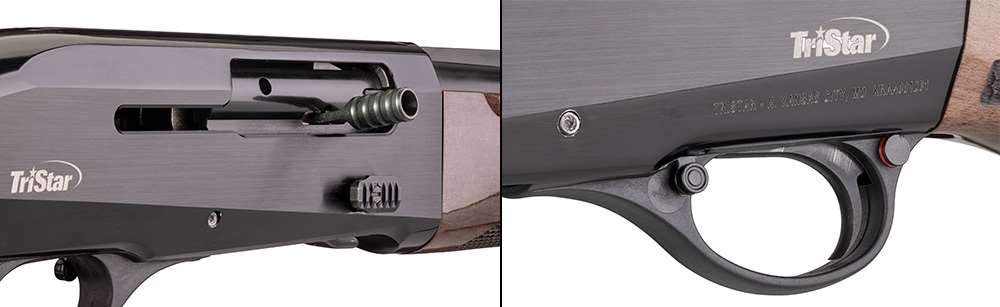
The shotgun’s 7075 aluminum receiver has been anodized and is replete with modern lines and angles. It isn’t drilled or tapped for an optics base, but there is a notch and a series of grooves spanning its top to aid sighting. Immediately noticeable is the oversize, grooved bolt release and extended bolt handle. Both will be appreciated when a quick reload is needed.
A unitized trigger group is secured to the receiver with one snug retaining pin. At the rear is a crossbolt safety with a red indicator illustrating when the gun is ready to fire. There is a cartridge drop lever/magazine cutoff, however, the switch is found on the left side of the trigger group—odd for a shotgun designed for right-handed shooters. The single-stage trigger of the sample gun broke at 6 lbs., 5 ozs.; although smooth, the trigger exhibited considerable creep.
As would be expected, the inside of the Raptor II’s 4140 steel barrel (and chamber) is chrome-lined to increase durability and longevity. Barrel lengths depend on the gauge; the 20-ga. guns have 26" tubes while 12 gauges have longer 28" barrels. A checkered, ventilated rib spans the length of the tube and ends with a red fiber-optic pipe for sighting. Prudently, the barrel was threaded to accept common and inexpensive Beretta/Benelli Mobil-style chokes. Three flush-fitting choke tubes accompany the shotgun that correspond to improved-cylinder, modified and full constrictions.
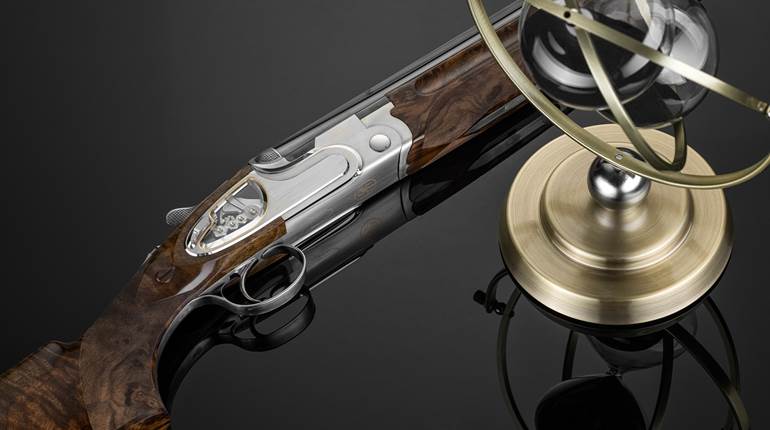
 As its name suggests, the Raptor II Walnut is equipped with wood furniture, but shooters who prefer synthetic stocks have options in both black and Mossy Oak’s Country Roots camouflage pattern. Consistent with standard-grade walnut common on thrifty shotguns, the wood on our sample exhibited minimal figure. Adding protection and luster is a polyurethane finish. Secured via a futuristic-looking, anodized-aluminum nut, the fore-end has a recess near its top on both sides for the fingers; finely executed, honeycomb-pattern texturing on the lower half further improves purchase. This is replicated on the pistol grip, which exhibits a slight mid-length swell. Capping the buttstock is a sticky, semi-pliable recoil pad—a welcome addition on a 3"-chambered shotgun that weighs so little.
Testing of the TriStar Raptor II Walnut occurred in multiple phases. Remember the bright orange sticker mentioned previously? Our evaluators did, so we proceeded to first fire 3", 1-oz. Rio Royal 20-ga. BlueSteel—at 1,400 f.p.s.—and various 2¾" heavy field and pheasant loads before subjecting the shotgun to target-type shells. Two boxes worth wasn’t enough, though, as the initial 2¾-dram loads still failed to cycle reliably. Somewhere between 100 and 150 total rounds of magnum and standard loads, the sample Raptor II achieved “break-in.” From then on—with the exception of Fiocchi Exacta Low-Recoil Target Loads, which propels 3/4-oz. of shot at a paltry 1,075 f.p.s.—all shotshells cycled without issue. Lesson: Heed the manufacturer’s warning.
We then spent an afternoon at a local sporting clays course judging the gun’s handling characteristics while further gauging its reliability. We found it fast to get into action from the low-gun hold, making it a solid choice for sub-gauge events (especially FITASC) and hunting upland species. Balancing near the receiver’s front, the sub-7-lb. Raptor II wasn’t overly whippy, despite its lightweight barrel, and it made short work of most targets, regardless of presentation and distance. We especially appreciated the purchase made possible by the slight palm swell and atypical-but-comfortable texturing on the furniture. Lastly, attention must be paid when shouldering, as the recoil pad’s stickiness can easily induce snagging. With the “break-in” gremlins gone, functioning with Federal and Challenger target-type loads was flawless—as expected.
Shooters and hunters seeking a utilitarian, inexpensive, semi-automatic shotgun would be wise to consider the TriStar Raptor II Walnut. It proved to be a solid design that’ll be equally at home on the clays course as it would be pursing game in the field.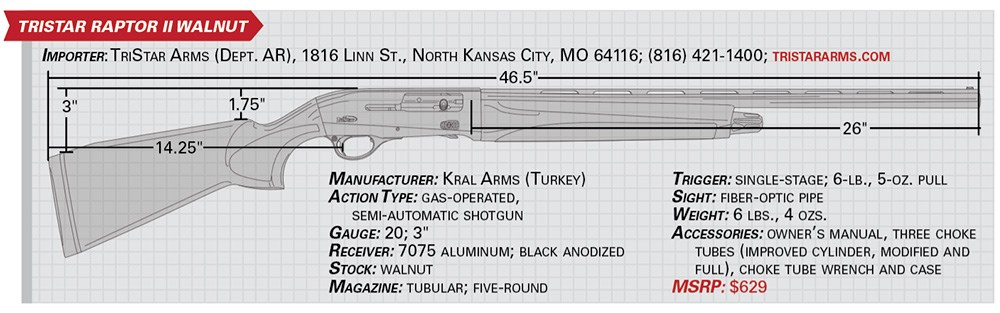
Most Popular