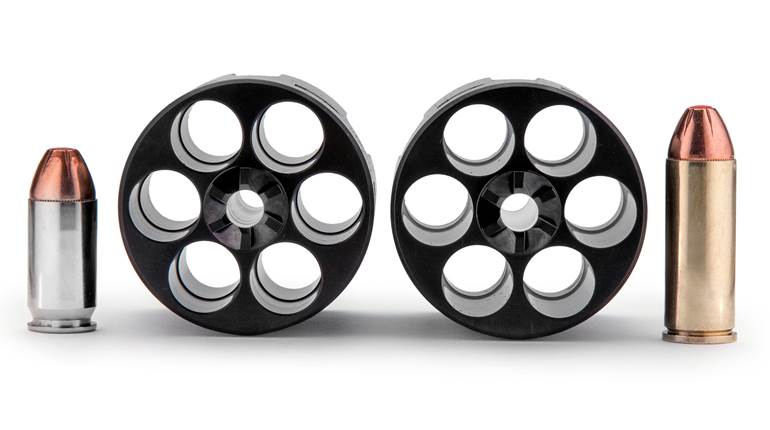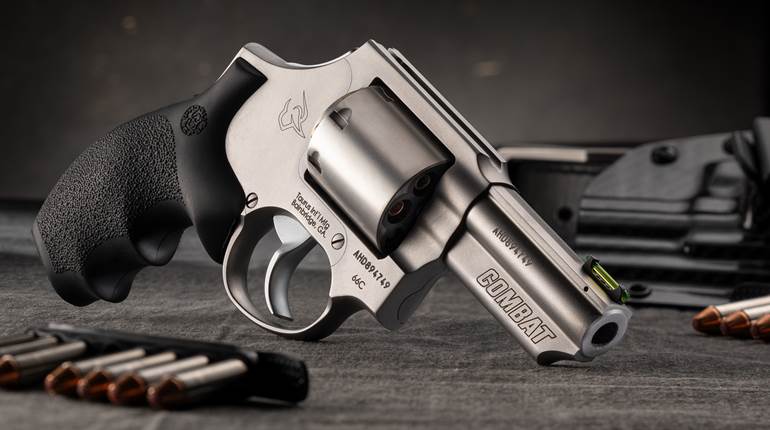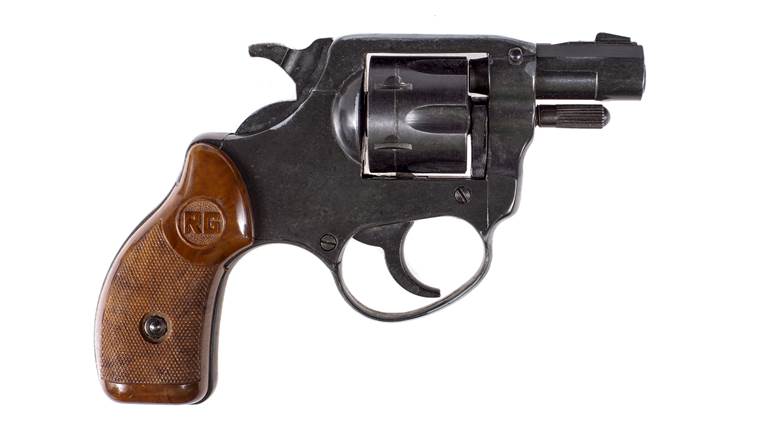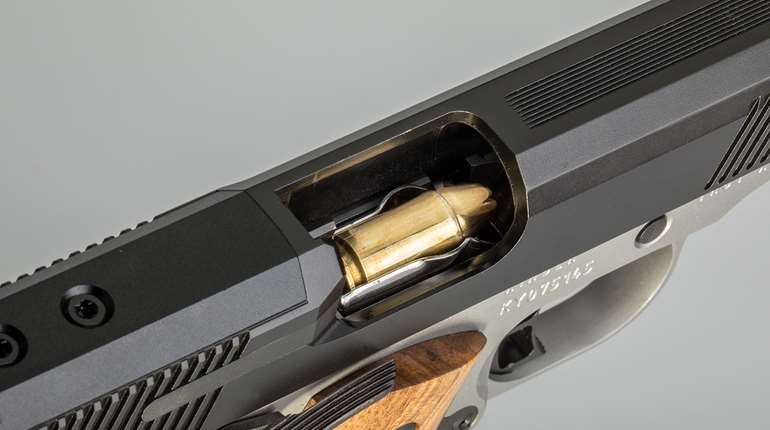
Most experienced handgunners know about the WWI half-moon (three-round) clips developed to adapt S&W and Colt revolvers to the rimless .45 ACP cartridge. In more modern times, Ranch Products came up with a full moon clip that holds six rounds in a circular unit which goes into the revolver cylinder as a unit. Originally, these clips were an expedient to permit service ammunition to be used in both 1917 revolvers and 1911 autos. There are some other advantages to this practice, particularly with the full moon types. Shooters have discovered speedier loading when they have only to fit one object—a loaded clip—into the cylinder. It’s better yet at the other end of the cycle when you push the ejector rod to dump the empties. If anything comes out of the cylinder, everything comes out—positive ejection. In recent years, the full moon clip idea has been applied to other auto calibers—9mm, .40 S&W and 10mm. It works very well.
But some unknown handgunner who liked the moon clip concept looked at some of the typical revolver cases. He had an idea that has really taken off. Look at a round of .38 Special ammo and consider how it fits in the revolver’s chamber. It has a rim that extends slightly beyond the diameter of the case body and which must fit perfectly flat against rear face of the cylinder. If there is any radius to the rim-to-body diameter transition, you may get misfires. Therefore, most cartridge manufacturers use a tiny little square cutter to cut a slight groove in the case body where it abuts the rim. This relief cut ensures a proper indexing of the case rim against the cylinder.
It is possible to use this groove to take a moon clip, made expressly for this purpose. A revolver thus equipped can be used with revolver cartridges for all the loading and ejecting advantages we have already described. The cylinder itself must be irreversibly modified, but you can get a bit more speed in loading and unloading. It’s an edge and sometimes “edge be everything.”
Most Popular