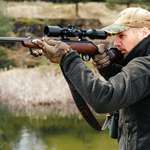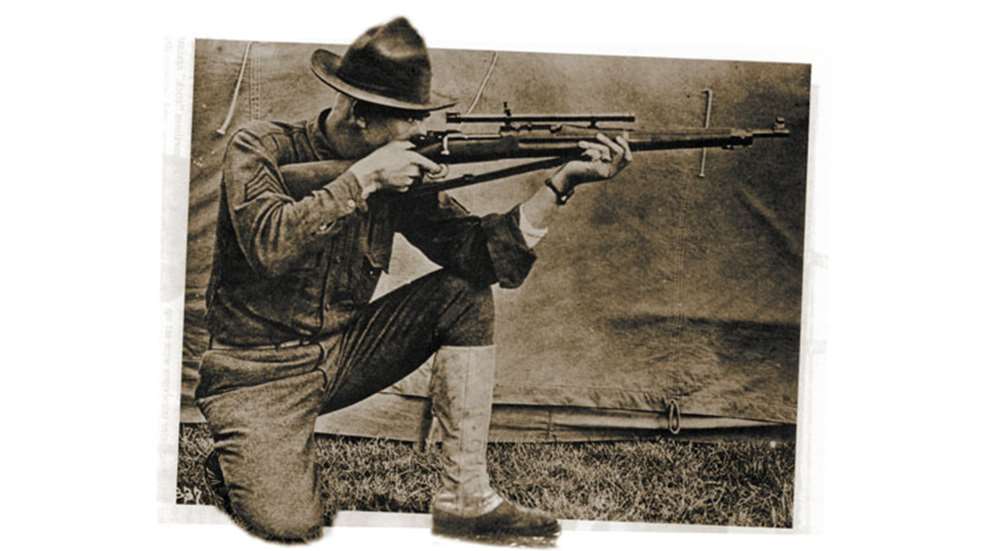
Top: National Archives image of a Marine rifleman with a Model of 1903 Springfield rifle fitted with a Winchester A5 riflescope.
In a previous post and “The Keefe Report” for the February 2015 issue of American Rifleman, I wrote:
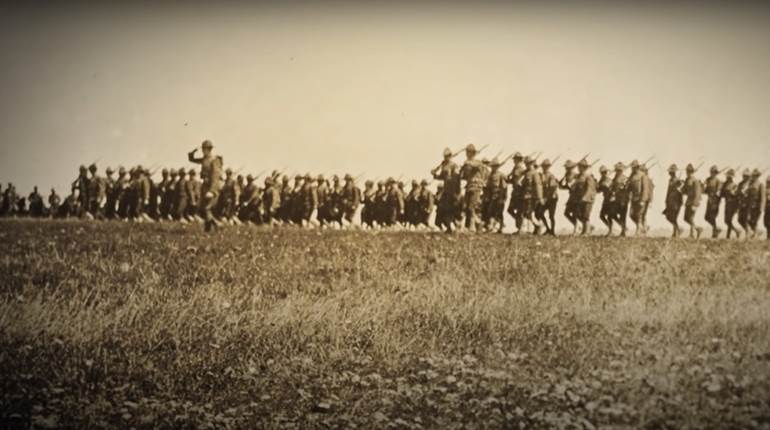
“In 1917-18, it was the Americans who brought precision rifle fire back to the battlefield. It was NRA President Col. Newton Baker and the commander of the American Expeditionary Force, Gen. John J. "Blackjack" Pershing (a competitive shooter himself), who made sure Americans could shoot before they went to France. "The rifle is a distinctly American weapon," once wrote Pershing. Ever heard of Sgt. Alvin York or Lt. Sam Woodfill or even the Marines at Belleau Wood? They killed German machine gunners with long-range, precision rifle fire. American riflemen used their rifles to save Paris again in 1918 and help break the stalemate of trench warfare.”
While space in “The Keefe Report” in the print magazine prevented me from elaborating on the deadly accurate rifle fire delivered by York, Woodfill or the Marines at Belleau Wood, my online blog has no such restraint. And I received some very informative specifics from Col. William T. Andersen, USMC (Ret.), about one particular Marine and his extraordinary marksmanship with the ’03 Springfield on May 6, 1918, which I share here:
“I read with great interest Editor In Chief Mark Keefe’s “Keefe Report” (February 2015, p. 6) about marksmanship in World War I. If I may, I would like to provide some evidence to support Keefe’s statement about Marines at Belleau Wood. I have studied Belleau Wood for almost 25 years and developed the battlefield tour that is being used there today. I am currently a member of the USMC World War I Commemoration Working Group and writing a Belleau Wood Battlefield Guide as part of the centennial activities.
“Please find enclosed a copy of correspondence from the service record of Roland Fisher from Minnesota who served in the 2nd Battalion, 5th Marine Regiment, during World War I. On May 6, 1919, his company commander recommended Pvt. Fisher for a Distinguished Service Cross for some remarkable marksmanship on June 11, 1918. For the record, on that date Fisher's battalion attacked Belleau Wood and suffered significant casualties, to include Fisher himself. As the memorandum states, Private Fisher struck six Germans at a distance of approximately 1,400 yds. using a telescopic sight (presumably with his ’03 Springfield). Unfortunately, the award was disapproved, but eventually Pvt. Fisher's family received a Silver Star Medal. Regrettably, although Fisher survived war, he died of influenza in February 1919 in Germany. He lays in rest at Arlington National Cemetery. 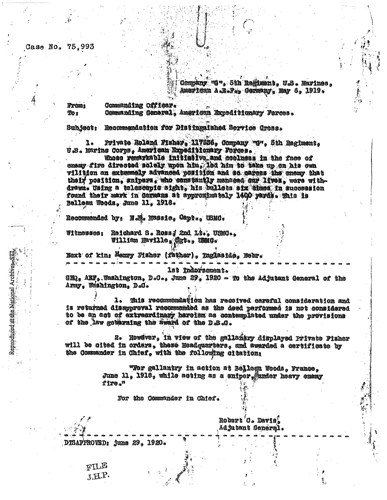
“An interesting footnote is that the French were amazed that anyone would take the time to estimate distance and adjust sights. In their view, the purpose of a rifle was to have something that you used with a bayonet in an attack.”
“Col. William T. Andersen, USMC (Ret.)”
A copy of the original document, kindly supplied by Col. Andersen, is shown here but due to the difficulty of reading it, we offer the text below.
Company “G”, 5th Regiment, U.S. Marines
American AEF, Germany, May 6, 1919
From: Commanding Officer
TO: Commanding General, American Expeditionary Forces
SUBJECT: Recommendation for Distinguished Service Cross
Private Roland Fisher, Company “G”, 5th Regiment, U.S. Marine Corps, American Expeditionary Forces.
Whose remarkable initiative and coolness in the face of enemy fire directed solely upon him, led him to take up on his own volition an extremely advanced position and so … the enemy that their position, snipers, who constantly menaced our lives, were withdrawn. Using a telescopic sight, his bullets six times in succession found their mark in Germans at approximately 1400 yards. This is Belleau Woods, June 11, 1918.
Recommended by: Name, Capt., USMC
Most Popular