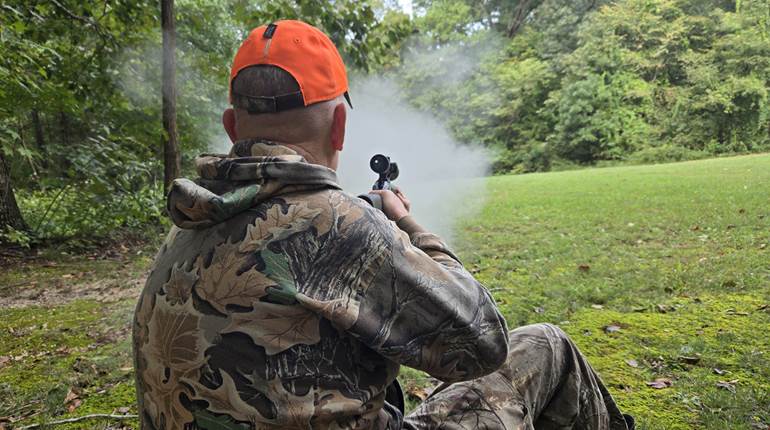
There has always been a fascination with long-range shooting—reaching out and touching something from distances approaching or even exceeding a mile. From Billy Dixon's legendary 1,538-yard shot on a mounted Indian at the Battle of Adobe Wells in 1874, to Carlos Hathcock bumping off enemies at 2,500 meters as well as the thousands of tales circulated through hunting camps over the decades, the allure of the long shot beckons nearly every shooter and hunter at one point or another.
For the purposes of this discussion let's define long-range shooting as anything between 200 and 500 yards on game animals. Yes, it can be done at longer ranges; I have seen many of the videos that depict shooting animals at 1,000 yards or more, but I have also spent enough time in the field and at the range shooting 600 to 1,000 yards to understand that at these ranges most shooters are incapable of consistently dispatching game under field conditions. Securing a first-round hit on an animal at long range is the mark of an expert rifleman—and requires a lot of preparation and work. Accomplished marksmen are consumed with details. They keep a meticulous record of every shot—everything from temperature, wind and barometric pressure to the time of day and lighting conditions is written down. Once they amass enough data, it becomes easier to predict the exact placement of a given shot.
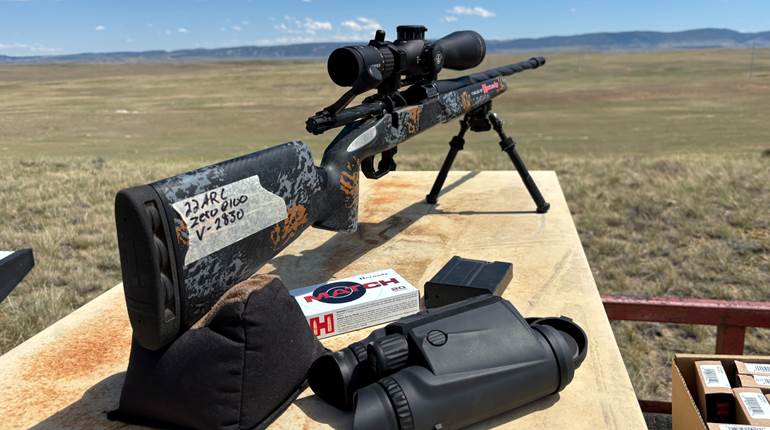
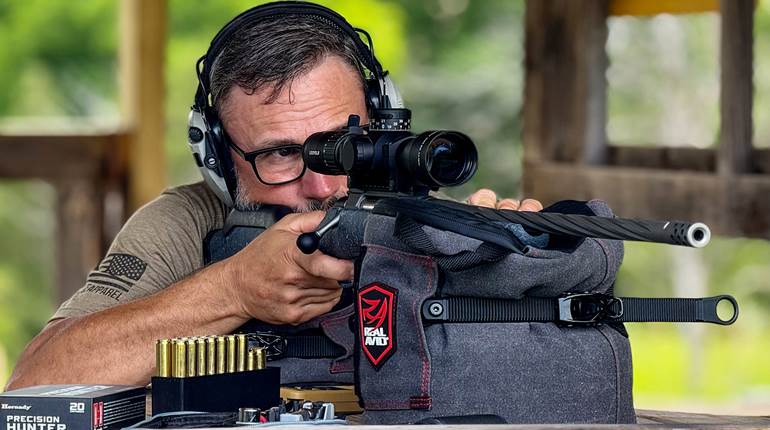
Becoming a consistently good long-range shot requires a significant commitment of time and ammunition. It takes a lot of range time to learn the minute particulars of a rifle. Long-range shooters invest in equipment that is much more durable and precise than the discount stuff weekend hunters and plinkers use. When it comes to optics, it isn't uncommon to see a riflescope that costs three times the price of the rifle. And ammo—plan on burning a lot of it. We're not talking the bargain bonus packs at the local discount center. When you are learning to shoot accurately at a game animal at a quarter mile or farther, every round is match grade in quality and probably handloaded.
Once you have a load that satisfies and you've shot real-world drops, it's time to get off the bench and practice using the same equipment as you would in the field , such as a bipod, shooting sticks or a sling. Often you will find that your groups will open up a bit. Especially with a sling, you may find your groups shift to the left (if you are a right-handed shooter) because the tension on the fore-end puts some pressure on the right side of the barrel. Keep careful notes of these anomalies as well as the influence of wind on your shooting.
As appealing as it is to shoot steel silhouettes or gongs, you will learn a lot more by shooting paper. When you shoot steel all you get is the tink of the bullet hitting metal and perhaps a swinging target—satisfying, but where exactly did you hit? Even if you paint the steel before you start shooting, you lack an exact point-of-aim vs. point-of-impact reference. Paper may be boring, but it never lies. Your target provides a precise point-of-aim, and the holes—or lack thereof—are a permanent record of what occurred. Remember that you are shooting to amass a database of information of what you and your rifle are capable of under field conditions. The more precise and extensive your data is, the better the information.
Eventually, you will learn the limits of your shooting ability at long range. It may be 300 yards at first, but keep shooting and that distance will lengthen as you learn more and hone your skills.
In the field you will need to know how to judge range accurately. A laser rangefinder is an excellent investment, and most are accurate to within a yard. However, understand that these tools have their limitations. Most are accurate within a specific range, say 300 to 600 yards. Even if it claims it is a 600-yard rangefinder, the best results are between 200 and 400 yards. A 1,000-yard rangefinder is most effective between 300 and 700 yards, depending upon the reflective properties of the target. Often buff-colored animals or trees do not reflect the laser as well as you might hope, and it may be difficult to get a reading.
You also need to know the depth of the chest cavity of the animals you hunt. Here are some approximate depths to use: A typical white-tailed buck is 16 inches from the top of the hair on its back to the hair at the bottom of the brisket; a mule deer buck is about 17 to 18 inches; a pronghorn buck is some 15 inches; and a bull elk is about 24 to 26 inches. Subtract 4 to 10 inches for hair, hide, fat, muscle and bone to estimate the size of the vitals. Females of these species are roughly 5 to 10 percent smaller.
Most modern hunting rifles are capable of delivering a humane killing shot at ranges that exceed our ability as shooters. Arming yourself with the information and skills necessary to utilize that capability will make you a better hunter and may be the difference between success and failure.
Most Popular