There’s an undeniable satisfaction in muzzleloading. Attempts at explaining the attraction often claim it’s the added challenge of a single shot, history lesson, skill polished with longer lock times or pleasure when the balancing act between propellant and bullet weight shrink groups. It’s all that and more, but in a gentle mix unique to every enthusiast, a blend that has kept the relatively primitive firearms alive, while others have gravitated to the convenience of metallic cartridges and self-loading guns.
Traditional blackpowder, however, is messy, volatile and requires thorough cleaning after use. That burden prevented some from participating in muzzleloading until 1975, when Hodgdon introduced Pyrodex. The blackpowder substitute eliminated a lot of the headache, although the relatively exposed ignition systems on “smoke poles” still fell victim to inclement weather.
That changed in 1985, when Knights introduced its MK-85. The in-line design launched a revolution in muzzleloading by placing its percussion cap nipple directly behind the chamber, where it was sheltered from rain, snow and spark-robbing humidity to introduce spark to the propellant reliably and consistently.
Company founder Tony Knight is often cited as the inventor of the in-line design, although that honor really goes to Jean Samuel Pauley. His patent for the approach was approved by England in 1812, only two years after the percussion cap was invented. What Knight did receive his initial patent for was an innovative knurled safety on the muzzleloader’s plunger-style hammer. With a simple twist of the knob concerns about a negligent discharge were alleviated, but that wasn’t enough—there was also a trigger safety on the MK-85.
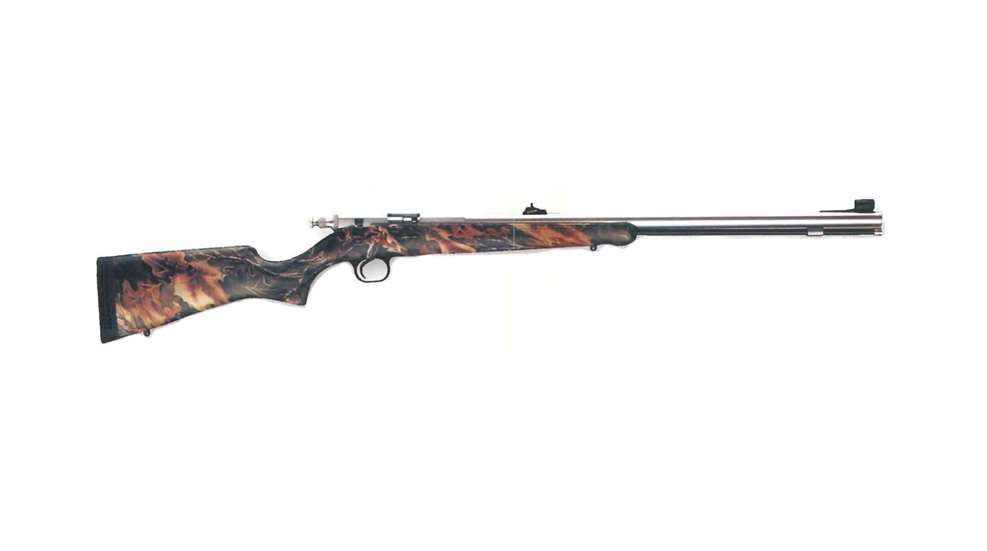
The MK name honors Knight’s daughter, Michelle Knight, followed by the year of its introduction, 1985. It had a 24" barrel and was available in either .50- or .54-caliber. Receivers were drilled and tapped for scope mounting, but the muzzleloaders shipped with a bead up front and adjustable metallic sights at the rear. Sling swivel studs and a recoil pad rounded out the design, which throughout its run was available with wood, wood laminate or synthetics stocks in various camo patterns. With a removable breech plug and hammer, routine maintenance was a breeze.
The design launched a revolution in muzzleloaders, and Knight invested considerable effort to increase the use of so-called "primitive weapons" during big game seasons across the nation. His design and dedication made a huge difference.
Knight sold the company to a father and son in 1991. Pradco purchased it from them in 1999, but sales failed to meet corporate expectations. Knight Rifles closed its doors in 2009. Thankfully, in 2011, Plastic Industries, Inc. resurrected the company and offers a complete line today. Unfortunately, the MK-85 is no longer part of the lineup.
Used MK-85 prices vary wildly, increasing with condition and model. Some of the hand-selected, limited runs that carried an MSRP of $1,000 in the late 1990s go for more today, while you can find field versions in good condition occasionally at or below $300 without optics.
Most Popular