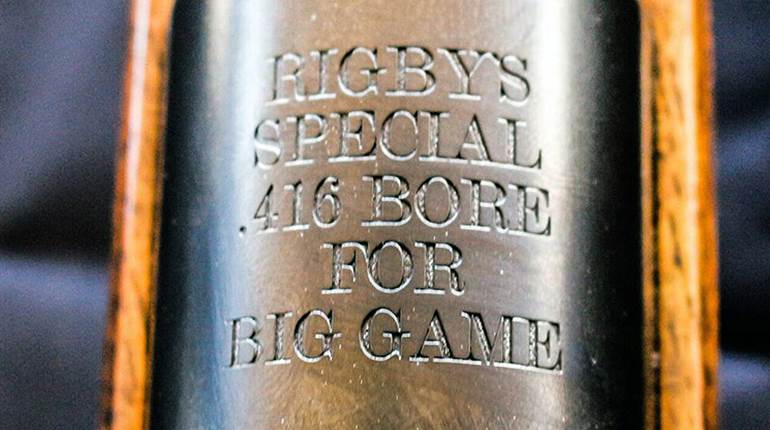
Famed English gunmaker John Rigby & Co. has weathered a driving storm of controversy the past few years, tossed from one owner to the next amid lawsuits, a bankruptcy and even a second “John Rigby” firmclaiming to be the original, but it’s all in the past now that a Dallas-based pair of investors have bought the storied brand.
John Reed, a businessman, and his partner have acquired all rights to John Rigby Gunmakers and, for the first time since 1997, has reunited the historic Rigby archives with the gunmaking assets. The Rigby archives include handwritten sales and gunmaking records of John Rigby & Co. from Dublin and London dating back to the 1700s, as well as historic firearms and artifacts. The ledgers, which had been in a private collection, consist of more than 80 handwritten volumes, many 700-plus pages long. Selected ledgers and artifacts were displayed by John Rigby & Co. at the 2012 Safari Club International Convention last week in Las Vegas.
The Rigby ledgers, which survived the Irish Rebellion of 1798 and two centuries of upheaval, were nearly lost after being moved for safekeeping during the Nazi firebombing of London.
Paul Roberts, Rigby’s authorized agent in the United Kingdom and owner of Rigby from 1982 to 1997, recalls that it took patience and some luck for him to find them again, more than 40 years after they had been removed from the city:
“During the Blitz, in 1940, John Rigby & Co. was at 43 Sackville Street, London, just 150 yards from Piccadilly. This is the center of London’s upscale West End, which was a prime target for Nazi bombers. It was decided to move the company ledgers to safety.
“My predecessor at Rigby, David Marx, had heard rumors about their movement from his shop manager, who’d been told by his predecessor, Frank Wallace. The story was that W.A.A. Greenwell, Esq., a Rigby director in 1940, owned a farm in West Sussex and that the ledgers, apart from the double-barreled guns number book, went there for safekeeping.
“However, after the war ended the books had not been returned to London, and since then Rigby had moved three times and no one was sure of their facts. I contacted Mr. Greenwell’s widow, who told me that her son William had inherited the West Sussex farm. Subsequently, William told me that he had seven or eight wooden boxes full of ‘old Rigby papers.’ These were indeed the 80-odd volumes of sales ledgers, invoice books et cetera which I loaded into my car and brought back to London.
“The old ledgers are fascinating reading and mention many historic customers: kings, counts, barons, prime ministers, maharajas, adventurers and explorers.”
Most Popular