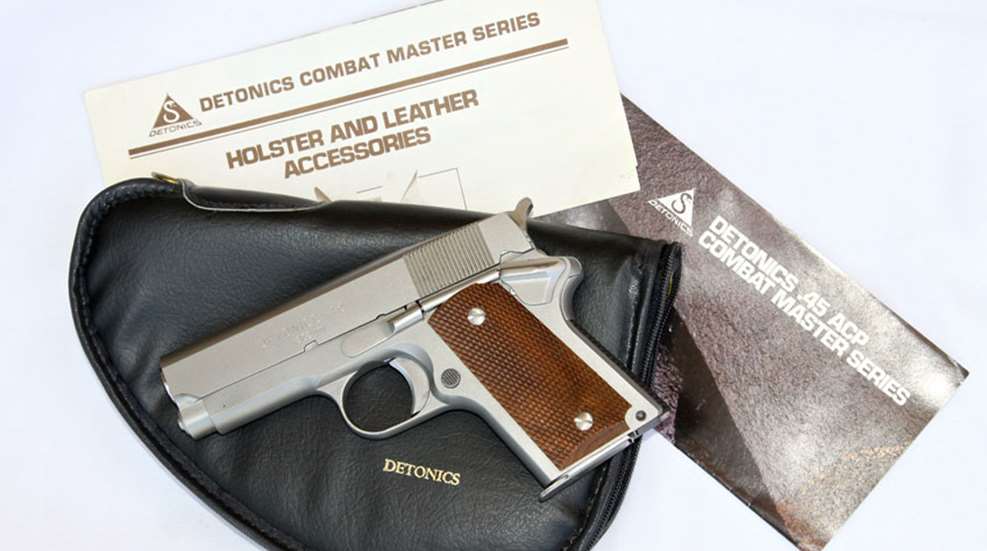
As a compact semi-automatic chambered in .45 ACP, named after an explosives company and conceived before “concealed carry” became a buzzword, the Detonics Combat Master is understandably obscure—except to a small group of dedicated fans.
The concept of a hard-hitting pistol that could be carried in one’s coat pocket, but was more than just a chopped-and-channeled M1911, was conceived in the 1960s by Pat Yates, an Explosives Corp. of America (EXCOA) engineer. A fellow worker, Sid Woodcock, offered to help. They were soon joined by Mike Maes and Chuck Lyford, who owned a Seattle, Wash., explosives company called Detonics. Having no firearms experience, they nonetheless decided to mass-produce the pistol. Thus, naming the gun after their company, the Detonics Combat Master was born.
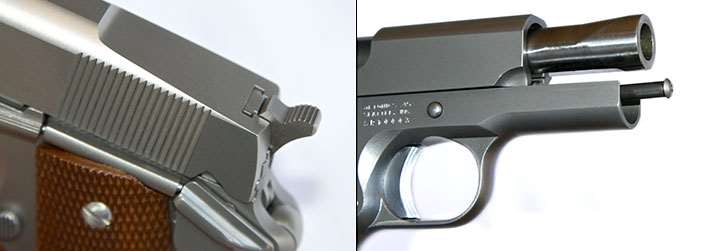
Measuring 6¾" long by 4 5⁄8" tall, with a 3 1/2" barrel, the Combat Master was not much bigger than a Walther PP, but was chambered for the man-stopping .45 ACP. The magazine held six rounds; a seven-round M1911 magazine would function, but it projected from the frame. Even the six-round magazine protruded slightly, but with only five rounds, it fit flush against the beveled magazine well. There was no grip safety, and a flared muzzle meant no barrel bushing was needed. But perhaps the most visually arresting feature of the Combat Master was its fixed rear sight, which was positioned far forward, close to the ejection port.
The first guns were matte blue; brushed nickel, chrome, polished blue and two-tone finishes came later. Stocks were wood or Pachmayr rubber. Approximately 17,000 guns were made between 1976 and 1987, but 10 percent were returned because of malfunctioning. Another problem was the Combat Master’s $389 price tag. In comparison, a new Colt Combat Commander cost $250 at the time. By 1984, the Combat Master’s price had risen to $754.
The company went through numerous owners and name alterations, and at one time was owned by the late novelist and gun writer Jerry Ahern—who featured the Combat Master in many of his apocalyptic novels. Although other models were produced, the Combat Master remained Detonics’ flagship. The matte-finished stainless steel Combat Master Mark VII shown here has no sights (allegedly a special CIA version), which adds to its mystique. In its 99 percent condition, with accessories—original box, fleece-lined case and original accessories brochure—it sold for $1,769 in July 2018 at Lock, Stock, and Barrel Auctions (lsbauctions.com).
Gun: Detonics Combat Master Mark VII
Chambering: .45 ACP
Serial No: CR14XXX
Manufactured: c. 1980s
Condition: 99 percent—NRA Excellent (Modern Gun Standards)
Value: $1,769
Most Popular