Photons are fickle. Scientists tell us those tiny little packets of light act like a particle, except under certain conditions when they wave. Then there’s the mysterious virtual form that’s even sneakier when it comes to measurement. How can self-defense enthusiasts accurately compare light output? It’s all relative, according to the experts.
Today reputable companies report tactical-light output in lumens, largely due to the efforts of the Portable Lights American Trade Organization (PLATO), which was established in 2010. More than 40 firms are now members, including most of the familiar players, and its accomplishments include establishing methods of measuring output, run time, effective distance and more. Lack of membership doesn’t necessarily reflect poorly on a manufacturer, but there’s only one unit of measurement it recommends.
“PLATO was formed to combat the tremendous amount of misinformation and misleading―at times even deceptive―marketing and advertising practices that had accompanied the evolution of flashlight technology,” explained Michael Hess, vice president of marketing for Armament Systems and Procedures (ASP), one of the founding members of the organization. “We believe it is critical for consumers to get accurate, honest, technically-objective information―and that’s particularly essential for ASP’s customers, who are primarily law-enforcement officers.”
Landing on Lumen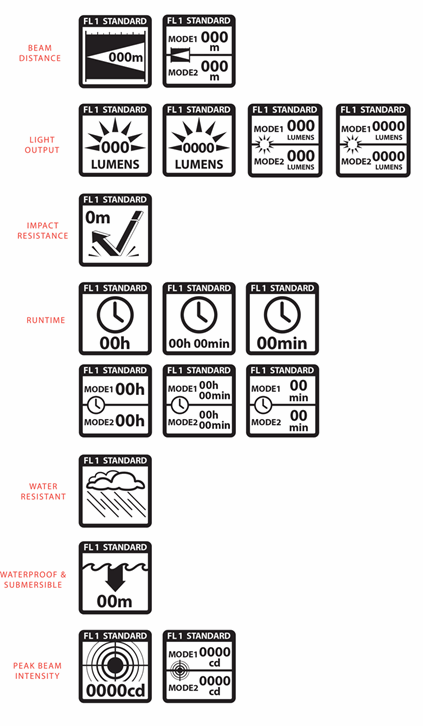
“There was much discussion on this topic at the time the original standard was written,” PLATO USA Executive Director Andy Skoogman said. “After much debate, and after consulting with several experts in the photometric sciences, lumens proved to be the best option for several reasons. It offers the best and most relevant measure in terms of telling a consumer or user exactly what is coming out of the product in a way that can be consistently measured and therefore reliably compared to other similar items.”
As a result, “In 2009, a uniform rating system for flashlight products was introduced called the ANSI (American National Standards Institute)/PLATO FL-1 Standard, designed to provide a uniform way of defining, measuring, and marking basic flashlight performance,” according to Raymond L. Sharrah, president and CEO of Streamlight. “The standard helps customers rate and compare the most important features of personal-lighting tools, including lumens, peak-beam intensity, beam distance, impact resistance, run time, light output and water resistance.”
What is a Lumen?
Sharrah distills the long scientific definition to a consumer friendly, “A lumen is a unit of luminance. As used in reference to flashlights, it represents the total amount of visible light emitted by the incandescent bulb or LED of the flashlight.”
He makes is sound simple, but it’s not. A single lumen is produced by the photons escaping a one-foot square hole in a light-proof sphere when a standardized “candle” is centered inside. “The use of the radiospectrometer and integrating sphere, which is how the lumen value is determined,” Skoogman explained, “provides a stable platform for repeatable testing at multiple locations around the world with consistent results.”
What about other units? “Candlepower is problematic,” Skoogman said. “It is an old measurement—perhaps the oldest. It was originally based on multiples of the light emitted from a wax candle made in Britain in the mid-1880s. Obviously, not all candles are the same, so the starting point for this measurement was flawed. However, even with more scientific methods available today, there is disagreement among users of this metric on how to arrive at the number.”
Kelvin and Color
“Kelvin temperature, or color temperature, is important but usually not listed by flashlight manufacturers,” Sharrah said. “LEDs are offered in a wide range of color temperatures and choosing the widest range results in lower cost. This can result in the light output appearing slightly yellow, blue, purple or green. Streamlight is careful to select the brightest LEDs in a narrow range of color temperature, so the beam appears white and is pleasing to the end user.”
Skoogman explained, “Increasingly, color temp is becoming a desired element in users’ choice. High CRI (Color Rendering Index), which will look to the user like a slightly warmer color, will render colors on the target more accurately. But we are seeing increased interest among other users, such as service techs who need to be able to distinguish between subtle color differences such as in a wire harness etc.”
Other Considerations
“…[W]hile a flashlight’s lumen output is a key metric to evaluate, it doesn’t tell the whole story,” Sharrah cautions. “Lumens are a measurement of all the light emitted by the flashlight, not necessarily brightness. The light’s candela or peak-beam intensity, on the other hand, measures its down-range ‘throw,’ and represents the brightest spot in the light’s focused beam.”
“When it comes to flashlights, looks can be very deceiving,” Hess warned. “ The word ‘tactical’ does not make something tactical, nor do matte black paint or an aggressive-looking shape. The quality of the components, the manner in which they are assembled, the credibility of the manufacturer and other criteria all factor in to how well a light will perform, how durable and reliable it is, and how long it will last. Though it is so cliché to say, as with so many other things, you absolutely do get what you pay for.”
Photons are fickle, particularly when focused, reflected and passed through a lens. Thankfully, the amount of light they produce is precisely measured in lumens—information that provides a apples-to-apples starting point for self-defense shooters searching for a new unit.
For detailed information on portable lighting standards, visit PLATO-USA.org.
Most Popular