The first hand-held battery-operated flashlight was invented by Russian/American immigrant Conrad Hubert in 1902, and patented the next year. Soon after that, firearm-oriented inventors explored the idea of mounting the new flashlight on a gun. Immediately, there was a big problem: When the gun fired, the recoil force would destroy the delicate filament in the bulb.
In 1911, inventor George A. Seely of San Francisco completed work on a firearm-mounted light that solved the problem. He filed for a patent in October 1911, and the Patent Number 1,029,951 was granted on June 18, 1912. The “Night Sight For Firearms” was made with watch-like precision. As you would expect, one of its main features was a careful spring-and-rubber cushioning of the delicate bulb.
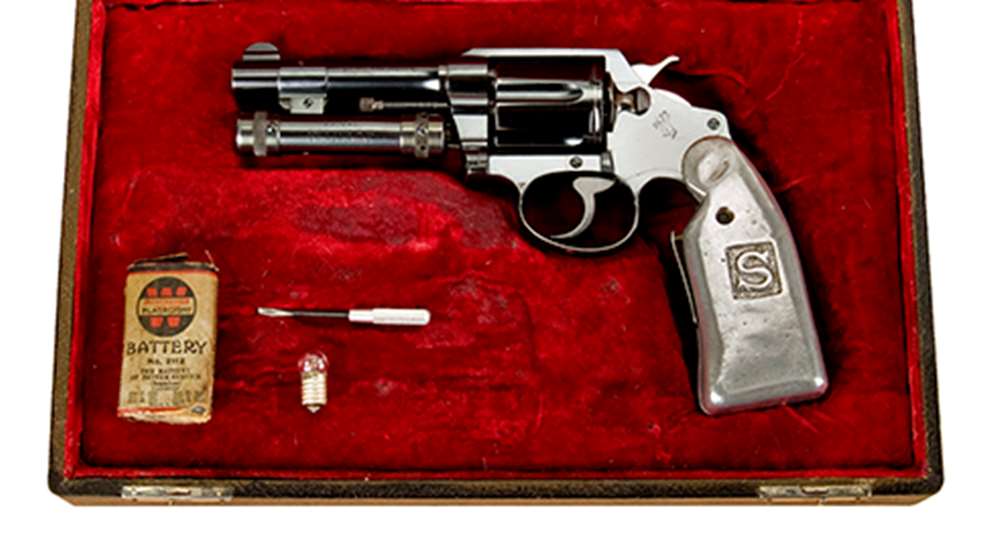
The drawing on the patent copy shows the device mounted on what appears to be a .22 rifle, but the only known example is attached to a Colt Police Positive .38 Spl. revolver. Obviously, the inventor wanted to show that his system would survive the recoil of the “magnum” of that time period. The light unit was fastened securely to the barrel and frame, and two small steel tubes at the rear carried insulated wires into the frame. From there, internally, the wires went to the battery in the grip-frame.
A large aluminum “over-grip” housed the Winchester-brand 3-volt battery. Incredibly, the original battery, which has not leaked, still produces 0.6 of a volt! A bar-type pressure switch at the front of the grip turns on the light. Four small screws on the light unit allow the beam to be adjusted to point-of-impact, in the same manner as a modern-day laser unit.
The Police Positive, serial number 113775, was made early in 1915. On April 9, 1915, it was one of 10 guns shipped to the Dunham, Carrigan & Hayden Co. of San Francisco. I think we can assume that the inventor, Seeley, bought his test gun from that firm. The revolver is in an original black-leather-covered fitted case, with recesses for the gun, battery, spare bulb, and a small screwdriver. The condition, overall, is 98 percent-very fine.
This is probably the only surviving example of the Seely Night Sight. It is presently owned by collector/dealer Randall Bessler of Carson City, Nev. As an experiment, a modern functional custom battery was made to the original dimensions by noted Nevada gunsmith Martin Scott. Once installed, the unit worked perfectly.
Along with George A. Seely, the patent lists a one-half assignment to “J. Salsbury,” who must have assisted in either the design, or perhaps, the funding. Today, with LEDs and lasers, we see gun-mounted light as an ordinary thing. For 1912, it was an extraordinary achievement.